Fundamentals Friday: Take Back Control with a Weekly Money Check
Canadian Solopreneur. Two Tools. One System. Complete Financial Visibility.

By L.Kenway BComm CPB Retired
This is the year you get all your ducks in a row! Start by starting ... and keep it simple. Consistency beats perfection.
Published March 16, 2026
WHAT'S IN THIS ARTICLE
The Three Hats | The Mindset Shift | Your Weekly 8 Numbers | Your CEO Monthly Pulse Dashboard | Building The Habit | The Payoff | FAQ | Terms Used
RESILENCE SYSTEM SERIES
Beginning of Series >> Building Financial Resilience for Canadian Solopreneurs (3 pillars habit-based system)
Previous in Series >> Financial Resilience Fundamentals 101
 You've been working in your business all week. Friday is the day you work on it.
AT A GLANCE - YOUR FUNDAMENTALS FRIDAY
30 Minutes. Every Friday. Same Time. Same Place.
Bookmark this page and come back every Friday.
Need the checklist? Head to the Fundamentals Friday Checklist page, copy and paste it into a plain document, and keep it handy while you work through the steps below.
- Minutes 0 to 5 ... Open your bank account, your accounts receivable, and last week's numbers. Pull up your weekly checklist.
- Minutes 5 to 20 ... Fill in your 8 numbers. No estimating. Actual figures only.
- Minutes 20 to 23 ... Write one short observation beside the number that surprised you most. Just a line. Good week, no explanation, or slow week, one client went quiet. That's enough. Short and to the point on what stands out.
- Minutes 23 to 30 ... Choose your Solo CEO Move. One number that concerns you. One action before next Friday.
That's it. Close the tab. Enjoy your weekend.
🦆 Solo CEO Move (if you're not there yet)
Don't know the information to do the routine? No judgement. Start here instead to take back control of your business finances. Actually follow through and setup the cash system. That's your win for this week.
The Three Hats
You have probably heard the saying that most small business owners work in their business rather than on their business. Fundamentals Friday is your weekly 30 minutes (or less) to step out of the work and look at the whole picture, the way a CEO would, the way a banker would, the way an investor would.
This is not bookkeeping. This is not cash management. This is leadership.
Before we dive in, here is how my three weekly rituals work together in your financial system as a simple financial rhythm for Canadian solopreneurs.
- Money Mondays is your administrative reset. You clear your inbox, file receipts, catch up your bookkeeping records, and start the week organized. It is the bookkeeper hat.
- Treasury Thursdays is your cash management exhale. Using a Profit First* framework, you review your cash position, allocate to your Profit First accounts, and confirm you can meet your obligations. It is the cash manager hat.
- Fundamentals Fridays is different from both. This is where you put on your CEO hat and ask the bigger question. Not just can I pay my bills this week, but is my business actually healthy, stable, and can it survive what is coming ... and come out the other side intact.
Jenifer Bartman, a respected Canadian business advisor, teaches that a small business succeeds when the founder understands the market, understands the numbers, and builds systems that allow growth. As a solopreneur in today's uncertain economic climate, you may not be thinking about growth just yet. You may simply want to know your business can survive.
Fundamentals Friday applies those same disciplines with that more immediate goal in mind ... resilience first, growth later, in under 30 minutes, every single week.
Key Takeaway
Fundamentals Friday isn’t bookkeeping. It’s leadership. It’s the weekly moment you stop 'doing the work and start reading your business like a CEO would.
- Money Mondays = processing the Admin Inbox (bookkeeper hat)
- Treasury Thursdays = cash allocation to ensure breathing room (cash manager hat)
- Fundamentals Friday = business health ritual to flag early warnings (CEO hat)
- The goal is resilience first, growth later ... without living in your spreadsheets.
🦆 Solo CEO Move
Decide on your weekly time slots and treat it like non-negotiable client appointments (with your business).
The Mindset Shift
On Thursday you exhaled because your cash looked good.
On Friday you zoom out.
Cash is only one signal. A business can have cash in the bank today and still be in serious trouble if revenue is slowing, margins are shrinking, customers are leaving, or expenses are quietly creeping upward. These are the signals that bankers and investors watch. These are the signals that experienced founders watch. And these are the signals that can save your business if you catch them early enough to course-correct.
That is exactly what Fundamentals Friday is designed to do.
This article gives you two things ...
First, a deeper look at what each of your eight weekly numbers is actually telling you, what a warning signal looks like, and what one concrete response might be.
Second, a monthly CEO dashboard called the CEO Monthly Pulse that turns four weeks of Friday data into a trend you can act on.
The weekly checklist gives you visibility. The monthly dashboard gives you perspective. Together they give you the complete picture.
Key Takeaway
Cash in the bank can lie. A business can look 'fine' today while the foundations quietly weaken underneath.
- Friday is for zooming out beyond the cash balance.
- You’re watching for early signals: slowing revenue, shrinking margins, rising costs, customer churn.
- Weekly data gives you VISIBILITY. Monthly review gives you PERSPECTIVE.
- The win is catching problems while they’re still small and fixable.
🦆 Solo CEO Move
Commit to writing one short observation every week (one line only). Those notes become your trend radar.
Solo CEO Tool 1
Your CEO Weekly Stability Check: A Deeper Look
Section TOC:
- Cash in Bank Today
- Cash Coming In Over the Next 7 Days
- Cash Going Out Over the Next 7 Days
- Tax Set-Aside Balance
- Sales for the Week
- Average Weekly Sales Over the Last 4 Weeks
- Accounts Receivable
- Admin Records Captured This Week
The Fundamentals Friday checklist asks you to capture eight numbers every week. Here is what each one is really telling you, what to watch for, and what to do if something looks off. It's the companion guide for the actual list. If you have not seen the checklist yet, you can find it here.
I've added sample fundamentals so you can get the idea of a typical week for a Canadian freelancer. These are sample numbers only. Your own weekly picture will look different. What matters is not the amounts but the pattern and whether anything needs your attention before you move on with your day.
1. Cash in Bank Today
EXAMPLE:
Metric | This Week | Last Week | Threshold | Note or Action
Cash in Bank | $6,400 | $5,900 | 4 to 6 weeks of fixed costs | Holding steady. No action needed.
What it really means
This is your actual runway right now. Not your revenue. Not what you invoiced last month. The cash that exists in your account at this moment is the only money you can spend today. Everything else is a promise.
What a warning signal looks like
If this number is lower than one month of your fixed expenses, you are operating without a cushion. One slow week, one late payment, one unexpected bill, and you are making decisions under pressure instead of from a position of stability.
One possible response
If your cash balance is consistently thin, the problem is rarely a single bad week. It is usually a structural gap between when money goes out and when money comes in. Look at your payment terms first. Are you giving clients 30 days when you could ask for payment on delivery or a deposit upfront. That one change can shift your cash position faster than almost anything else.
But if you have addressed your payment terms and your cash balance is still thin, the problem may be structural in a different way. Not when money arrives but what happens to it after it lands. That is a cash management question and it is worth understanding before you go further.
2. Cash Coming In Over the Next 7 Days
EXAMPLE:
Metric | This Week | Last Week | Threshold | Note or Action
Cash Coming In (next 7 days) | $2,200 | $1,800 | Covers next week's outgoing | Two invoices due. On track.
What it really means
This number separates scheduled relief from wishful thinking. Invoices due, expected deposits, and confirmed transfers belong here. Revenue you hope to close this week does not.
What a warning signal looks like
If this number is consistently thin or zero, you have a receivables timing problem. Your revenue may be fine but your cash flow is lagging behind it. That gap is where businesses get into trouble even when sales look healthy.
One possible response
If accounts receivable is a recurring problem, revisit your payment terms before the next piece of work begins. Service-based solopreneurs have no repossession option. A bookkeeper cannot take back a reconciliation. A designer cannot repossess a website. Once the work is delivered your leverage is gone. In uncertain times, deposits on account and advance payment are not just acceptable. They are how you protect yourself before the work begins rather than chasing after payments.
3. Cash Going Out Over the Next 7 Days
EXAMPLE:
Metric | This Week | Last Week | Threshold | Note or Action
Cash Going Out (next 7 days) | $1,450 | $1,450 | Less than cash coming in | Predictable. Fixed costs stable.
What it really means
This is where surprises hide. Known bills, subscriptions, loan payments, and any payroll obligations belong here. The act of listing them forces reality into view. Many solopreneurs discover expenses here they had genuinely forgotten about.
What a warning signal looks like
If this number is larger than your cash coming in over the same period, you have a short-term gap that needs a plan before Friday is over. If this number is keeping you up at night on a recurring basis, the problem is not a bad week. It is a structural expense load that your revenue cannot comfortably support.
One possible response
Business debt is not always a spending problem. It is often a habit problem. If your outgoing cash is consistently high relative to your income, a spending freeze combined with a line-by-line expense review against a baseline is the place to start. Not a dramatic overhaul. Just an honest look at what you are paying for and whether it is earning its place.
4. Tax Set-Aside Balance
EXAMPLE:
Metric | This Week | Last Week | Threshold | Note or Action
Tax Set-Aside Balance | $3,100 | $2,800 | 25 to 30% of gross revenue | On track. Added $300 this week.
What it really means
This is the money you owe CRA that is currently sitting in your account. It was never really yours. GST, HST, and PST collected belongs to the government the moment your client pays you. Income tax owing accumulates from the first dollar of profit you earn. This number is your honest accounting of that obligation.
Here's a short list of taxes you need to ensure you are covered for:
- GST, HST, PST collected (if registered)
- estimated income tax payable at tax time
- payroll remittances (if applicable)
- income tax installments (if applicable)
What a warning signal looks like
If this number is zero and you have been earning income, you are carrying a hidden liability. The cash may feel available but it is not. Spending your tax set-aside is one of the most common and most painful mistakes solopreneurs make, because the bill arrives all at once and with interest.
One possible response
If you are following a simple cash management system, your tax account balance goes here automatically. If you are not, start with an honest estimate of what you owe CRA so far this year and move that amount to a separate account today. Naming the account something like CRA Funds helps. It is harder to spend money that is clearly labelled as belonging to someone else.
5. Sales for the Week
EXAMPLE:
Metric | This Week | Last Week | Threshold | Note or Action
Sales This Week | $2,800 | $1,600 | Consistent with 4-week average | Strong week. One new project started.
What it really means
This is your business heartbeat. A single week of lower sales is not a crisis. But this number, tracked consistently over time, is the earliest warning system you have. Revenue dips show up here weeks or months before they show up in your bank account.
What a warning signal looks like
One slow week is noise. Two slow weeks is a pattern worth watching. Three consecutive weeks of lower sales is a signal that something in your market, your offer, or your client base deserves your attention before it becomes a cash problem.
One possible response
Do not react to a single week. But do note it. Write a one-line observation beside the number. Slow week, holiday weekend, or slow week, no explanation. Over time those notes become a pattern you can actually read and respond to.
6. Average Weekly Sales Over the Last 4 Weeks
EXAMPLE:
Metric | This Week | Last Week | Threshold | Note or Action
Average Weekly Sales (4 weeks) | $2,100 | $2,050 | Stable or growing trend | Trending up slightly. Good sign.
What it really means
This number smooths out the noise of any single week and shows you the direction your revenue is actually moving. A business with one great week and three slow ones is trending differently than a business with four steady weeks even if the great week looks more impressive in isolation.
What a warning signal looks like
If your 4-week average is declining for two or more consecutive months, that is a trend, not a blip. Trends are slow enough to feel normal while they are happening and significant enough to matter by the time you notice them. This number is how you notice them early.
One possible response
Trust the trend over the single data point. If your average is declining, ask one honest question. Is this seasonal, situational, or structural? Seasonal means it happens every year at this time. Situational means something specific caused it and that thing is temporary. Structural means something fundamental about your revenue model, your market, or your offer needs attention. The answer changes what you do next.
7. Accounts Receivable
EXAMPLE:
Metric | This Week | Last Week | Threshold | Note or Action
Accounts Receivable | $3,800 total, oldest 38 days | $2,400 total, oldest 24 days | Zero invoices over 30 days | One invoice gone overdue. Follow up today before the weekend.
What it really means
The total outstanding tells you how much future cash you are owed. The age of the oldest invoice tells you whether that cash is still likely to arrive. Old receivables are not just slow money. They are future cash that is starting to rot. The older an invoice gets, the less likely it is to be paid in full and on time.
What a warning signal looks like
An invoice over 60 days is a problem. An invoice over 90 days is a serious problem. If your oldest invoice age is creeping upward week over week, your collection process is not working and your future cash position is less secure than your total outstanding number suggests.
One possible response
Pick the oldest invoice on your list and make one contact this week. Not a passive reminder. A direct, professional, personal follow-up. One call or one specific email asking for a payment date. That single action, done consistently, is more effective than any automated reminder system. And if a client is consistently slow to pay, that is information about whether the relationship is worth continuing on the same terms.
8. Admin Records Captured This Week
EXAMPLE:
Metric | This Week | Last Week | Threshold | Note or Action
Admin Records Filed | 9 receipts | 6 receipts | All receipts captured same week | Good week for staying current.
What it really means
This number is your audit readiness indicator. Every receipt captured and filed, every transaction categorized and posted this week is one less thing you are doing in a panic at year end or in response to a CRA inquiry. Audit readiness is built in small batches. This number keeps you honest about whether those batches are actually happening.
What a warning signal looks like
A consistent string of zeros or near-zeros here means your administrative backlog is growing quietly in the background. It will not feel urgent until it is. And when it becomes urgent, it is usually because something else has gone wrong at the same time.
One possible response
If this number is low, Monday morning is your reset. Money Mondays exist for exactly this reason. Clear your admin inbox while your coffee is still hot and this number takes care of itself by the following Friday. The goal is not a perfect filing system. The goal is a current one.
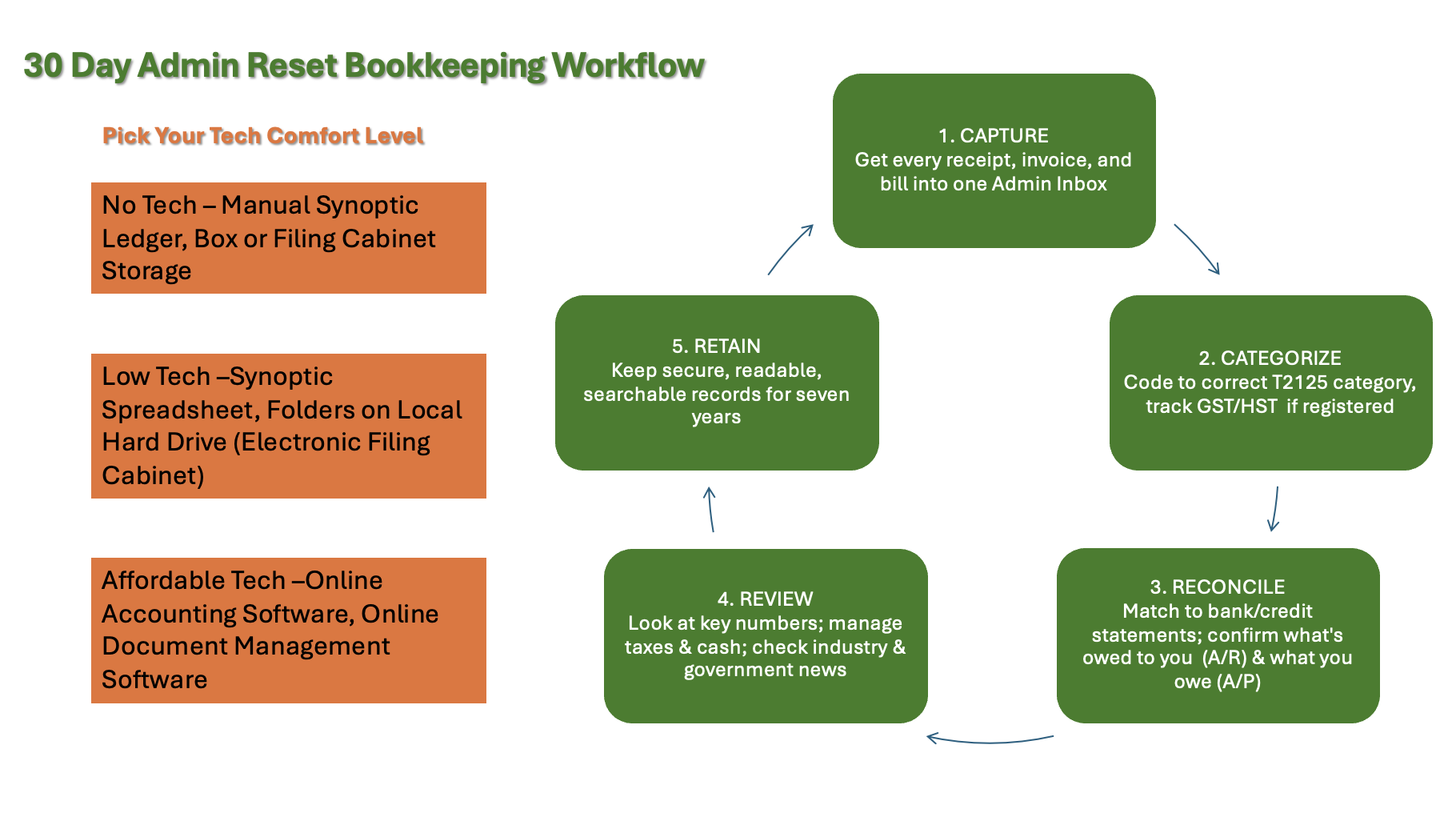
Not sure where to start? The 30 Day Reset walks you through the 5 step admin flow from inbox to audit-ready. Here is an flowchart of the process:
Key Takeaway
The 8 numbers aren’t 'financial homework'. They’re a weekly stability scan that keeps you out of surprise and panic.
- Use actual figures only (no estimating) so the signals are trustworthy.
- Watch for patterns, not drama
One bad week = noise Two weeks = watch Three weeks = respond - Protect your future self by tracking core fundamentals
Runway, receivables age, tax set-aside, and admin backlog. - The goal isn’t perfect metrics ... it’s early warning leading to one concrete response.
🦆 Solo CEO Move
Pick one threshold you’ll use immediately (e.g., no invoices over 30 days or 4–6 weeks of fixed costs in business savings account).
Solo CEO Tool 2
The CEO Monthly Pulse
Your weekly Fundamentals Friday gives you visibility.
Eight numbers, every Friday, under 30 minutes. You can see your business clearly from week to week.
The CEO Monthly Pulse gives you perspective.
Once a month, you step back further and look at what four weeks of Friday data is actually telling you as a trend. This is where patterns become visible. This is where early warnings become undeniable. And this is where you make the strategic decisions that weekly visibility alone cannot prompt.
The CEO Monthly Pulse is built around five core business fundamentals. These are not five tasks. They are five lenses that a CEO uses to read the health of a business at a glance. Inspired by the teaching framework of respected Canadian business advisor Jenifer Bartman, these five areas give you the bigger picture that your weekly numbers are pointing to.
When to do it. Once a month, on the last Friday of the month. Your weekly Fundamentals Friday becomes your monthly CEO Pulse review on that day. It takes longer, perhaps 45 to 60 minutes, but it only happens once a month and it is the most important business review you will do all month.
CEO Monthly Pulse Dashboard
The goal of this dashboard is to answer four critical questions every founder should be able to answer.
- Are my sales stable enough to sustain the business?
- Are my margins strong enough to absorb cost increases?
- Am I lean enough to weather a slow quarter?
- Do I have enough runway to outlast uncertainty?
Lens 1. Cash Flow and Runway
It's not just your bank balance but your runway. How many months can you operate if no new revenue came in?
A. Cash Position
Cash in bank end of month: $_______
Average monthly fixed expenses: $_______
Cash runway: _______ months
To calculate your runway, divide your cash in bank by your average monthly fixed expenses. The result is how many months you could operate with zero new revenue coming in.
B. Tax Set-aside Balance
Tax set-aside balance end of month: $_______
C. Accounts Receivable
Accounts receivable total end of month: $_______
Age of oldest outstanding invoice: _______ days
Questions to ask
- Is your runway growing, holding, or shrinking month over month?
- Is your tax set-aside keeping pace with your income?
- Is your oldest invoice age increasing?
What to watch for
A runway under three months in a stable economy is a yellow flag. In the current Canadian economic climate of March 2026, with tariff uncertainty and supply chain disruption affecting solopreneurs across industries, a runway under six months deserves a serious response plan. If your biggest client paused their contract tomorrow, how long could you cover your fixed costs before you had to make a hard decision. That number is your real runway and most solopreneurs do not know it until they need it.
Lens 2. Revenue Momentum & Gross Margin Profitability
Are sales growing, holding steady, or quietly declining? Trends matter more than single data points?
A. Monthly Revenue Snapshot
Revenue this month: $_______
Revenue last month: $_______
Revenue two months ago: $_______
3-month trend: Growing / Holding / Declining (circle one)
Average weekly sales this month: $_______
Average weekly sales last month: $_______
Questions to ask
- Is the trend direction consistent across all three months?
- Is there a seasonal explanation for any dip or spike?
- Is this month's average weekly sales higher or lower than last month's?
What to watch for
Three consecutive months of declining average weekly sales is not a slow season. It is a structural signal that something in your market, your offer, or your client base needs attention.
B. Profitability Check
Revenue this month: $_______
Cost of goods or services delivered: $_______
Gross margin this month: _______ %
Gross margin last month: _______ %
To calculate gross margin, subtract your cost of goods or services from your revenue, divide by revenue, and multiply by 100.
Questions to ask
- Is your gross margin holding steady month over month?
- Did you discount any work this month and if so is that reflected here?
- Are your costs of delivery increasing without a corresponding increase in your prices?
What to watch for
A sudden drop in gross margin is one of the earliest signs that your pricing is not keeping pace with your costs. Many solopreneurs discover this number is quietly shrinking long before they feel it in their bank account. If your margin dropped this month, the question is whether it was a one-time situation or the beginning of a trend.
Lens 3. Customer Health
Are you gaining new customers? Are existing customers buying again? Is your average sale value holding?
Customer Snapshot
New customers this month: _______
Total active customers: _______
Customers lost or inactive this month: _______
Average sale value this month: $_______
Average sale value last month: $_______
Questions to ask
- Is your active customer count growing, holding, or shrinking?
- Is your average sale value holding steady?
- Are you replacing lost customers with new ones?
What to watch for
If your total revenue looks stable but you are serving fewer clients at higher prices, that may be exactly the strategy you intended. Fewer better clients, working smarter not harder, is a sound application of the 80/20 rule. But if that concentration is unintentional, or if one of those key clients pauses or leaves, your revenue can drop sharply and quickly. The question is not how many clients you have. The question is whether you know why you have the ones you do, and whether you have a passive income stream is cushioning your exposure.
Lens 4. Operational Stability
Are your expenses under control and proportional to your revenue? Are costs growing faster than income?
Monthly Expense Overview
Total monthly expenses: $_______
Total monthly revenue: $_______
Expenses as a percentage of revenue: _______ %
Main expense categories this month. List your own top 5. These will be different for every solopreneur and they may shift from month to month as your business changes.
1. _________________ $_______
2. _________________ $_______
3. _________________ $_______
4. _________________ $_______
5. _________________ $_______
Total top 5 expenses: $_______
Total all other expenses: $_______
Total monthly expenses: $_______
The reason I suggest breaking it into top 5 plus all other is that it forces you to see where the majority of your money is actually going rather than spreading attention evenly across every line. In most solopreneur businesses, the top 5 expenses represent 80 percent or more of total spending. Knowing that concentration is part of what makes this lens useful.
Your top 5 expenses are where your money lives. If costs are rising, the answer is almost always in this list.
Questions to ask
- Are expenses growing faster than revenue?
- Are there subscriptions or auto-renewals that appeared this month unexpectedly?
- Is any single expense category disproportionately large relative to the revenue it supports?
What to watch for
Software subscriptions, payment processing fees, and auto-renewals have a way of quietly accumulating. A solopreneur spending 40 percent of revenue on tools and overhead has a structural problem that no amount of new sales will fix. This lens is where that problem becomes visible before it becomes critical.
If your expenses as a percentage of revenue stopped you just now, the next step is not a dramatic overhaul. It is a spending freeze combined with an honest evaluation of every expense against a baseline. Business debt is not a spending problem. It is a habit problem. I explain how to do exactly that here.
Lens 5. External Threats
A quick honest scan. Is anything in your market, your industry, or your client base shifting that deserves your attention?
Questions to ask
This is not a numbers section. It is a thinking section. Give yourself five minutes to answer these questions honestly.
- Has anything changed in your market or industry this month that affects your clients or your revenue?
- Are any of your key clients showing signs of pulling back, delaying decisions, or reducing scope?
- Are your input costs, supplier costs, or tool costs increasing in ways that are not yet reflected in your pricing?
- Is there an external threat on the horizon, economic, regulatory, or competitive, that you have been meaning to think about but have not yet made time for? This is that time.
- Is there an opportunity in the current disruption that your competitors are not seeing or not moving on quickly enough?
What to watch for
Canadian solopreneurs in March 2026 are navigating tariff uncertainty, rising costs, and unexpected global supply chain disruptions that nobody predicted and nobody can fully control. You cannot control any of that.
What you can control is whether you are paying attention. External awareness does not require a solution. It requires honesty. Name the threat. Write it down. That single act moves it from background anxiety into something you can actually think about and respond to.
🦆 Solo CEO Move (for your monthly pulse)
After completing all five lenses, circle the one area that concerns you most this month. Not five areas. One. Identify one concrete action you will take before your next monthly pulse review. Write it here.
My one concern this month: _______________________
My one action before next month: _______________________
Monthly Pulse Warning Summary
Before you write your Solo CEO Move, do a quick scan across all five lenses.
- Sales slowing for three or more consecutive months. Yes / No
- Gross margin declining month over month. Yes / No
- Expenses growing faster than revenue. Yes / No
- Cash runway under six months. Yes / No
- Oldest invoice over 60 days. Yes / No
- Active customer count declining. Yes / No
- An external threat you have not yet made a plan for. Yes / No
If you answered yes to any of these, that is your Solo CEO Move this month. Not all of them. The one that concerns you most. Name it. Act on it before your next monthly pulse review.
One more thing before you move on with your day ...
Key Takeaway
Once a month, you stop tracking numbers and start reading the story. The Pulse turns weekly data into decisions.
- The dashboard answers the real founder questions:
1) Are sales stable?
2) Are margins holding?
3) Are we lean enough for a slow quarter?
4) Do we have enough runway for uncertainty? - The 5 lenses make it simple: runway, revenue/margin, customer health, operational stability, external threats.
- The point is not 'fix everything'. It’s choose one priority and act before next month.
🦆 Solo CEO Move
On the last Friday of each month, circle one concern and write one action you’ll complete before the next Pulse.
Why Friday and Not Monday?
Many experienced entrepreneurs do a version of this check on Monday mornings. And that works. But there is a strong argument for doing your CEO stability check on Friday instead, and it comes down to response time.
When you spot a warning signal on a Monday morning, you already have your week lined up. Client calls are booked. Deadlines are looming. The week has momentum and it is hard to stop and think strategically.
When you spot a warning signal on a Friday afternoon, you have the weekend. You can think without pressure. You can research, make a few calls, sleep on it, and walk into Monday with a clear head and a plan already forming.
Problems caught on Friday become plans by Monday. Problems caught on Monday become stress by Wednesday with little maneuvering ability.
Key Takeaway
Friday gives you response time. You can think, research, and plan before the week starts moving again.
- Monday discoveries often turn into midweek stress.
- Friday discoveries can become Monday plans.
- The weekend creates space for calm decisions instead of reactive ones.
🦆 Solo CEO Move
If Fridays are impossible, keep the concept. Schedule your check before your busiest work block, not after it.
Building The Habit
Like all habits, Fundamentals Fridays works best when it is anchored to a consistent routine. Here are a few suggestions.
- Do it at the same time every Friday. Many solopreneurs find that late Friday afternoon, after client work is done, works well. Others prefer Friday morning with their first coffee before the day begins.
- Keep your dashboard in the same place every week. A simple spreadsheet works perfectly. Some solopreneurs print a fresh copy each week and keep a binder. Use whatever system you will actually maintain.
- Do not skip it when things are going well. The whole point of a stability check is that it catches problems before they become visible. If you only check when you are worried, you have already missed the early warning.
Key Takeaway
The Payoff
After a few months of consistent Fundamentals Fridays, something shifts. You stop guessing about your business health. You stop being surprised by slow months or cash crunches. You start seeing patterns. You start making better decisions because you are making them with real data, not gut feelings.
And if you ever sit down with a banker, an investor, or a business advisor, you will be the solopreneur who actually knows their numbers. That is rarer than you think. And it is exactly the kind of founder that Jenifer Bartman describes when she talks about businesses that succeed.
Monday is your bookkeeping hat. Thursday is your cash manager hat. Friday you lead. It's your solo CEO hat.
FAQ
What if I skip a week? Do I have to start over?
What if I skip a week? Do I have to start over?
No. Missing one Friday does not undo the habit.
When you come back, simply fill in the numbers for the current week and move forward. If you want to fill in the week you missed, do it quickly from your records, but do not let that become a reason to delay. The value of this routine is in the pattern over time, not in a perfect streak. One missed week tells you nothing. Six missed weeks tells you something needs to change.
I understand Jenifer Bartman's philosophy is that most early business problems are not about the product or service. They come from weak financial management, poor focus, and ignoring market feedback. Don't make missing Fundamentals Friday a habit!
What if my income is seasonal? The number look bad for months at a time.
What if my income is seasonal? The number look bad for months at a time.
Seasonal income is normal for many Canadian solopreneurs, especially in trades, tourism, agriculture-adjacent services, and retail.
The routine still works, it just works differently. During your slow season your job is to watch your cash buffer carefully and confirm it is covering your fixed costs. During your busy season your job is to build that buffer back up and watch for signs of overextension.
The 8 numbers do not judge your slow season, they help you manage it. If you know a slow season is coming, your weekly check gives you early warning so you are not caught off guard.
How do I know if my cash buffer is enough?
How do I know if my cash buffer is enough?
A common starting guideline is enough cash to cover 4 to 8 weeks of your essential fixed costs.
Fixed costs include things like software subscriptions, insurance, phone, and any loan payments, not your personal draw. If your business is seasonal or your income is irregular, aim for the higher end of that range.
Your weekly check is where you watch whether that buffer is growing, holding steady, or shrinking. If it is shrinking for three or more weeks in a row without a clear reason, that is your signal to investigate before it becomes a crisis.
What I've said so far is a good start. But many business advisors suggest founders try to maintain roughly:
- 12–18 months runway for startups seeking growth
- 6–12 months runway for stable small businesses
Their reasoning is that less than that can create constant financial pressure.
Do I need an accountant if I am doing this weekly check myself?
Do I need an accountant if I am doing this weekly check myself?
The weekly routine is not a replacement for professional advice. It is what makes your time with an accountant or bookkeeper more productive and less expensive.
When you arrive at a tax appointment or a quarterly review with 52 weeks of organized numbers and notes, you spend less time reconstructing what happened and more time on decisions that matter.
Many Canadian solopreneurs work with an accountant once or twice a year for tax filing and year-end review. The weekly habit keeps you informed in between those appointments so you are never flying blind.
What counts as accounts receivable if I am a service-based freelancer?
What counts as accounts receivable if I am a service-based freelancer?
Accounts receivable is any money a client owes you for work you have already completed and invoiced.
If you sent an invoice last Tuesday for a project you finished, that amount is accounts receivable until the client pays it. It does not include work you have done but not yet invoiced, and it does not include deposits or retainers you have not yet earned.
For your weekly check, you are looking at the total of all unpaid invoices and noting whether any of them are overdue. In Canada, most service-based freelancers consider an invoice overdue after 30 days unless a different term was agreed in writing.
Terms Used in This Resilience Series
These are the terms used specifically in this resilience series. For broader context used across the wider 'Managing Uncertainty' section, see the main terms guide.
Series Definitions
Financial Resilience: the capacity to absorb financial shocks and bounce back through sound, proactive money management.
Solo CEO Move: signals a single, specific action needed that moves one number in the right direction. Watch for the 🦆 throughout this series.
Tax Set-Aside: reserve a portion of income for tax obligations
* Profit First is a registered trademark in the U.S. and other countries.
Disclaimer: I am not a certified Profit First Professional or associated with Mike Michalowicz. I just like the system and introduced some of my client's to it. Get Mike's book to learn more about the system.
Cash Management Strategies
NSF Fees Canada 2026: New $10 Cap | Cash Management for Solopreneurs
In March 2026, NSF fees capped are at $10 for Canadian personal accounts. What's changing, why it affects your business, and how to avoid these fees entirely.
Cash Management Strategies to Protect Your Money | Canada Solopreneur
Take back control of your cash flow. With tariffs shifting costs overnight, you need to protect your money with practical, simple cash management strategies.
Understanding Your Investment Tax Slips | T3 T5 T5008
Guide to T3, T4, T5, T5008 tax slips for Canadian business owners. Understand salary vs dividends, investment income, and why retirement planning matters.