The Bookkeeper Behind This Site
Business Card

L. Kenway, B.Comm., CPB Retired
Serving Canadian home-based Solopreneurs and micro businesses
Bookkeeping-Essentials.ca
A practical roadmap to CRA compliance and financial stability during uncertain times
Hi, I'm Laura … and this page is all About Me! I don't much like websites where the author doesn't own their work, so here I am. The purpose of this page is for you to meet me, not just provide my credentials that search engines like. If you want to know why this site is worth your time, that's covered in About This Site on my home page.
What I'm not ... to be clear
In anything to do with finances, it's really important to layout some boundaries. This section is to ensure there is no misunderstandings about my credentials.
- I was never a licensed accountant (CPA CA, CPA CGA, CPA CMA), and I never provided review or audit services. I am a retired Certified Professional Bookkeeper.
- I'm not a tax expert, either. My tax background is basic Canadian tax preparation ... some CGA theory courses, a handful of practical, hands on courses through H&R Block, and self-study of Jacks Institute course materials, undertaken as professional development along the way.
- My actual experience is in budgeting, financial planning, accounting, business administration ... then later bookkeeping and basic tax preparation. Where I write about anything outside that, I research it, and I try to be clear about what comes from my own experience and what I've learned secondhand.
- What's on this site is general information, not professional advice. It is always, always prudent to talk to a qualified professional about your own unique situation.
I'm going to let you know this page wasn't easy for me to write ... because I'm writing for two different audiences. I need to keep the search engines and AI (artificial intelligence) happy if I want to be found, but I also want to introduce why you, a human, might want to trust what I have to say. Like the royals 😄, I had trouble figuring out the line between letting you 'meet me' vs what is overshare and shouldn't be in the public forum. I hope I found the right balance.
What are you curious about?
- Retirement and how I work now? Learn why I'm not travelling?
- Why I write what I write? My philosophy? Check out Beyond The Spreadsheet.
- My background and credentials? Checkout my non-linear career path.
- What is my philosophy on AI tools? Discover how I think about tools ... including AI.
- Do I hold any certificates ... or badges of affiliation? I do. I've gathered them in one place for you.
In my wrap up I give two options ... Do you want to contact me? Wondering where to go next?
So, About That Retirement ...
In a moment I'll let you in on what my experience brings to this site's content … but first let's take a peek into my 'go-go' retirement years. To be honest, my retirement plans don't include travel, exotic or otherwise. A long-standing chronic health issue makes that kind of go-go harder to pull off, so my version is closer to what others probably call semi-retirement.
Semi-retirement has meant still being engaged with some light bookkeeping and maintaining my websites. It's about reframing my day to be more flexible and giving myself permission to be kind of lazy ... like on a permanent vacation.
I'm a voracious reader and now I get to indulge that passion. I spend a part of every day reading ... about economics, business, accounting, taxation, and to a lesser degree technology. I even sneak in a bit of fiction. I couldn't do that pre-retirement.
We are living in interesting times so the news (written or broadcast) is compelling. Sometimes what I've consumed has no relation to this website. Other times however, the daily news catches me. It makes me sit up and think that a small business owner with no professional support needs to have this on their radar. That's usually when I start writing.
My MIS (Management Information Systems) background probably has something to do with how I approach presentation of the information. I'm less interested in collecting facts (though that is very important) than in figuring out how the pieces connect, and how to explain that in a way that's actually useful for someone running a small business.
Beyond the Spreadsheet ... Because Life Happens
Running a business, and the bookkeeping and admin that goes along with it, is never just about numbers. For many self-employed people, financial admin sits in the background of daily life creating pressure, uncertainty, and mental clutter. I have seen how easily that stress can spill into sleep, decision-making, and confidence.
That is part of why this site includes more than checklists and rules. Good systems matter, but so do habits, steadiness, and making manageable decisions one step at a time. In addition to business matters, it's important to take time to establish healthy habits around self-care, personal relationships, and personal finances.
With that framing ...
A Perfect Spring Morning
The Habit of Walking Daily
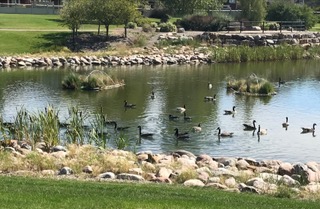 Lethbridge storm pond
I'm all about establishing healthy habits and routines whether it's related to work or my personal life. If you work at a desk all day, stepping away from the screen and establishing the habit of a daily walk is one of the best things you can do.
In Lethbridge on this particular spring morning, the sun was shining with a very light breeze at 12 degrees C. I recently implemented recess as I'd been doing a lot of desk work these previous few months. Recess that day was perfect 'walking the dog' weather. It gave me the time to lift my head and look around. Here's what I noticed on that spring walk.
Lethbridge has these storm ponds in the newer subdivisions to handle flash flooding and overflows. It creates many lovely walking paths in the neighbourhoods throughout the city. One storm pond near me usually has geese, but this year some ducks have shown up as well as migrating pelicans. I'd never seen a live pelican before moving here.
Personally, I enjoy the mundane and ordinariness of everyday life, and all that entails. I like finding ways to feel joy in the simple things, blessings in the annoyances, and a bit of excitement in daily chores. Taking the time to find delight in regular, everyday living is empowering, and I suspect chronic health struggles have a lot to do with why I feel that way. It's one of the ways I coped because I wanted to stay positive and pleasant to be around.
I'm aware this section isn't going to win any favour with search engines or AI bots, since it's not really answering anything anyone typed into a search bar. I'm okay with that. Some things are worth including even when the algorithm doesn't quite know what to do with them, so I'm about to wander into Beyond The Spreadsheet ... Because Life Happens territory. Fill up your beverage cup and let's dive in.
One Small Habit at a Time
One bad habit repeated for years quietly adds up. But the opposite is also true. One good habit repeated for years quietly adds up too. I challenge you to pick one habit to change.
That's how I've approached the habits below. I took them one at a time, mastering each before adding the next. I'll be honest ... the routines still don't come easily to me anymore like it did when I was younger. So it's perfectly okay if you struggle to establish a new habit. No judgment here.
If anything here appeals to you, don't hesitate to steal it for yourself.
You'll see that each one addresses something I've personally needed to work on. I have some chronic health issues that place limitations on what I can do. That has made me more interested in preventative approaches and in finding things I can do myself to support my health and, hopefully, put off some of the medications doctors might otherwise prescribe.
I'm not suggesting these habits will work for everyone, or that they replace medical care. They're simply things I've tried because I wanted to be more in control of my own daily choices.
| Wellness Pillar | The Habit | What I Was Trying To Address | Why I Keep It | Time / Effort |
|---|---|---|---|---|
| Physical Mobility | Desk Yoga | 'Tech neck' and shoulder tension from screens | Relieves physical pain points, helps me move, resets my posture | 6 minutes right at my desk |
| Internal Nutrition | 30 Plant-Based Foods A Week | Gut issues that could be improved through dietary changes | Encourages dietary diversity without restrictive dieting and calorie counting | Daily effort accumulates over the week |
| Active Fitness | Functional Fitness, HIIT Workouts |
Too much sitting and the muscle loss that can come with being less active | Combines strength and cardio; helps me maintain mobility | 10 to 30 minutes per session. |
| Seasonal Routine | Autumn Soup Challenge | Dietary ruts when weather changes; lack of cooking inspiration. | Gives me new recipes and encourages seasonal variety | A weekend, 10 days, or 30 days, depending on the challenge |
The table I put together above is really my own holistic wellness list of habits tailored to the realities of desk work and my own energy limitations. Each one started with a particular problem I was trying to address. I wasn't looking for a perfect health routine. I was looking for things I could actually do.
Here are my notes as I made the changes one at a time. Again, take it or leave it. No judgement here.
- Desk Yoga - I've done yoga off and on for about 25 years because I've found it useful for managing some of my energy limitations. This is a nice six minute chair sitting routine to ease 'tech' neck (pain in the neck and shoulders caused by looking at computers, phones and other screens). I have my own favorite stretches I like doing at my desk but this routine is a great place to start.
For me, the point isn't becoming flexible or doing a perfect yoga practice. It's having something I can do when my body is reminding me that I've been sitting (at a desk) too long. - Healthier Gut Biome - I started following the plant based diversity plan of introducing 30 plant based foods to my existing eating habits every week a few years ago. I was looking for ways to support my digestive health and manage some ongoing health issues.
Plant-based foods can include nuts, seeds, oils, herbs and spices (other than salt and pepper), whole grains, legumes, beans, fruits, and vegetables. The idea is to increase the variety of foods I eat rather than focusing on calories or eliminating foods.
It is working for me because it's inclusive, not exclusive ... and there is no calorie counting. I don't know about you, but if you tell me I can't eat something ... it's all I want.
If you think it's something you want to try, check out The Gut Doctor, Zoe, and/or Dr. Will Bulsiewicz. - Hit The Gym -I started a functional fitness class because I was dealing with a chronic health issue and wanted to find a way to build strength and maintain mobility without committing to the hour-long format of most fitness classes. I also needed a change from my yoga.
The HIIT (High-Intensity Interval Training) format really works for me. Why? I think it's because I'm combining building muscle and cardio in the same workout. This format alternates short bursts of intense exercise with brief periods of rest or lower-intensity activity.
Building and maintaining muscle became important to me because I want to remain as mobile and independent as possible as I get older. I didn't want to wait until I had an unmanageable problem before trying to do something about it.
HIIT workouts are often shorter, making them an excellent option if you have limited time for exercise ... or just plain don't like exercising. If you're not familiar with functional fitness, check it out. It is simply training your whole body for real-life, everyday movement.
I notice it makes daily tasks, like carrying heavy groceries, walking up and down stairs, or doing yard work, easier and more manageable. That's the kind of fitness that matters to me. - Fall Soup Challenge - If you're trying to eat healthier and just feeling better, keep an eye out for Jen Hansard's free challenges; she runs a few a year. I've done her autumn soup challenge which runs in October. Some challenges are free, some have a modest entry fee.
I don't know about you, but I eat differently once the cool weather arrives and soup fits the bill ... and new recipes are always welcome. If your eating choices fall into a narrow band of foods, a food challenge might be worth trying. For me, it's another way of making healthy choices easier by making them interesting. Your gut will say thank you. Thank you very much.
Once I try something that helps, I try to keep it in my toolbox, even if I implement it imperfectly. I'm not trying to create a perfect routine. I'm trying to find things that make living with my limitations a little easier and that might help me stay healthier for longer.
It's the same thing I keep telling readers about their books. Good bookkeeping is preventative too. You don't wait for the CRA problem, the cash-flow crisis, or the missing receipt to discover that something needs attention.
Life is messy. Putting one foot in front of the other is how you get to the other side, blisters and all.
My background and credentials ... are not a straight line
About Laura
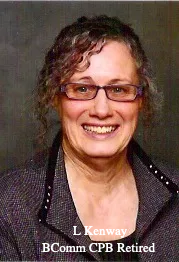
Bachelor of Commerce 1978
Retired Certified Professional Bookkeeper
QuickBooks Online Canada
Certified Advanced QuickBooks Online ProAdvisor
Re-certified 2026
The funny thing is, the last thing I ever intended to become was a bookkeeper. I came from a family of professional accountants, so I'd already decided that wasn't going to be my path.
Training and Early Years
Instead, I majored in Management Information Systems (MIS) at the University of Calgary, later adding postgraduate economics courses there at night. I was trained in how information could be organized, accessed, and turned into something management could use.
Then I started working. Whatever the job title, I kept ending up doing the same kind of work that involved organizing information (usually numbers) and turning it into something people could use to make decisions. It ranged from capital budget monitoring, departmental budget preparation, financial planning modelling and forecasting, to general accounting, and eventually bookkeeping and tax preparation.
So, despite my best efforts, analytical work kept finding me.
Over 20 years, I worked for medium and large corporations in branch banking, oil & gas exploration and development, a natural gas utility, and a helicopter charter service. At my employer's encouragement, I studied accounting through the Certified General Accountants (CGA) Association of Alberta along the way, reaching the fifth of six levels of Program 91 before life circumstances prevented me from finishing.
Flexibility and Self-Employment
Eventually I needed work that gave me more flexibility. I stopped fighting my limitations and made the switch to self-employment. In 1999, I enrolled in the excellent Self-Employment Benefit Program through Community Futures BC and bought a bookkeeping franchise, which I operated for two years.
I put the H&R Block comprehensive T1 tax preparation course and The Jacks Institute's T2 preparation course materials to use. After that, I worked at a vehicle leasing company, a telecommunications company, and briefly in a Chartered Accountant's office, along with two tax seasons at a tax preparation company.
In 2006, I began taking on my own bookkeeping clients from home. In 2009, I moved the business online, serving Canadian home-based Solopreneurs and small businesses until I retired from client work in 2020. That same year, I earned my Certified Professional Bookkeeper designation and maintained my professional development through ongoing CPB webinars until I retired.
None of it was a straight line.
Before the self-employment work settled into place, I spent several years rearranging my life and work to accommodate chronic health issues and family obligations. I tried different kinds of work and different ways of working until I figured out what would actually fit.
It taught me to be flexible and kind to myself when things didn't go the way I'd planned.
Some of what shaped my current approach to money and administration didn't happen at an office desk, either. I did bookkeeping for a community nonprofit as a volunteer for several years. Later I spent 8½ years on the board of a not-for-profit condominium corporation, many of them as president.
None of that was part of a plan … and believe me I had a plan … I’m a planner. But that's often how life works. Stuff happens while you are making plans.
What I Bring To This Site
Looking back, I think that's probably the biggest thread running through my career. I became someone who has figured out how to adapt when the plan stops working.
And that is part of what I bring to this site today.
The world changed dramatically in January 2025. The business environment many of us had built our plans around changed with it. Some of those changes may eventually settle down, but I don't think we're simply going back to the way things were.
For a small business owner, that means being able to adapt isn't just a nice skill to have. It's part of running a business.
That's why so much of what I write about here isn't about predicting exactly what happens next. It's about understanding what's changing, knowing what you can control, and figuring out what you need to do when the plan you started with no longer works.
How I think about tools ... including AI
 Is it the tool or the person using it that makes the final product?
Technology changes how we work. Sometimes people embrace that right away. Sometimes they're understandably wary. I get that. I've watched this happen a few times over the course of my career.
The introduction of personal computers revolutionized accounting workflows in the 1980s. I can still remember how much easier and faster developing departmental budgets became once we had an Apple Macintosh to build our spreadsheets on. Since launching this site in December 2023, I have been learning how to integrate AI (artificial intelligence) tools into my workflow in much the same way I did back then.
It seems to me that the current AI debate aligns with historical discussions about photography. Is it the tool or the person using it that makes the final product? The camera was a new tool. Photographers still had to know what made a good photograph. They made creative choices in their work. It could be an incredibly useful tool. The tool could also be a disaster in the wrong hands, and I'd know. Back before digital photography, I was a pro at taking pictures where heads were missing!
My Writing Process And How AI Fits In
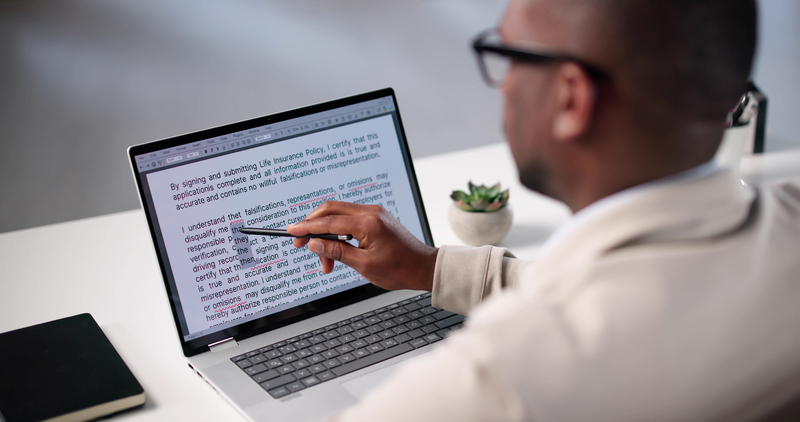
I use AI as part of my research and writing process. It helps me organize information, work through an outline, spot gaps, and might suggest a better way to explain something. But I don't outsource my thinking to it. I decide what to investigate, I read the source material, I check facts, and I make the final call on what gets published.
The tool doesn't replace the person using it. It changes the workflow, and sometimes the speed, of getting the work done. You still need to know your topic well enough to catch the errors. This is not a cut-and-paste process. In fact, I actually find it takes longer to write an article than it did previously.
The same judgement applies to the other tools I use day-to-day. When I'm choosing an app for my work stack, one thing I always consider is whether it's Canadian. It's not my only criterion, but it's always a factor, since I like to support Canadian companies. Two I use and like are LedgerDocs and Rotessa. FYI ... these are digital tools too!
How AI Affects Professional Judgement And Critical Thinking
 Does automating early-stage work remove the training ground for critical thinking skills?
I know some of you are wary of AI, and that's a reasonable place to stand. Even within the accounting and legal professions, there's a real conversation happening about what should be automated and what shouldn't. It's an important conversation because accountants and lawyers are selling professional judgement applied to a body of knowledge.
Junior bookkeepers and accountants built professional judgment and critical thinking the same way I did ... by doing the unglamorous work, over and over, until you start to see the patterns and connections. Some worry that automating too much of that early-stage work quietly removes the training ground the next generation needs. Training now is beginning to replace some of the old entry level grunt work with simulated cases emphasizing anomalies and risk-assessment workshops. Personally, I usually do better in real-life situations than scenarios.
We don't necessarily need to preserve the old work just because that's how we learned. We do need to make sure the important capability that the old work developed doesn't get lost when the workflow changes. As is often the case, the new workflow develops a completely different and surprisingly impressive skill set.
Two Companies, Two Approached To AI Pricing
I've also watched two companies whose products I've used for a long time handle their own AI rollout very differently. It got me thinking (dangerous, I know) about how different their approaches to AI are. I started wondering what the boardroom conversations were around: How do they use it? Who gets to choose? How do they price it? And what does the implementation tell me about the company's priorities?
- SiteSell built Tai into their platform as an optional tool. You choose whether to use it and how much through purchasing credits. Your base subscription price stays the same either way.
- Intuit built AI Assist into QuickBooks Online (and Accountant) differently. The AI buildout is increasing the subscription price, whether you use the AI features or not. They are choosing to increase revenues by increasing revenue per customer rather than primarily through attracting new customers.
I don't think either company is wrong to build AI into its products. But how a company prices that choice tells you something about who they're building for ... the shareholder, the customer, or both?
Why Does This Matter To You?
That's also why I'm telling you how I use AI. Simply saying 'AI was used' doesn't tell you very much. Just as I look at how a company implements and prices AI rather than simply saying 'they use AI'.
I think you should know how I use it here. AI is one of the tools in my toolbox. I decide what questions to ask, what sources to read, what information matters, what needs checking, and what ultimately makes it onto this site. The responsibility for the finished work is mine.
Do you hold any certificates ... or badges of affiliation?
I do.
Some of these are professional certifications. Others are badges showing my relationship with digital products I use and support. I look for efficiency and convenience over bells and whistles ... and a nice blend of manual and automation ... because I kind of like to be in the driver's seat.
As you can see, I've always been pretty selective about the tools I use. (Some refer to it as an app stack). In addition to LedgerDocs and Rotessa, I have been a long-time user of QuickBooks.
For many years, Intuit has provided accountants and bookkeepers with a way to access and work with individual client files through its accountant programs. QuickBooks Accountant for desktop (QBA) evolved into QuickBooks Online Accountant (QBOA) when QuickBooks Online came to Canada in 2013. Intuit is retiring QBOA in 2026 and replacing it with a modern platform called Intuit Accountant Suite (IAS).
Intuit began requiring certification of QBOA participants in 2017. In 2021, they moved to an annual recertification exam for those who wanted current confirmation of their QuickBooks knowledge.
I've been using QBOA (QuickBooks Online Accountant) since 2013. Before that, I used QuickBooks Desktop Accountant from 2000-2020.
For those of you who like to see the evidence, I've gathered my Intuit certificates from over the years, along with my LedgerDocs and Rotessa badges.
 LedgerDocs
Certified Partner
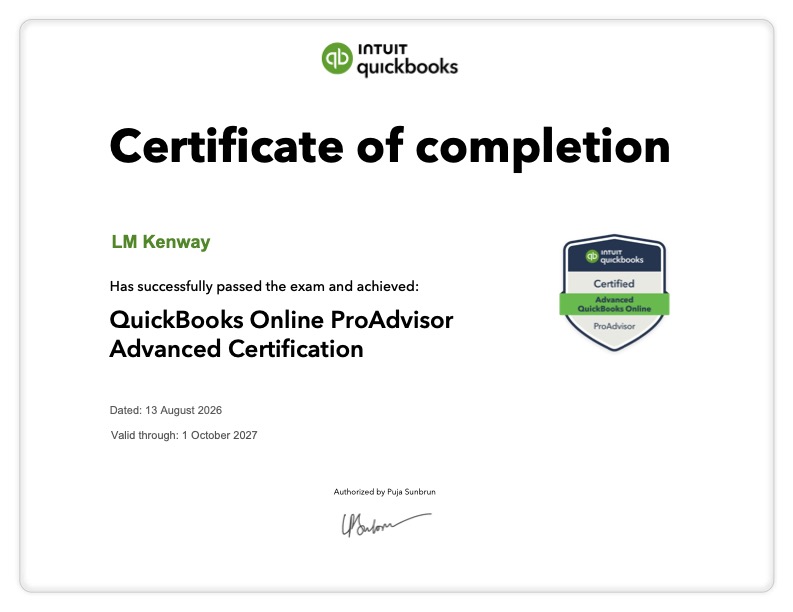 IAS 2026 Certification
 Rotessa
Partner
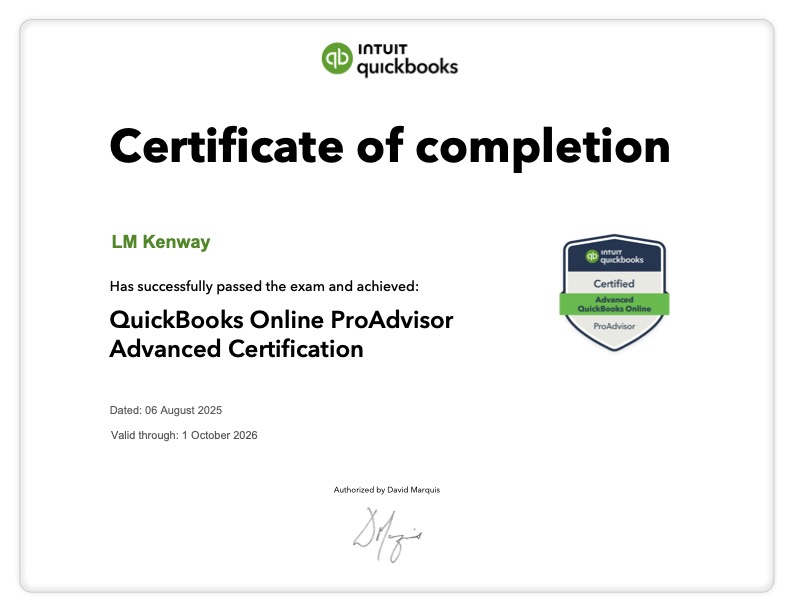 QBOA 2025 Certification
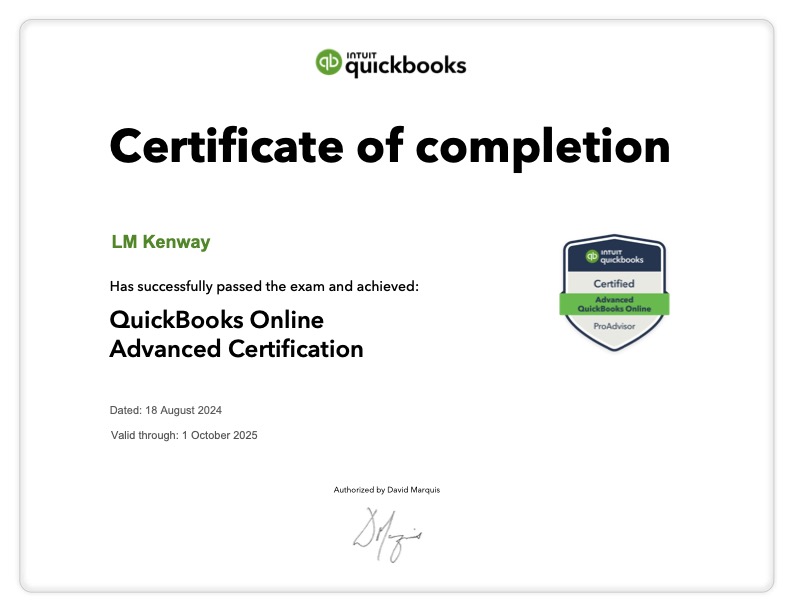 QBOA 2024 Certification
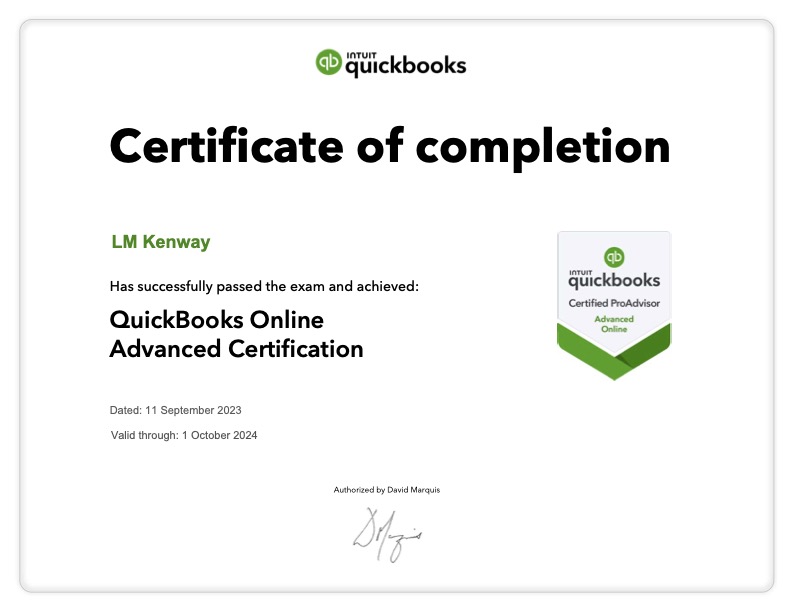 QBOA 2023 Certification
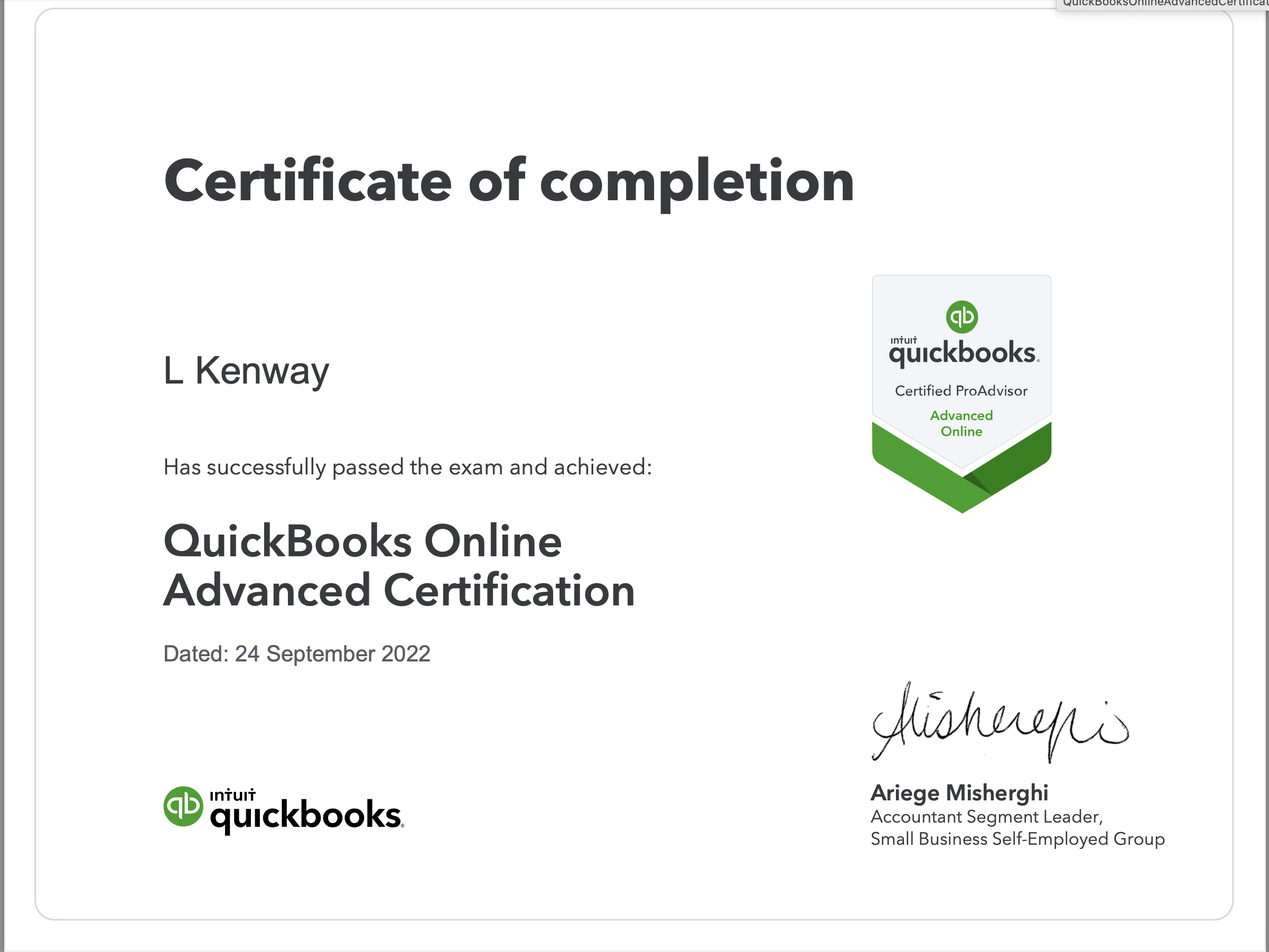 QBOA 2022 Certification
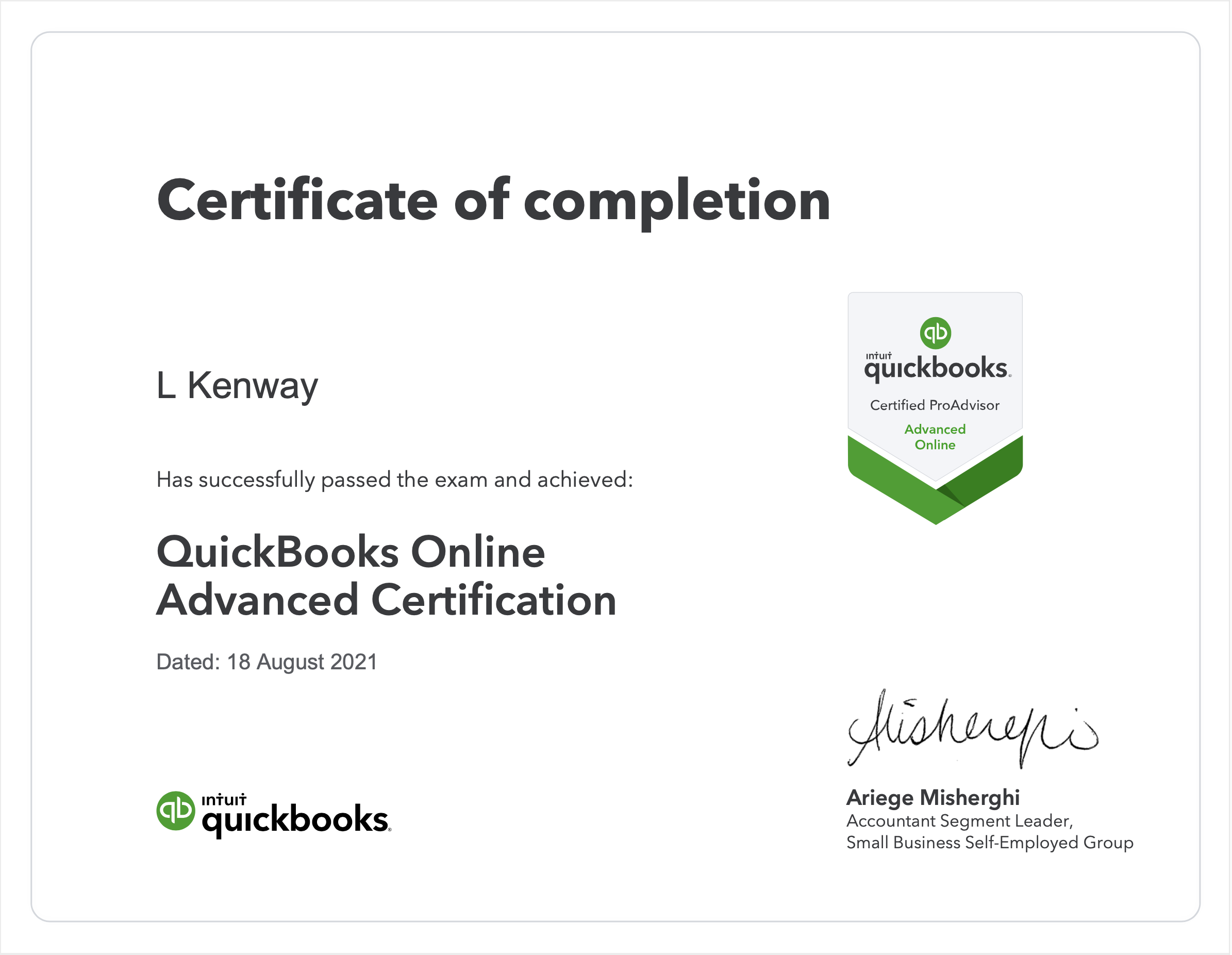 QBOA 2021 Certification
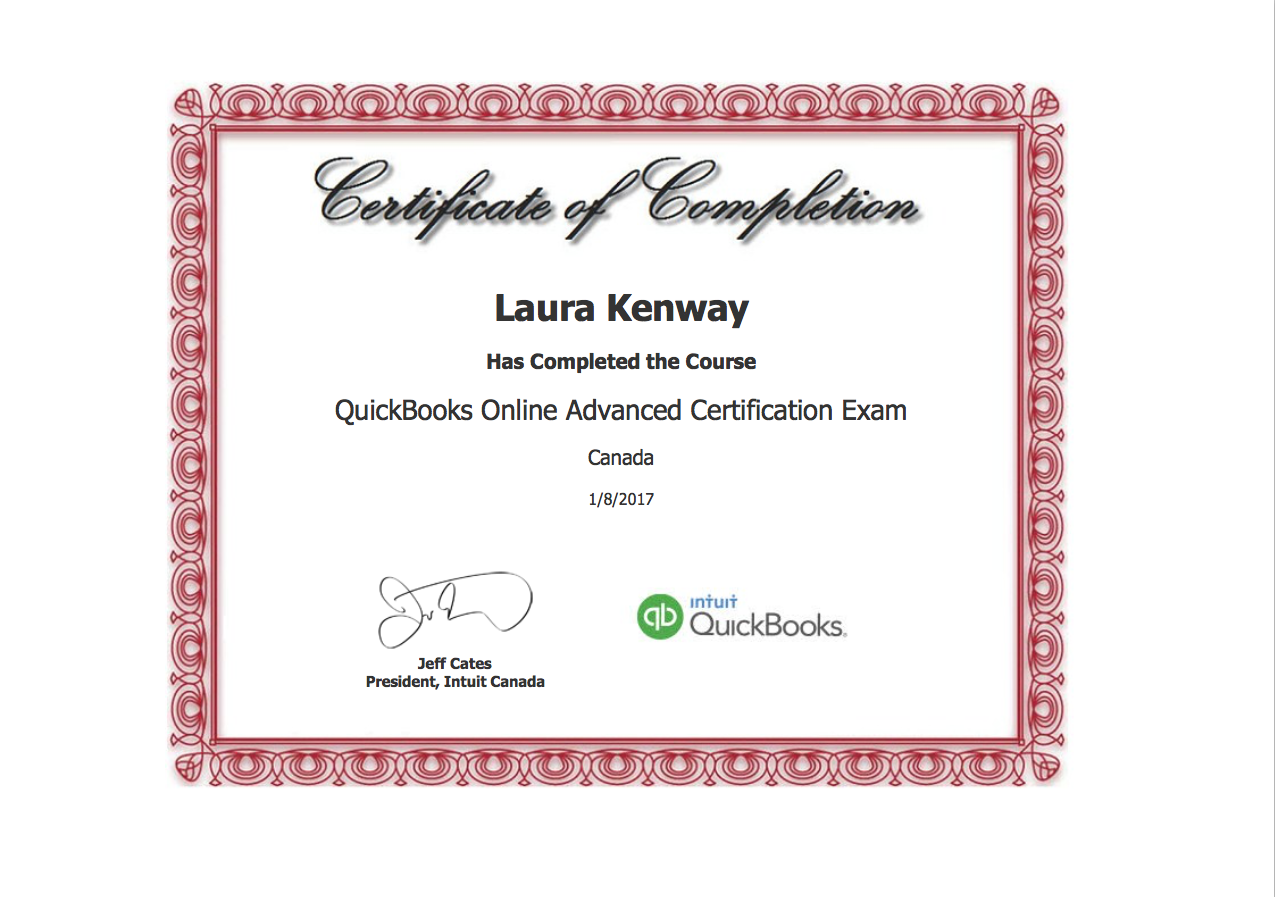 QBOA 2017 Certification
I don't expect you to take my word for it. Where I can, I like to show you the evidence behind what I tell you ... whether that's my professional credentials, my experience with the tools I write about, or the sources behind the information on this site.
Welcome to my site. I hope you enjoy your visit ... and come back often.
Ready to dive in? Head to the home page and choose the path that fits where you are today.
A quick note about how I manage this site since retirement. I no longer accept questions. There are so many social media groups that do this now, I feel it is no longer the best use of my time. But if for some reason you need to contact me, you can do so below. Heads up. I don't check my email on a regular basis so you may have to be patient for a reply.
I don't work as fast as I used to but ... I am in the process of creating some eBooks that I am hopeful you will find useful.
Just Breathe, Laura
Page last reviewed: September 3, 2026