- A Roadmap To CRA Compliance and Financial Stability
- Protecting For Audits
CRA Audit-Ready Books For The Self-Employed
Protecting Yourself In A CRA Review Or Audit

By L.Kenway BComm CPB Retired
This is the year you get all your ducks in a row! Start by starting ... and keep it simple. Consistency beats perfection.
Updated May 27, 2026 | Revised April 27, 2026 | Published May 2, 2024
WHAT'S IN THIS ARTICLE
Choose Your Path | The 2026 AI Shift | If You Want Audit-Ready Books | If CRA Contacted You | If You Want To Understand The Process | If You Are Ready To Act Now | Browse By Topic | Terms Used
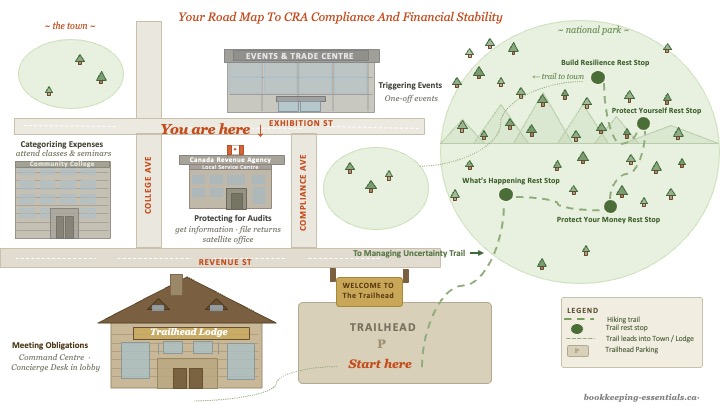 Checking the map. You are at the local CRA Satellite Office. This is where Protecting For Audits gets real ... defining audit-ready books, the audit process, and what to do if CRA comes knocking.
You're not in trouble with the Canada Revenue Agency (CRA) ... yet. But somewhere in the back of your mind is that constant nagging, "If CRA ever comes knocking on my door, would my books hold up?"
If you're self-employed in Canada, a CRA audit is something you hope never happens ... but smart business owners don't leave it to hope. Whether you're here to tighten your books before anything goes wrong, or you've just received a letter and need to know what comes next, you're in the right place.
🦆 You do not need to know the CRA terminology yet ... just start with the path that matches your situation. A glossary of CRA terms is at the end of the page if you need it.
Where Are You Right Now?
I want audit-ready books
- Clean records, consistent habits, and nothing to hide. Start here if you want to be audit ready before CRA ever comes knocking on your door.
I received a CRA letter
- Don't panic ... most contacts are routine. Start here to understand what you're dealing with and what your next step is.
I want to understand the CRA audit process
- Walks you through the process ... from the pre-assessment to the notice of objection ... plus your rights and one option you may not know you have if it's a serious letter. Understand all this BEFORE you respond to the notice letter.
I prefer to browse by topic
- Already know the subject you want? Browse the audit topics below and jump straight to the article that fits.
AI in 2026: The Quiet Shift Changing CRA Reviews
🦆 A quiet heads up before you dive in.
CRA has introduced several changes quietly, but the combined effect is bigger than it may look at first glance. If you have not been reading CRA updates closely, you could miss how much the environment has changed.
AI is now part of how CRA identifies files for review and audit
This is not just a human flipping through returns looking for something unusual anymore. CRA systems can now compare deductions, reporting patterns, and other data points at scale and apply the same statistical analysis across large volumes of returns. If a file is flagged, a human still decides whether to move it forward, but the first layer of screening is happening much faster and more consistently than before.
AI changes the scale of review
It can screen far more files than a human ever could, which means more returns and patterns can be reviewed for possible follow-up. A human still appears to enter the process at various stages, but the first-pass screening is now faster and broader than before.
That matters because being 'roughly right' is riskier than it used to be. What may once have blended into the background is now more likely to stand out if your numbers, patterns, or recordkeeping do not make sense. CRA's switch to AI is a game changer and makes staying 'invisible' much harder to do.
Digital delivery matters more now too
CRA’s default is now to deliver notices through the My Account or My Business Account email portal. When a notice lands there, the response clock starts from that date ... not from when you finally open it. If checking your CRA portal is not already a habit, this is a good time to change that.
And failing to respond has become more expensive
New penalties can apply for not providing requested information or ignoring CRA inquiries, including $50 per day up to $25,000 in some situations. In practical terms, ignoring a CRA request is now a much higher-risk move than it used to be. Slow-walking a letter used to be low-risk. Not anymore.
None of this means you are in trouble
It means the system is changing quietly, and the habits that used to be 'good enough' may not be enough now. This page will help you understand what that means, what the key terms are, and which path makes the most sense for your situation because the bar for what 'good records' means has levelled up for everyone.
JUMP TO >> Skip the Terms Used and go right to Path A
Path A: I Want Audit-Ready Books
JUMP TO >> What Audit-Ready Means | 10-Point Checklist | Areas CRA Audit Regularly | Proper Rates Used? | Records and Data | If You Only Do 3 Things | I'm ready to ...
Most self-employed Canadians who get audited aren't cheating ... they just never built the habit of keeping records that tell a clear story or didn't know the rules and CRA finds a mismatch.
And if you've ever considered doing business 'off the books', especially in these economic uncertain times with costs soaring in part due to global events ...
... You'll want to know why saying yes puts everything you've built at risk. CRA has sophisticated tools for finding unreported cash income. Ask yourself first before you leap ... are the consequences worth it?
What 'Audit-Ready Books' Means
Audit-ready means three things are true at the same time:
- Your numbers tie out … bank, credit card, sales, and tax accounts reconcile.
- You can show your supporting documentation … invoices, receipts, payroll records, contracts, and any adjustments.
- Someone else could follow your trail … clear descriptions, consistent categories, and reports that make sense.
If you can do those three, you are in good shape for the CRA … and for your own peace of mind.
CRA Audit-Ready Books 10-Point Checklist
- Yes or No? Do you have separate business and personal spending accounts (even if you are a micro business or a solopreneur)?
- Yes or No? Do you have one system to capture every receipt … photo, email, or scan, in one place?
- Yes or No? Do you record ALL sales consistently … invoices, e-transfers, cash, Stripe, Etsy, whatever you use?
- Yes or No? Can you match deposits in your bank feed to a sale or other income source … no mystery deposits such as receiving a family transfer?
- Yes or No? Do you reconcile bank and credit cards at least quarterly but preferably monthly?
- Yes or No? Do you have tidy GST/HST record tracking … do you know what you charged, what you claimed, and what period it belongs to?
- Yes or No? Do you categorize the grey area expenses … meals, vehicle, home office, subscriptions ... consistently?
- Yes or No? Do you track what you own and owe … equipment, loans, shareholder draws, taxes payable?
- Yes or No? Do you run and download/save your core reports … Profit and Loss, Balance Sheet, and General Ledger ... regularly?
- Yes or No? Do you keep a simple notes trail … on why you made adjustments, what a weird transaction was, what you decided?
- Bonus question. Yes or No? If you lost access to your software tomorrow, or faced a fire or flood, could you reconstruct your records from backups or offsite storage?
Areas CRA Audits Regularly









Are You Using The Correct CRA Rates?


Do You Meet CRA's Record Retention and Data Storage Requirements?


If You Only Build 3 Audit-Proof Habits This Month … Start Here:
- Set up a simple cash management system ... put your cash on auto pilot.
This is about decision fatigue. When your money has a job (tax, operating, owner pay, savings) you stop guessing … and you can make calmer choices even if your books are a bit behind. And an auditor who sees organized, purposeful money movement has less to question. - Practise CAPTURE … one Admin Inbox for everything.
Receipts, bills, invoices, statements, email confirmations, Interac e-Transfer screenshots … all of it goes into one place first. Paper or digital is fine. The win is consistency. Missing receipts are the number one reason an auditor denies legitimate deductions. - If you are registered … file GST/HST on time.
File on time even if you are missing a few ITCs (input tax credits). You can generally claim eligible ITCs for up to four years, and late filing penalties and interest are not worth it. But I recommend you claim your ITCs as soon as possible to avoid messy books. Late filing flags on your account invites an auditor to scrutinize more closely.
These three habits reduce panic fast … then reconciliation becomes the next easy habit when you’re ready.
I'm ready to build my audit trail
- You've done the self-audit. Now put it into practice ... entry by entry, habit by habit.
- You're already keeping up but you want to protect yourself and your business.
Path B: I Received a CRA Letter
Getting a letter from CRA is unsettling. I don't know about you, but it always gets my heart beating just a little faster before I open it.
The good news? Most contacts are routine CRA processes and don't mean you are in serious trouble. The first thing to do is figure out what you're actually dealing with. Is it a processing review, a mismatch issue, a desk audit, or a full field audit? They are all very different things. Start there, then follow the path that matches your situation.
I received a processing review letter
- CRA is telling you something doesn't match. They are giving you the opportunity to either support it or correct it before anything more serious happens.
I received a mismatch letter
- CRA is telling you there is a mismatch error on the income and credits reported on your return versus the information it has already received from other sources.
I received an audit letter
- There are two kinds of audits. One is more serious than the other but both require a timely and thoughtful response. Don't just whip up a response and send it out.
I received a Notice of Reassessment
- CRA will issue a Notice of Reassessment if a review or audit results in changes to your return. Like the original Notice of Assessment, this is an official document ... keep it with your records
- Before filing it, determine if you agree with the reassessment. You have 90 days to file a Notice of Objection if you don't.
Path C: I Want To Understand The Audit Process
JUMP TO >> The Audit Process | The Solution
This section walks you through what to expect at every stage ... from pre-assessment to filing a notice of objection. It also covers how to respond when an audit notice arrives.
You'll also find information about your taxpayer rights as a small business owner plus a look at whether the Voluntary Disclosure Program is the right move for your situation (Psst ... it isn't always the right move).
Not sure where to start? Begin with the audit process to understand CRA's flow then work your way through the rest.
Understand The CRA Process And Your Options



If You're Ready To Act Now
You made it through the review or the audit and now you want to know how to avoid that happening again. I have some suggestions below.
The Solution: Next Steps, Recovery, and Prevention




Path D: I Prefer To Browse By Topic
Already know the subject you want? Browse the audit topics below and jump straight to the article that fits.
Audit Process
Audit Readiness and Documentation
Proactive Damage Control
Common CRA Scrutiny Areas
New to CRA language?
Here are the main terms used on this page and in this series so you don’t have to guess what they mean:
- Canada Revenue Agency (CRA) - The federal organization responsible for administering tax laws for the Government of Canada and most provinces/territories, alongside collecting taxes, auditing, and delivering benefits.
- Self-assessment - Canada’s tax system expects you to calculate, report, and file your taxes correctly yourself, even if someone helps prepare the return.
- CRA review - A check of specific items on your return, such as receipts, deductions, or credits. A review is not the same as a full audit.
- CRA audit - A deeper examination of your records and reporting to verify that what you filed is accurate.
- Pre-assessment review - CRA’s initial arithmetic check of your return before issuing your Notice of Assessment.
- Notice of Assessment (NOA) - CRA’s official summary showing how your return was processed and whether you owe tax, are getting a refund, or had changes made.
- Express NOA - A fast initial assessment available through tax software or your CRA portal. It does not mean CRA is finished reviewing your return.
- Processing review - A post-assessment request for documents to support specific amounts claimed on your return that CRA is monitoring. It also has an educational component to it.
- Matching program - CRA compares what you reported with information it receives from third parties such as slips from banks, employers, and platforms. It also includes global reporting standards exchanged between countries. Distribution of tax credits and benefits depend on the correct net income.
- Office audit (desk audit) - An informal, routine audit handled remotely, usually through document submission, phone, or correspondence. If not handled properly, it can become a field audit.
- Field audit - A detailed audit where CRA examines records at your business location or through your authorized representative. The scope and process are more thorough, broader, intense and serious.
- Notice of Reassessment (NOR) - A notice issued when CRA changes your return after a review, audit, or an amendment request.
- Notice of Objection - The formal process for disputing an assessment or reassessment if you believe CRA is wrong.
- Voluntary Disclosure Program - a program that may offer partial relief in some situations if you correct past issues before CRA takes certain enforcement steps. It may not be the best tool for your situation.
More Audit Protection Articles
CRA and the Underground Economy | Cash Under The Table
Dealing in cash thrives in the underground economy. Here's what to do when your customer wants to do "cash under the table". Legal tax planning tools are dis...
7 Key CRA Mileage Log Requirements | Don't Lose Your Tax Deduction
The Canada Revenue Agency (CRA) requires meticulous tracking of mileage for the purpose of business deductions. Here are 7 key mileage log requirements.
Can CRA Forms Be Electronically Signed | Form T183
Can CRA Forms Be Electronically Signed? It is the taxpayer's choice to sign traditionally or electronically. Accepted forms are T183, T21...