- A Roadmap To CRA Compliance and Financial Stability
- The Concierge Desk
- The Backgrounder Library
- How Governments Raise Revenue
How Governments Raise Revenue
A Backgrounder Article | Drawer A: The Tax System - How It Works

By L.Kenway BComm CPB Retired
This is the year you get all your ducks in a row! Start by starting ... and keep it simple. Consistency beats perfection.
Published February 20, 2026
WHAT'S IN THIS ARTICLE
The Three Ways Governments Raise Revenue | How Provincial Governments Fund Services | The Global Shift: Taxing Consumption Over Income | Strategic Implications for Small Business Owners | Practical Takeaways
BACK TO >> What Is Tax Compliance?
NEXT ARTICLE >> How Sole Proprietors Are Taxed
RETURN TO >> The Backgrounder Card Catalogue
 Understanding how things fit together
The Three Ways Governments Raise Revenue
To do Canadian bookkeeping requires some basic knowledge of taxes so you can properly record sales tax, payroll tax, employee taxable benefits, or allowable income tax deductions.
Let me say that again. To do Canadian bookkeeping requires some basic knowledge of taxes so you can properly record sales tax, payroll tax, employee taxable benefits, or allowable income tax deductions.
I think ... no, I know... it helps YOU to keep a better set of books if YOU understand a little bit about the kinds of taxes there are in Canada ... and the reason governments use one type of tax over another.
Governments use taxes not only to raise revenues but also to direct social policy. The trend in the world today is to tax consumption more than income.
David Robertson, a Canadian tax lawyer explains ... in a paper entitled Sales Tax Harmonization: The Facts & Nothing But The Facts ... that there are only three ways for a government to raise revenues:
- When money is earned by a taxpayer - for example income taxes, payroll taxes and profit taxes.
- When money is spent by a taxpayer - for example consumption taxes, sales taxes, land and property transfer taxes.
- On the value of a taxpayer's assets - for example property and estate taxes.
How Provincial Governments Fund Services
Provincial governments have four sources of revenue:
- provincial taxes - for example personal income taxes, corporate income taxes and sales taxes;
- federal government transfers;
- income from investments and government businesses - for example the liquor board;
- other income - for example natural resources, fines and permit fees.
Mr. Robertson [1] points out that "the choice between which of these taxes to impose and when is generally driven by not only the need to raise revenues for government purposes, but also the behaviours the particular government wishes to encourage or discourage.
The Global Shift: Taxing Consumption Over Income
Amongst OECD member countries, the trend, at the beginning of the twenty first century, was to place more emphasis on taxing consumption and to reduce taxes on business profits and investments.
The policy reasons for this are clear. Taxation of income and profits provides a disincentive for citizens to earn more.
By reducing income taxes, government place more after-tax dollars into taxpayers’ hands, allowing them more flexibility to choose to invest that money in further income-earning activities or to use it for personal consumption.
If the taxpayer chooses the former, no further taxation is imposed. If the taxpayer chooses the latter, a consumption tax applies. In this way, the tax system provides an incentive to taxpayers to invest in further income-earning activities with the added benefit of discouraging excess consumption."
Strategic Implications for Small Business Owners
Understanding how governments raise revenue isn't just academic. It influences smart business decisions in four key areas.
- Business Structure Decisions
Knowing that Canada shifted toward consumption taxes and away from heavy profit taxation in the 1990s can inform your incorporation timing. If you're earning significant income as a sole proprietor, understanding how different business structures are taxed helps you plan strategically. - Compensation Planning
Owner-managers who understand tax policy can, with the help of their accountant, make informed decisions about salary versus dividends, knowing how each is taxed and why. - Major Purchase Timing
Understanding consumption taxes helps you plan when to make significant business purchases. Should you buy that equipment before or after a fiscal year-end? The answer often lies in understanding how sales tax and income tax interact. Your accountant can help you with this type of decision. - Investment Decisions
Tax policy often encourages reinvestment over consumption. When you understand this principle, you can align your business growth strategy with tax advantages ... reinvesting profits into equipment, training, or expansion rather than taking everything as personal income.
Practical Takeaways
Keep these principles in mind. You don't need to become a tax expert, but understanding the 'why' behind tax policy helps you ask better questions when planning your business future.
Questions to discuss with your accountant as your business grows ...
- Should I be setting aside money differently knowing consumption taxes work this way?
- When I'm ready to hire, how will payroll taxes affect my costs?
- If I'm thinking about buying expensive equipment, what's the tax advantage of reinvesting versus taking the money personally?
- As my income grows, at what point should I talk to my accountant about different business structures?
Tax policy shapes the business landscape you operate in. While it won't affect your daily bookkeeping tasks, this background knowledge helps you make informed strategic decisions as your business grows.
🦆 Remember: These are general principles. Always consult with a qualified tax professional for advice specific to your situation.
Reference
[1] Mr. Robertson is a partner with the firm EY Law LLP. His paper was presented in September 2005 at the CICA Commodity Tax Symposium. The article is no longer available online. The 75 page paper is written in a user friendly way ... which means it didn't sound "legalize" to me. I could actually follow what he was saying ... and it was really interesting and informative ... so I thought I'd share just a piece with you. I hope you enjoyed it.
Backgrounder Articles
What the Recession Headlines Aren't Telling You
The story is more complicated than "economists say we're not in a recession." The technical two-quarter definition has been met. The BOC acknowledges that but..
HST Compared to PST/RST in Canada | A Backgrounder
A backgrounder on how HST differs from PST/RST and why understanding the difference helps small business owners make better bookkeeping and pricing decisions.
The Backgrounder Library For Canadian Solopreneurs
Short reference articles explaining Canadian tax, bookkeeping, and CRA concepts for home-based solopreneurs and micro-businesses. The why behind the rules.
Can Canadian Solopreneurs Use Excel for Bookkeeping?
The best bookkeeping system isn't the fanciest; it's the one you use to stay organized, meet CRA rules, and clearly understand your business's financial health.
Certificate vs Certification | Why the Difference Matters
Certificate vs. professional certification: What’s the difference, and what does each tell you about a bookkeeper? The distinction matters when you’re hiring one.
How Tariffs Actually Move Supply Chains | A Case Study
Why did U.S. auto exports to Canada fall 22%? This case study explains why businesses optimize globally, not politically ... and how supply chains change.
Why Was GST Introduced in Canada? | Backgrounder
Why did Canada introduce GST/HST? Learn what tax it replaced, why the change mattered, and how GST/HST works as a value-added tax.
The Six Stages of a Trade Deal | Explainer For Canadian Solopreneurs
Why does it take the Prime Minister years to land a signed trade deal? An explainer to the six stages every trade agreement goes through.
When Economic Growth Doesn't Feel Like Prosperity | Solopreneur Canada
Learn the difference between GDP and GDP per capita, and why economic growth doesn't always translate into higher living and what it means for your business.
What Triggers Tax Audits in Canada?
We'll look at three issues that might trigger audits in Canada plus recent CRA audit projects and their findings
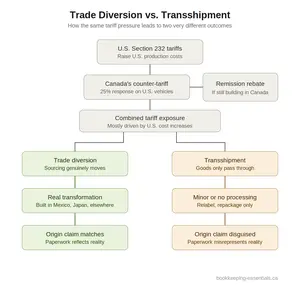
Cheating the System: How Transshipment Works
Not every rerouted shipment is trade diversion. Learn how transshipment works, why businesses do it, and how Canada's rules tell the two apart.
What Is GST/HST? What Is VAT? | Canadian Sales Tax Backgrounder
What is GST/HST and why is it called a value-added tax? This short Canadian backgrounder explains how GST, HST, and VAT work for small business owners.
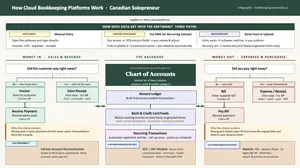
How Cloud Bookkeeping Software Works | A Blueprint
Not sure how your bookkeeping software fits together? This blueprint shows you the floor plan before you walk in the door.
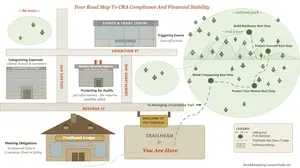
Canadian Bookkeeping Compliance Resource | Site Blueprint
A structural blueprint for the website making it easier for visitors to find what they are looking f