- A Roadmap To CRA Compliance and Financial Stability
- Navigating Change
- Resilient Self-Employed Finances
Building Financial Resilience for Canadian Solopreneurs
Build cash flow resilience and stay CRA-ready with a 3-pillar, habit-based system without drowning in admin.

By L.Kenway BComm CPB Retired
This is the year you get all your ducks in a row! Start by starting ... and keep it simple. Consistency beats perfection.
Published March 16, 2026 | Revised May 2, 2026
WHAT'S IN THIS ARTICLE
Introduction | Is This Is For You? | How To Use This Series | Start Here | Weekly Stability Check | Pillar A: Fundamentals | Pillar B: Workflow | Pillar C: Resilience | Terms Used
NEXT >> Companion Guide
BACK TO >> Navigating Change During Uncertainty
 Running Your Business Without a System Is Like Navigating Back Roads Without GPS
Introduction to Building Resilient Business Finances
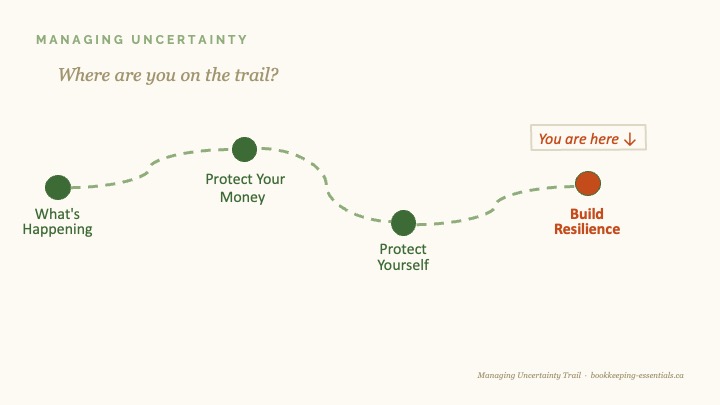 You are at the 4th rest stop on the journey to Managing Uncertainty.
There are three tents to choose from for your stay.
Stabilizing Numbers, Stabilizing Workflow, or Stabilizing Data.
If you’re doing everything yourself, the scariest moment is the quiet one ... when you open your bank balance and realize you can’t see what happens next week.
This page is built for that moment. It is built for Canadian solopreneurs who have been running on instinct ... and may not yet realize that instinct alone leaves you exposed even when things feel fine. We are entering a period where economic uncertainty is likely to become the norm rather than the exception. Global restructuring takes time. New alliances, new trade relationships, and new pressures on small business are already unfolding and will continue to for years. Solopreneurs who build financial resilience now will be far better positioned to absorb what comes next than those who wait until the pressure is already on them.
So before we dive in, let's go sit at the end of the dock, dangle our feet in the water, and just chat. I don't know about you, but I'm not a just jump in the water kind of gal. I like to get myself oriented to my surroundings first.
A note on how this is written. If you landed here stressed about your finances, I am not going to rush you straight to a checklist. In my experience, smart people make better decisions when they understand why they are doing something, not just what to do. So we are going to take this one step at a time. I will explain my thinking as we go. You can decide what fits your business and what does not. That is not me being slow. That is me respecting that you are capable of making good decisions when you have the right information in front of you.
If a phrase stops you along the way, the Terms Used box on this page covers the series-specific language. For broader background terms used across the wider Managing Uncertainty section, the main terms guide has you covered.
The fix is not more effort. It is more visibility. That is why I am going to introduce you to the concept of financial resilience and show you how to build it into your business.
So what does financial resilience even mean? I am glad you asked. Financial resilience is the capacity to absorb financial shocks and bounce back through sound, proactive money management. That is what this series is about. Not perfect bookkeeping. Not fancy dashboards. Not advanced corporate tax strategy.
What you need first is a practical system that helps you see your numbers, protect your cash flow, stay on top of tax obligations, and keep records you can defend if CRA ever comes asking questions.
This page is the working overview for that system.
Start with a simple weekly check-in I call Fundamentals Friday. Use it to make cash in and cash out, tax set-asides, overdue invoices, and receipt proofing VISIBLE so surprises stop living in your blind spot. Then work through the three pillars built for Canadian solopreneurs:
Pick one Start Here path, do the first step, and you’ll have a weekly rhythm you can repeat that replaces a bookkeeping project you avoid. The goal is not to turn you into an accountant.
The goal is to ensure you can react fast when the economy (both micro and macro) surprises you with a hit. I'll show you simple habits and a practical flexible structure that helps you keep a steady, stable cash flow.
At some point, learning the CRA rules that apply to your business stops being optional if you want a business that can weather the hard years, not just the good ones. Why? So you keep records that are defensible if CRA ever asks questions.
The PROBLEM with skipping this step is that you do not know what you do not know. You will not discover the gap until you are sitting across from a CRA auditor in year five looking at records you cannot defend.
When that happens, the cost compounds quickly. Deductions get denied because the supporting documentation is missing or the expense was never eligible to begin with. Then penalties and interest start accumulating on top of the tax owing. What started as a small records gap becomes a serious financial hit that is very hard to recover from.
The good news is that this is one of the most preventable risks in your business. Learning the rules now and building habits around them from the start means you are not scrambling to explain five years of decisions to someone with the authority to reassess them. That is not just good bookkeeping. That is proactive protection for everything you are building.
Learning the CRA rules is part of running a business responsibly in Canada. When you skip that step, you are leaving your business exposed to a risk that is unnecessary and entirely preventable.
This is a Canada-only resource written for home-based solopreneurs and micro-business owners who want a calm, repeatable routine ... not perfection, and not chaos. It helps you find and establish your business's rhythm.
Watch for the 🦆 Solo CEO Moves. They point you to your next step.
I'm going to introduce you to 🦆 Solo CEO Moves in this series.
For the purpose of this site, a Solo CEO (self-employed) isn’t someone trying to scale fast or hire a team. It’s a self-employed Canadian who runs their business with simple numbers and repeatable habits ... so they can react quickly, stay CRA-ready, and keep going through economic uncertainty.
Spotting a Solo CEO Move means you lifted your eyes off the road long enough to check the map. That is exactly where you want to be.
Start the way you want to end. Keep it simple, but set it up so it’s repeatable and CRA-defensible from the beginning.
Getting Your Ducks Aligned
You Are Probably in the Right Place If ...
This pond is for you if:
- You have been running on instinct and you are ready for better visibility into cash, tax, and records.
- You’re self-employed in Canada (home-based, solo, freelancer), and the admin side keeps slipping.
- You want to stay compliant and audit-ready without becoming an accounting expert.
- You want a calm weekly routine you can run even when you’re busy.
This pond is probably not for you if:
- You have a robust business with a finance/admin team and/or complex internal processes.
- You’re looking for advanced corporate tax strategy.
- You want 'perfect books' more than a system you’ll actually stick with.
Use this page like a dashboard:
- Once a week, run the Weekly Stability Check.
- Pick one small fix for the week (one habit, one cleanup task, or one cash decision).
- Read one item from the pillar that matches your situation right now.
Consistency beats perfection. A boring, repeatable routine will protect you better than a heroic 'catch-up weekend' once or twice a year. It's the difference between wiping a spill in the fridge as soon as it happens, versus six months later. The first cleanup takes a minute, the second requires elbow grease.
That is how this series is meant to be used:
- one weekly check
- one small correction
- one deeper read
Over time, that rhythm compounds.
Getting Your Ducks Aligned
Start Here
You do not need to fix everything at once. If you’re not sure where to begin, choose the path that feels most true today ... not the one you think you 'should' pick.
DIY Simple Cash Management System
If cash feels tight or you’re worried it could get tight fast:
- Start with >> A Simple Cash Management System
Put a basic habit-based system in place so cash has a job the moment it arrives in your bank account. It's a quick win and should give you back a sense of control. - Then >> Cash Management Strategies to Protect Your Money
Strengthen that system so you can handle pressure with fewer surprises.
30 Day CRA Admin Reset
If you’re overwhelmed, behind, or avoiding your books:
- Start with >> 30 Day CRA Admin Reset
Use a simple method to get organized without trying to clean up everything in one push. - Then >> Why You Avoid Your Business Finances (Canada) | And How to Stop
Understand what avoidance is costing you ... and how to stop feeding the pattern.
Workflow System
If you want a system designed to survive tool churn, platform risk, and AI hype ... not just your next audit:
- Start with >> Solo CRA-Ready Workflow
Run a simple three-step workflow that closes every period cleanly. - Then >> CRA-Grade Records System
Build a records system that's portable, platform-independent, and defensible.
Business Fundamentals 101 (With 🦆 Solo CEO Moves)
If money stress is always there in the background even when nothing is actually wrong:
- Start with >> Business Fundamentals 101
Learn the core numbers and habits that help you see what is really going on in your business.
- Then >> Fundamentals Friday
Use a simple weekly money check-in to stay grounded in your numbers.
Audit-Ready Books
If you’re specifically worried about CRA scrutiny or whether your books would hold up in an audit:
- Start with >> Self-Employed Audit Ready Books
Choose the path that matches your recordkeeping risk. - Then >> Responding to a Tax Audit Notice
See what the process looks like if CRA ever does come knocking.
This series is a work in progress. Bookmark this page and come back as new articles are added. I will keep building it out.
🦆 Solo CEO Move (next 10 minutes)
Open ONE of the 'Start with' links above and skim the article to find the actionable item. Stop there. Then read it and do the thing.
Getting Your Ducks Aligned
Fundamentals Friday: CEO Weekly Stability Check
Most small businesses do not fail because of one catastrophic event.
They fail quietly. A slow month that becomes two. An invoice that ages past 60 days and gets quietly written off. A subscription that auto-renewed. A tax set-aside that got spent because the cash was just sitting there. A revenue dip that showed up in the numbers three months before it showed up in the bank account.
None of those things feel like emergencies when they happen. That is exactly why they are dangerous. That is why this check matters.
What is the purpose of the CEO weekly stability checklist?
In a stable economy, checking your business fundamentals once a week is simply good practice. In the economy we are actually living in right now (2025 and 2026), it feels like survival instinct.
Canadian solopreneurs are navigating tariff uncertainty, rising costs, and supply chain disruptions that nobody predicted and nobody can fully control. You cannot control any of that. What YOU CAN CONTROL is whether you see your own numbers clearly every single week.
That is the purpose of this checklist. This is not about perfect bookkeeping. Don't get me wrong. Accuracy is still important. Getting the major figures correct is important. But don't spend an entire day getting 100% perfection on trivial items.
The CEO Weekly Stability Check is about visibility. Eight numbers, under 30 minutes, once a week. The goal is not to have perfect numbers. The goal is to see your numbers clearly enough that nothing sneaks up on you.
I think this is the perfect task to close out your week so you can enjoy your weekend (or not), which is why I call it Fundamentals Friday. Friday works because if something looks off, you have the weekend to think before Monday arrives with its own demands. But pick the day that works for you and protect it.
🦆 Solo CEO Move (Now)
One rule before you start. Do not try to fix everything you see. Circle one number that worries you. Do one thing about it this week. That is the Solo CEO Move at the bottom of this checklist, and it is the habit that actually builds financial resilience over time. Not through one heroic cleanup, but through steady attention and repeated small corrections.
Bookmark This Page
Last reviewed: March 2026
ACTION: Bookmark this page and come back every Friday. This checklist is meant to be used repeatedly, not read once and forgotten. It is maintained on this page so you’re always using the latest version.
If you prefer to work offline, copy and paste the checklist into a plain document on your computer and fill it in each week. Either way, the goal is the same. One page. Eight numbers. Under 30 minutes. Every week.
Do not aim for perfect numbers. Aim for visible ones. If one number looks off, pick one small fix for next week.
Your Weekly Numbers
☐ 1. Cash in bank today
$_________
Why it matters: This is your real runway right now. Not your revenue. Not your profit. Cash.
☐ 2. Cash coming in over the next 7 days
$_________
Invoices due, expected deposits, scheduled transfers.
Why it matters: This tells you whether relief is actually on the way ... or whether you are running on hope.
If this number is consistently thin and accounts receivable is a recurring problem, it may be time to revisit your payment terms. Goods may require a deposit on account. Service based solopreneurs have no repossession option. A bookkeeper cannot take back a reconciliation. A designer cannot repossess a website. Once the work is delivered your leverage is gone.
In uncertain times deposits on account and advance payment are not rude. They are how you protect yourself before the work begins instead of chasing payment after the fact.
☐ 3. Cash going out over the next 7 days
$_________
Known bills, subscriptions, loan payments, payroll if applicable.
Why it matters: This is where surprises hide. Listing it forces reality into view.
If what you see here is keeping you up at night, business debt isn't a spending problem. It's a habit problem. Before you cut randomly, stop and compare your spending against a baseline. Then decide what actually needs to go.
☐ 4. Tax set-aside balance
$_________
Your GST/HST/PST reserve plus income tax savings.
Why it matters: This keeps you out of the classic trap of spending money that was never really yours.
If you are using my simple cash management system, record your tax account balance here. If you are not, enter your honest estimate of what you owe CRA so far this year.
Either way, know the number.
☐ 5. Sales for the week
$_________
Why it matters: This is your heartbeat. A sudden dip is your earliest warning signal ... before you feel it in cash.
☐ 6. Average weekly sales over the last 4 weeks
$_________
Why it matters: This keeps you from overreacting to one weird week and helps you see the direction of the trend.
Trust the trend.
☐ 7. Accounts receivable
Total outstanding: $_________
Age of oldest invoice: _________ days
Why it matters: Old receivables are future cash that is starting to rot. Age matters more than the total dollars outstanding.
☐ 8. Admin records captured this week
Number of receipts and records filed: _________
Why it matters: Audit readiness is built in small batches, not in one panicked annual cleanup. This one number tells you the truth about your admin health.
If this number is low or zero, that is your reminder that Monday morning is your reset. Money Mondays exist for exactly this reason. Clear your admin inbox while your coffee is still hot and this number takes care of itself.
🦆 Solo CEO Move (this week)
Every stability check ends with one decision, not ten.
- Circle ONE number that worries you.
- Do ONE fix that directly moves it (one invoice follow-up, one subscription cancellation, one 'tax set-aside' transfer, or one receipt-capture habit).
Small consistent moves compound. That is how financial resilience is actually built.
Something Look Off?
If any number stopped you this week, you are not behind. You are paying attention. That is exactly what this check is designed to do.
Getting intimate with your numbers is not about becoming an accountant. It is about getting to know your business on a deeper level. What makes it breathe. What makes it stall. What it needs from you this week.
Here is something nobody tells you when you start a business. A business left unexamined will behave like a spoiled child. It will want everything. The shiny new software tool. The upgraded subscription. The course you will definitely take someday. The equipment that would be nice to have. And if you are not looking closely at your numbers every week, you will find yourself giving your business everything it wants instead of everything it needs. The difference between wants and needs shows up quietly in your expense lines and loudly in your cash runway.
The solopreneurs who build real financial resilience are not necessarily the ones with the biggest revenue. They are the ones who show up every Friday and look their numbers in the eye.
Head to the Fundamentals Friday companion guide for a deeper look at what each number is telling you and what to do about it.
A reminder this series is a work in progress. Bookmark this page and come back as I add new articles. I will build out the three pillars below as I write the article. For now, here is the framework for the series.
Resilient Self-Employed Finances - The System
Pillar A - Solopreneur Stability Fundamentals
The Numbers + Decisions Under Uncertainty
When things get uncertain, most solopreneurs do one of two things ... they freeze, or they chase tactics.
This pillar is the middle path.
It is about the few numbers, routines, and decision rules that help you stay steady when costs shift up or down, sales wobble as demand changes, or the version of 'normal' you built your business around stops behaving normally.
You’ll learn the few numbers and simple tests that drive better decisions ... what to check weekly, what to track monthly, and how to review it fast (without building a complicated spreadsheet life).
So here's the plan ...
1. Your Trail Map and Where To Start
Pillar A articles are being added now. Start with Business Fundamentals 101, which covers the 6 core fundamentals, 5 practical rules, and the 1 number every solo operator needs to know. 🦆 Solo CEO Moves throughout turn theory into action before you leave the page. The Solo CEO Pulse dashboard is live in Fundamentals Friday. More articles are coming.
2. Getting Your Ducks Aligned
Work through these three actions in order:
- Know your weekly 'must-pay' expenses.
- Set a default tax set-aside rate (% of revenue) and where those funds will live.
- Do a weekly cash check routine like Treasury Thursdays.
3. 🦆 Solo CEO Move (today)
Write down your upcoming weekly 'must-pay' list (rent, software, loan payments, insurance, etc.). That’s your survival number set for this week.
Resilient Self-Employed Finances - The System
Pillar B - Solopreneur CRA-Ready Workflow
Workflow + Tool Choices
CRA compliance is rarely about one big mistake. It’s usually death-by-a-thousand-small-gaps:
- a receipt that never got captured,
- a missing invoice trail,
- a bank account that wasn’t reconciled,
- not knowing the CRA rules, or
- books that live entirely inside one platform you don't fully control.
With the exception of the CRA rules, every one of those gaps is a workflow gap, not a knowledge gap.
This pillar gives you a modern solo workflow. A simple three step back office cycle ... Gather, Process, Results Delivered. It's a repeatable, platform independent cycle built to hold up if CRA ever asks questions.
So here's the plan ...
1. Your Trail Map and Where To Start
If you are starting from zero (no system, avoided books, inbox full of receipts), start with the 30-Day CRA Admin Reset. It builds the foundation this pillar runs on.
If you have basic habits in place and want to run your back office like a professional, start with The Solo CRA-Ready Workflow. It's a three-step workflow that takes you from source document to closed period, every time.
Then I'll explain in more detail why you want to formalize delivering results and suggest a simple set of tools that serve the system, not the other way around.
2. Getting Your Ducks Aligned
Work through these three actions in order:
- One capture inbox for all receipts/invoices.
- One naming rule you can follow when you’re busy.
- One monthly export routine so you’re not locked into any tool.
3. 🦆 Solo CEO Move (today)
Create ONE capture habit ... set up a folder (email or cloud) called 'Admin Inbox' and use it for everything for 7 days.
Resilient Self-Employed Finances - The System
Pillar C - Solopreneur CRA-Ready Records Resilience
Risk Reduction + Portability + A Real Backup / Restore Discipline
Most solopreneurs do not think about audit readiness until CRA reaches out. That is normal. This pillar is about getting ahead of it in a practical way.
Audit readiness is not about perfection. It is about reducing avoidable risk and being able to prove your numbers if CRA asks. You will learn which habits tend to trigger CRA scrutiny so you can eliminate preventable red flags, and how to build a backup and restore routine that actually works under real-world stress ... device failure, account lockouts, and modern cyber incident risks.
Durable records mean independent copies that live outside your bookkeeping app and can actually be restored. Not "I think I am backed up". Recovered. Verified. Usable. We will dive into how to achieve that.
As we are going back to basics to shut out some of the noise ... I’ll show you a CRA‑grade records system (a modern digital version of a classic bookkeeper's workflow) designed to survive tool churn, platform risk, and AI hype.
This pillar gives you a modern solo records system that’s simple, repeatable, and platform-independent ... what to save, where to save it, and how to name it.
So here's the plan ...
1. Your Trail Map and Where To Start
This pillar includes a chat about a CRA audit trigger checklist, backup strategies like 3-2-2, what immutable backups and verified restores mean, and a simple annual restore test.
2. Getting Your Ducks Aligned
Work through these three actions in order:
- Know the avoidable audit-risk habits to eliminate.
- Keep independent copies of key records, not just inside one app.
- Verify you can restore, at least annually.
3. 🦆 Solo CEO Move (this week)
Start a 'Financial Archive' folder and put your PDF bank and credit card statements in it. That’s your first portable, evergreen record set. We’ll build the rest of the system from there.
Here's a basic file naming convention (start the way you intend to end):
YYYY-MM-DD Institution Account DocumentType (if applicable)
2026-02-28 BMO Chq Stmt
2026-01-31 Telus Bill
Two quick rules that keep it resilient:
- Lead with the date (YYYY-MM-DD) so files sort correctly forever.
- Keep names boring and consistent (same words every month), so searching is effortless later. Feel free to create shorthand such as Chq instead of Chequing or Inv instead of Invoice.
Terms Used in This Resilience Series
These are the terms used specifically in this resilience series. For broader context used across the wider 'Managing Uncertainty' section, see the main terms guide.
Series Definitions
Financial Resilience: the capacity to absorb financial shocks and bounce back through sound, proactive money management.
Solo CEO Move: signals a single, specific action needed that moves one number in the right direction. Watch for the 🦆 throughout this series.
Tax Set-Aside: reserve a portion of income for tax obligations
Cash Management Strategies
Understanding Your Investment Tax Slips | T3 T5 T5008
Guide to T3, T4, T5, T5008 tax slips for Canadian business owners. Understand salary vs dividends, investment income, and why retirement planning matters.
RRSP Tips and Traps | Small Business Owners
RRSPs can be a valuable tool for small business owners in Canada to save for retirement. Some RRSP tips and traps to keep in mind to maximize their benefits.
Solopreneur Two-Bank Strategy | Combine Traditional & Online Banking
The smart business guide to a solopreneur two-bank strategy. Learn how to combine traditional and online banking for maximum business benefits.