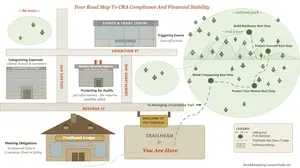
- A Roadmap To CRA Compliance and Financial Stability
- The Concierge Desk
- The Backgrounder Library
- What Triggers An Audit?
What Triggers Tax Audits in Canada?
A Backgrounder Article | Drawer B: CRA & You - How They See Your Business

By L.Kenway BComm CPB Retired
This is the year you get all your ducks in a row! Start by starting ... and keep it simple. Consistency beats perfection.
Published April 23, 2026 | Revised May 6, 2026
WHAT'S IN THIS ARTICLE
How CRA Selects Returns | 3 AI Trained Patterns | Your Best Defense | CRA's Favourite Targets | 1. Vehicle Expenses | 2. Five CRA Audit Projects
NEXT ARTICLE >> How Canada's Self-Assessing Tax System Works
RETURN TO >> Understanding Tax Audits In Canada
BACK TO >> The Backgrounder Card Catalogue
In this article: CRA refers to the Canada Revenue Agency. AI refers to artificial intelligence. T2125 refers to Statement of Business or Professional Activities.
 Audit selection is driven by risk assessment systems that flag returns for further review
How CRA Selects Returns For Audits
Audits are rarely random. As Barrett Tax Law notes in their glossary under Audit Risk Factors, "... the odds of being audited depend on who you are, where you are, what you do, and what types of expenses you have, and so on. ... And the more risk factors a taxpayer has, the greater the odds of that taxpayer being audited."
What has changed in 2026 is how CRA finds those risk factors. The CRA's 2026-27 Departmental Plan confirms the agency is now using AI and advanced analytics to identify and prioritize high-risk non-compliance cases across the entire filing population. Automated systems score your return against industry benchmarks, third-party data (including international sources), your own filing history, and known non-compliance patterns before a human auditor ever sees your file.
The CRA is clear that AI does not make final audit decisions. It acts as a triage layer, flagging returns that fall outside expected patterns for human review. But because the system processes millions of returns simultaneously, even small inconsistencies can trigger that flag.
The more your return deviates from what CRA expects to see for someone in your industry, income range, and expense profile, the higher your risk score. A high risk score means a human reviewer takes a closer look.
The Three Patterns CRA's AI Is Trained To Find
CRA has flagged these three broad patterns as audit risks for years. What changed in 2026 is that AI now finds them faster, across more returns, and with far less human effort than before. Do any of these apply to you?
Are You Claiming Unreasonable Expenses CRA Won't Allow?
Deductions that fall outside what CRA expects for your industry and income level raise your risk score. This includes expenses that are personal in nature, double-dipped, or simply not deductible under the Income Tax Act.
It also includes claims that spike significantly from one year to the next without a clear business reason.
A reasonable expectation of profit matters here too. If your expenses consistently exceed your revenue, CRA may question whether your activity qualifies as a business at all.
Is All Your Income On The Table?
Every source of income counts.
Freelance payments, platform earnings, CASH transactions, and side income all need to be reported. CRA now receives third-party data from online platforms and financial institutions and its AI systems cross-reference that data against your return automatically.
- If money hits your bank account, assume CRA can see it.
- If cash doesn't hit your bank, assume CRA has sophisticated methods to find it. AI is very good at finding patterns.
Does Your Filing History Look Suspicious?
CRA's AI is designed to detect patterns across your filing history, not just a single return.
Rounding every number to the nearest hundred on your T2125 signals estimates rather than actual records. Reporting losses year after year raises the hobby versus business question. Large swings in income or deductions from one year to the next trigger automated scrutiny. A history of multiple or frequent amended returns can increase your risk score over time.
CRA's AI looks across multiple years, not just your current return. If you recognize any of these patterns in your own filing history, the best time to act is before CRA does.
Your Best Defense
Good records do not prevent your return from being selected but they determine the outcome. A mileage logbook, organized records and receipts, fully reported income, and consistent bookkeeping habits. And not just any receipt.
MORE >> Know what CRA considers a legitimate receipt before an auditor asks.
Most audits result from sloppiness, not fraud. If your records are accurate, your income is fully reported, and your deductions are reasonable and documented, you have done what you can.
Get in the habit to document, document, and did I mention document?
CRA's Favorite Targets: Known Enforcement Targets
CRA's AI flags the three patterns above across all returns. But some triggers are specific enough that CRA has launched dedicated audit projects to pursue them. If any of the following apply to your situation, the stakes are higher.
1. Vehicle Expenses: A Guaranteed Audit Trigger
Vehicle reimbursement is one area where good bookkeeping habits really matter. Taking shortcuts will cost you. Because the rules for writing-off business use of auto expenses are complicated and very inflexible, CRA auditors will always examine them. So follow the rules closely if you want your deduction to pass a tax audit.
CRA has three distinct sets of rules for vehicles used for business purposes. Choose the one that fits your circumstances to stay CRA compliant.



2. CRA Audit Projects
CRA formally selects audit projects each year, targeting areas where non-compliance is common or where new rules have created gaps. Some of the following are publicly announced 2026 enforcement priorities. Others began as formal audit projects and have remained areas of ongoing scrutiny. All of them directly affect home-based business owners.





3. Other Backgrounder Articles
Canadian Bookkeeping Compliance Resource | Site Blueprint
A structural blueprint for the website making it easier for visitors to find what they are looking f
How Are Sole Proprietors Taxed In Canada | Marginal Tax Rate Explained
Knowing how sole proprietors are taxed provides motivation to have audit ready books. You're in a high risk group for getting audited. Learn about your marginal tax rates as well.
How Governments Raise Revenue | A Backgrounder
Discover the three ways governments raise revenue and why understanding Canadian tax policy helps you make better strategic decisions for your business.