- A Roadmap To CRA Compliance and Financial Stability
- Navigating Change
- Protect Your Money
Cash Management Strategies to Protect Your Money
Take Back Control Of Your Cash Flow

By L.Kenway BComm CPB Retired
This is the year you get all your ducks in a row! Start by starting ... and keep it simple. Consistency beats perfection.
Published February 22, 2026 | Revised May 4, 2026
WHAT'S IN THIS ARTICLE
Introduction | Is This Your Pond? | Choose Your Path | Quick Compliance Check | Tools & Strategies | Your Next Move | How The Pieces Connect | Why This Can't Wait | Start By Starting | What To Do First | Terms Used
NEXT >> Put Your Cash On Auto Pilot
BACK TO >> Navigating Change During Uncertainty
 Beautiful, harsh, real ... just like running a Canadian business right now.
Introduction To Protecting Your Money
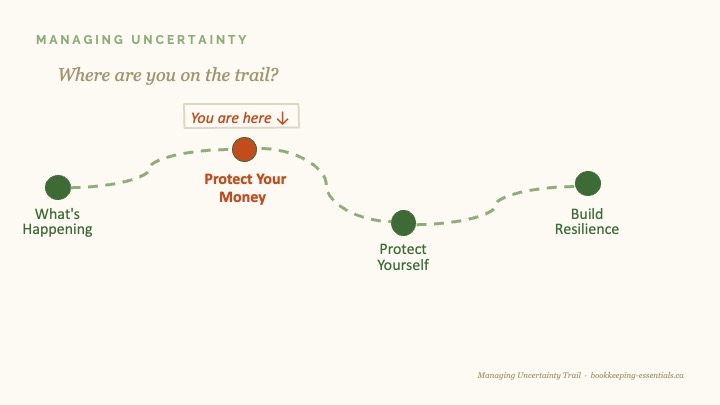 You are at the 2nd rest stop on the journey to Managing Uncertainty.
There are four tents to choose from for your stay.
Control your cash flow, your banking, your payments, your admin.
Tariffs don't just raise prices ... they squeeze your margins from multiple directions. Supplies cost more. Shipping jumps overnight. Packaging materials you ordered last month arrive at this month's higher price. And if you're importing parts, tools, or finished goods? The math changes before you can adjust your pricing.
You can't control tariff policy. But you can control how you manage cash while costs shift around you. That is what this section is for.
These four practical systems protect your money when costs move faster than you can react. A simple daily tracker that shows your cash position every morning, a banking strategy that saves you fees while earning better interest, guidance on payment methods that won't create compliance nightmares, and a 30-day reset that will keep you CRA-compliant without drowning in paperwork. I'll show you how to reduce some of your decision fatigue.
You don't need perfect books to run your business day-to-day. But you do need to know where your cash stands, which payment methods are safe, and how to stay compliant before CRA comes knocking. These strategies build the routine and rhythm that makes all three possible.
Is This Your Pond?
This isn't about complex financial planning or investment strategies. It won't teach you how to read a balance sheet or build a five-year forecast.
This series does one thing. It shows you how to manage cash day-to-day so you stay compliant, protect your money when costs shift, and avoid the year-end scramble that costs solopreneurs time, money, and stress.
This series is for you if:
- You are self-employed, home-based, and operating in Canada.
- You want practical systems you can actually maintain on your own.
- You want to establish natural rhythms as you get to know your business intimately.
- You are willing to build one habit at a time instead of overhauling everything at once.
This series is not for you if:
- You are looking for investment advice or long-term financial planning.
- You need incorporated business or corporate tax guidance.
- You want someone to just hand you a checklist without explaining why it works.
That last point is worth a moment. When money is tight and stress is high, the instinct is to want the shortest path to an answer. I understand that. But a checklist you don't understand is a checklist you won't maintain.
So here is what I am going to do instead. Together, we are going to move through this, one step at a time, with the reasoning visible. You decide what fits your business and what doesn't. That is not me being slow. That is me making sure the time you spend here actually sticks.
If a term stops you along the way, the Terms Used appendix at the end of this page covers the jargon used throughout this Managing Uncertainty pillar. It is there whenever you need it.
When I became self-employed myself, I kept meeting people who were getting into serious trouble with CRA. Some of them simply didn't think the rules applied to them. Let's just say an audit has a way of changing that perspective and your life well into the future.
But there was another group that stayed with me. The ones who wanted to do it right but paperwork was not their forte. They had more of the pieces than they realized. What they were missing was a system that fit how they actually worked, not how a textbook said they should.
That is what this series is built around.
Choose Your Path: Which Cash Problem Is Causing You The Most Pain?
Start with the issue that's keeping you up at night. If you are unsure where to begin, start with daily cash tracking. It gives you the fastest visibility, and better visibility makes every other decision easier.
You do not need to solve all of this at once. You need one starting point ... the one that is costing you the most stress.
Each wobble card below focuses on one habit that may be creating the most pain for you. Choose the one that feels most familiar, not the one you think you should tackle first. And yes, hover over the duck. It wobbles. Go on.
"I never know if I have enough money to spend."
Constantly guessing whether you can afford that supply order or new tool? Start by putting your cash on autopilot so know your cash position. Every day you can make spending decisions with confidence, not fear.
"I'm paying too much in bank fees and earning nothing on my balance."
Watching service charges eat into your profits while your business savings sit earning a pittance? A strategic two-bank approach can slash fees, earn competitive interest rates, and still keep the human banking relationship you will need if you ever apply for a loan.
"I'm worried about payment security and CRA compliance."
Are you using Zelle, Venmo, Cash App, PayPal (popular peer-to-peer payment services), and three credit cards without knowing if you're creating a compliance nightmare?
You are right to be cautious when using personal payment apps. Find out best practices for the Canadian platform economy, how to protect yourself from fraud, and what CRA's digital economy rules and enhanced monitoring mean actually mean for your business.
"I'm months behind on my books and terrified of an audit."
Starting from scratch or drowning in existing chaos? The 30-Day CRA admin reset meets you where you are and builds simple rhythms over a four week period that become as automatic as your morning coffee.
By day 30, you'll be on your way to audit-ready books, less stressed, more in control of your paperwork, and the numbers to make smart money decisions. Start by starting ... your future self will thank you.
You may see yourself in more than one of these. That is normal. Start with the one creating the most immediate pressure in your business right now.
Not sure which issue needs your attention first? Trust your gut and pick the one that feels most familiar. The checklist below will confirm whether you chose well.
Quick Compliance Check: Are You CRA-Ready?
Use this checklist to spot gaps before CRA does:
- ▢ You know your cash position at the start of each business day.
- ▢ You record ALL your sales.
- ▢ You can trace every business expense back to a receipt or invoice.
- ▢ You know which payment apps you use and can export transaction history.
- ▢ You reconcile your business account(s) monthly (quarterly is a minimum).
- ▢ You have a system (even a simple one) for tracking HST/GST collected and paid.
- ▢ Your records go back at least 7 years (CRA's requirement).
- If you checked fewer than 3 boxes, start with put your cash on autopilot. Get intimate with your cash flow. Get to know your business's cash rhythm without requiring perfect bookkeeping.
- If you checked 3-4 boxes, add the banking strategy and payment safety practices to strengthen what you've already started.
- If you checked 5 or more boxes, you're ready for the 30-day CRA admin reset to take full control of your admin and back office.
Protect Your Money: Tools & Strategies
Here's a roadmap for your journey. Just like you don't do everything on your vacation list on the first day, you don't need to implement everything at once. Pick one, get it working, then add the next layer. If you want the most bang for your buck, put your cash on autopilot first.
These four strategies work together to give you clarity and control. Start with the quick win (daily cash tracking), optimize while you're setting up (banking), protect your system (payment methods), then make it official (CRA compliance). Pick one, get it working, then add the next layer. It feels good to take back control of your money.




Your Next Move: From Reading To Doing
1. See How The Pieces Connect
Each strategy in this series builds on the last. You do not have to implement them in order, but understanding the sequence helps you see why each one matters.
- Daily Cash Tracking >> You know what you have and what you can spend.
- Smart Banking >> Your money works harder for you with better rates, lower fees.
- Safe Payments >> You protect your tracking from app chaos and fraud.
- CRA Compliance >> You build the routine that keeps it all audit-ready.
Start with the quick win. Get your cash tracking working. Then optimize your banking while you're setting things up. Protect your payment methods once money's flowing. And when you're ready, take full control and make it all officially compliant with the 30-day reset.
You do not have to be at step four to feel the difference. Even step one changes how your mornings feel.
2. Why This Can't Wait
When costs shift overnight, suppliers change prices without warning, or an unexpected expense hits your business, you need accurate numbers to make fast decisions.
Not perfect books. Accurate numbers on what matters most. Your cash position. Your sales. Your tax obligations. Your major costs. Get those right and you have the clarity to act quickly and confidently when things move fast around you.
- Can I afford this shipment at the new price?
- Do I need to adjust my pricing today?
- Which expenses can I delay if cash gets tight?
You cannot answer any of those questions if you are three months behind or flying blind on your cash position. And inaccurate numbers do not just slow your decisions down. They cost you deductions you were entitled to claim.
These four strategies build the foundation that makes fast, confident decisions possible. Not someday. Starting with whichever one you choose today.
3. Start By Starting
Pick the strategy that feels most urgent right now. Don't wait for the perfect moment or the perfect system.
- Feeling cash-stressed? >> Start with daily cash tracking.
- Paying too much in bank fees? >> Start with a new banking strategy.
- Worried about payment security? >> Start with best payment method practices
- CRA compliance keeping you up at night? >> Start with why the 30-day reset matters more than ever before.
If the new routine feels awkward or resistible at first, that is not a sign something is wrong. That is just how new habits feel before they stick. Your brain is wired to avoid discomfort, so admin tasks trigger resistance. Every time you work through that "I don't want to do this" feeling and do it anyway, you are strengthening the habit pathway. It's a sign you're building a new muscle.
The solopreneurs who weather cost shifts best aren't the ones with perfect systems. They're the ones with flexible, adaptable systems and simple routines they actually do.
4. What to do First
If you only do three things this month, make them these. They match the same priorities you’ll see across this series: reduce decision fatigue, capture proof, and stay compliant.
- Put your cash on autopilot
Give every dollar a job before you spend it. Even a simple two-account setup, one for operating and one for reserves, helps you stop guessing what’s “safe” to spend when costs jump. This is how you protect payroll, taxes, and essentials even if your bookkeeping is a bit behind. - Capture everything in one place (so cash decisions are based on real numbers)
One admin inbox for receipts, bills, supplier emails, shipping confirmations, app payment screenshots, everything. Consistent capture prevents 'invisible spending' and makes it easier to explain cost changes later, whether that is to your accountant, CRA, or even yourself. - Stay on time with CRA deadlines (GST/HST, payroll, instalments if applicable)
File and remit on time, even if you’re missing a few details. Late penalties and interest cost more than imperfect reporting. You can usually claim eligible input tax credits (ITCs) up to four years later, but keeping filing current protects cash flow and reduces the kind of panic that leads to bad decisions.
Once those three habits are in place, reconciliation becomes the next easy step. Not an emergency. Just the next thing.
Appendix: Terms For The Navigating Change Series
You do NOT need to know all this already. If a term keeps popping up and you’re not fully sure what it means, start here. This quick reference will help you make sense of the language used across the series.
Series 1: What's Happening - Trade and Tariff Terms
- Tariffs: Taxes on imported goods. For small businesses, they often show up as higher costs because unlike GST/HST, it is not revenue neutral (i.e. there are no input tax credits).
- De minimis: A rule for free shipping of low-value shipments. In practical terms, it used to help small packages cross the border without duties.
- CUSMA review: The 2026 review of the trade agreement between Canada, the U.S., and Mexico. It matters because trade rules affect pricing, sourcing, and planning. The U.S. refer to it as USCMA.
- Trade rules in flux: A fancy way of saying the business rules around cross-border trade are still changing, which makes planning harder.
Series 2: Protect Your Money - Cost and Cash Flow Terms
- Input costs: The cost of the things you need to buy to run or deliver your business. That can include raw materials, inventory, parts, packaging, software, or tools.
- Direct costs: Costs tied directly to what you sell. If you make or sell products, this could be materials, inventory, packaging, or shipping. If you provide services, it could include subcontractor time or project-specific tools.
- Indirect costs: Costs that support the business overall but are not tied to one specific sale. Think internet, bookkeeping software, insurance, office supplies, rent, or utilities.
- Operating costs: The ongoing costs of keeping the business running day to day. This includes both direct and indirect costs, depending on the business.
- Packaging and shipping costs: The cost of getting a product safely to the customer. That can include boxes, mailers, tape, labels, postage, courier charges, customs, brokerage, and related fees.
- Service business costs: If you do not sell physical products, your business still has inputs. These may include software, phone, internet, mileage, subcontractors, professional fees, or equipment needed to deliver your work.
- Pricing pressure: What happens when your costs go up but you cannot easily raise your prices without risking lost sales or unhappy customers.
- Margins: The portion of your sales income left after covering direct costs. When costs rise and prices stay the same, margins shrink. Or said another way, if your costs go up faster than your prices, your margins get squeezed.
- Cash flow: What money is coming in, what money is going out, and whether the timing works in real life. A business can look profitable on paper and still run into trouble if cash is tight because profit does not equal cash flow.
- Liquidity: How much cash, or near-cash, you have available to pay bills, taxes, payroll, and surprises without scrambling.
- Perfect Bookkeeping: A phrase sometimes used loosely to mean having flawless, audit-ready records at all times. On this site it means something more specific. Accuracy on what matters most. All sales reported. Major expenses captured and traceable. Tax obligations tracked. The goal is not perfection on every trivial transaction. It is accuracy where accuracy protects you.
Series 3: Protect Yourself - Stress and Money Terms
- Financial stress: The mental and emotional strain that comes from money pressure, uncertainty, debt, or not knowing what happens next.
- Avoidance: Putting off looking at your numbers, opening bank statements, dealing with bookkeeping, or making decisions because the stress feels too heavy.
- NSF fee: 'Non-sufficient funds' fee. A bank fee charged when a payment goes through but there isn’t enough money in the account to cover it. The payment is often charged back to your account.
- Personal financial stability: Having enough order in your own personal finances that business decisions are less likely to come from panic, fear, or desperation.
- Profit Margins: The same thing as margins. See Series Two.
- TFSA: Tax Free Savings Account
- RRSP: Registered Retirement Savings Plan
Series 4: Build Resilience - Systems and Record-Keeping Terms
- Financial resilience: Your ability to keep operating, adapt, and make steady decisions even when conditions stay uncertain and do not 'go back to normal'.
- CRA-ready: Organized enough that your reports are easier to file correctly and easier to defend if the Canada Revenue Agency ever asks questions. It focuses specifically on Canadian tax compliance and supporting your income and expense claims and other reporting obligations. It increases the likelihood of any future audits going smoothly.
- Audit-ready: Having organized, traceable financial records that are easy for an outside party to review, verify, and follow. It means your books are in good order for general compliance, review, or audit purposes.
- Audit-proofing: The proactive process of keeping clear, organized, well-documented records so your transactions are easy to verify and support if CRA or another regulator asks questions. It helps reduce stress, mistakes, and risk by creating a solid audit trail.
- Habit-based system: A way of managing your business that works with what you already tend to do naturally, instead of fighting it. For example, if you already check your bank balance to make money decisions, the system builds on that habit by separating your money into different accounts or “buckets” so you can see what is available for each purpose. It greatly reduces decision fatigue in a day.
- Solopreneur: A self-employed business owner running a business mainly on their own, with little or no staff.
Cash Management Strategies
Solopreneur Two-Bank Strategy | Combine Traditional & Online Banking
The smart business guide to a solopreneur two-bank strategy. Learn how to combine traditional and online banking for maximum business benefits.
NSF Fees Canada 2026: New $10 Cap | Cash Management for Solopreneurs
In March 2026, NSF fees capped are at $10 for Canadian personal accounts. What's changing, why it affects your business, and how to avoid these fees entirely.
Understanding Your Investment Tax Slips | T3 T5 T5008
Guide to T3, T4, T5, T5008 tax slips for Canadian business owners. Understand salary vs dividends, investment income, and why retirement planning matters.