- A Roadmap To CRA Compliance and Financial Stability
- Navigating Change
- Protect Yourself
Financial Stress to Success: Protect Yourself and Your Future
Practical strategies for managing money stress, building resilience, and securing your financial future as a Canadian solopreneur

By L.Kenway BComm CPB Retired
This is the year you get all your ducks in a row! Start by starting ... and keep it simple. Consistency beats perfection.
Published February 22, 2026 | Revised May 3, 2026 | Edited May 26, 2026
WHAT'S IN THIS ARTICLE
Introduction | The Real Cost of Financial Stress Habits | Choose Your Path | Financial Protection Checklist | Building New Habits | Beyond The Spreadsheet | Your Next Step | Terms Used
NEXT >> Why You Avoid Your Business Finances (And How to Stop)
BACK TO >> Navigating Change During Uncertainty
 After the storm comes clarity. Find your way from stress to security.
Introduction to Protect Yourself
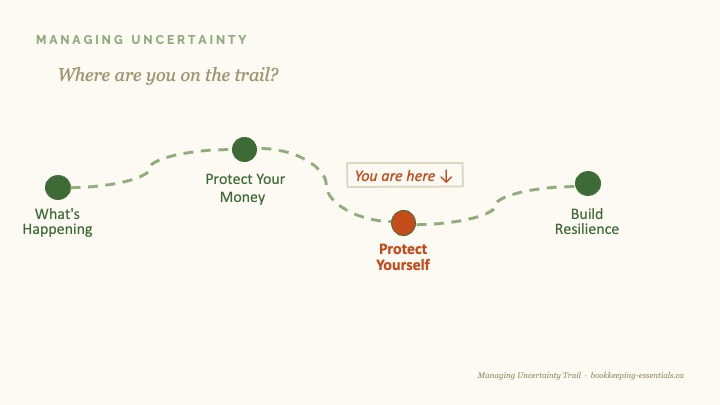 You are at the 3rd rest stop on the journey to Managing Uncertainty.
There are two big tents to choose from for your stay.
Break the emotional habits. Build the practical habits.
Financial stress doesn't just show up in your bank balance. It shows up at 3 a.m. when you can't sleep. It shows up when you avoid opening your accounting software. It shows up in the knot in your stomach every time an invoice goes unpaid or an unexpected expense hits.
Here's what most self-employed business owners don't realize. Financial stress isn't just a money problem. It's a habit problem.
It's the habit of avoiding your numbers. The habit of making decisions from fear. The habit of putting your business survival ahead of your personal financial security. The habit of saying "I'll deal with retirement later" while later keeps getting further away.
When you're operating from these habits, you make reactive decisions instead of strategic ones. You say yes to the wrong clients. You underprice your services. You put off the planning that would actually help you.
But here's the good news. Habits can be changed. Let me say that again ... habits can be changed.
This hub brings together everything you need to build new habits that move you from financial stress to financial success ... not just in your business, but in your life.
Before we go further, a quick note about how this page works.
If you landed here because you are stressed about your finances, I am not going to rush you straight to a checklist. In my experience, people make better decisions when they understand why they are doing something, not just what to do.
So we are going to take this one step at a time.
I will explain my thinking as we go. You can decide what fits your business, what does not, and where you want to begin. That is not wasted time. That is how you build better habits and make steadier decisions under pressure.
If a phrase stops you along the way, the Terms Used appendix at the end of this page explains the series-specific language for each series in the wider Managing Uncertainty pillar.
Before I lay out the starting options, let's take a look at what financial stress is really costing you.
The Real Cost of Financial Stress Habits
Beyond the obvious money problems, financial stress doesn't just affect your bank account. It:
- Drains your energy and kills your creativity.
- Leads to avoidance of the very tasks that would help you.
- Creates a cycle where small problems snowball into bigger ones.
- Puts your retirement at risk while you focus on today's fires.
- Threatens your health and relationships.
Sound familiar? You're not alone. And breaking these patterns starts with recognizing them for what they are usually ... learned behaviours you can unlearn.
Choose Your Path: Which Habit Needs Breaking First?
Start with the pattern that is creating the most pressure in your business right now.
You do not need to solve all of this at once. You need one starting point ... the one that is costing you the most energy, clarity, money, or peace of mind.
Each path below focuses on one habit that may be creating unnecessary pressure. Choose the one that feels most familiar, not the one you think you should tackle first.
The Avoidance Habit
Dreading your bookkeeping? Ignoring financial reality? Your feelings about money are driving your decisions more than you realize.
The Isolation Habit
Trying to figure everything out alone? Want to stop spinning your wheels?
The Crisis Habit
Constantly firefighting NSF fees and cash flow emergencies? Want some breathing room?
The Business First Habit
Always reinvesting in the business while your personal savings suffer?
The Someday Habit
Would you let an employer skip your retirement contributions every month? Then why are you doing it to yourself?
The I'll Work Forever Habit
No exit plan because you can't imagine stopping?
Not sure which habit needs your attention first? Use this checklist to confirm where the biggest pressure points are.
Your Financial Protection Checklist
Use this checklist to see where you already have protective habits in place ... and where you may need to build a few.
- ▢ I have a separate emergency fund for personal expenses (3-6 months).
- ▢ I'm contributing regularly to my TFSA, RRSP, or both.
- ▢ I have a support system (accountant, bookkeeper, or mentor).
- ▢ I understand my true business costs and profit margins.
- ▢ I have a plan for retirement that doesn't rely solely on selling my business.
- ▢ I make financial decisions from clarity, not panic.
- ▢ I open my accounting software without dread.
If you checked fewer than 3 boxes, you're not alone ... and this is exactly why this series exists. Each unchecked box represents a habit you haven't built yet. Not a failure. Just an opportunity.
Building New Habits: The Emotional AND Practical Work
Here's something that gets overlooked. Your business success means nothing if your personal finances are a mess. You can have a profitable business and still reach retirement age with nothing saved. You can work yourself to exhaustion and have nothing to show for it.
Breaking old habits and building new ones requires work on both fronts. The emotional work helps you understand the habits driving your decisions.
The practical work helps you put better habits in place so the change lasts.
The Emotional Work
Stop avoiding. Start addressing. These pages help you understand why you do what you do ... and how to do something different.


The Practical Work
Stop reacting. Start planning. These pages give you practical frameworks and strategies to make better habits stick.


There is one more piece to protecting yourself that often gets missed. If you are running on empty, even good financial habits are harder to maintain.
Beyond the Spreadsheet ... Because Life Happens
Self-Care Habits: Because You Can't Show Up If You're Running On Empty
You are the most important person in your business! Consistent habits beat perfect routines every time, but consistency requires showing up. And you cannot show up if you are burnt out, skipping meals, or running on stress and caffeine.
That is why Beyond The Spreadsheet ... Because Life Happens is woven throughout this site. Protecting yourself is not just about your finances. It is about making sure you are still standing to enjoy what you are building.
So here's a work-life balance suggestion to give you the energy boost you need to tackle your books this year:
Dr. Will's Breakfast Smoothie | A Meal In A Glass
Great For When You Are Working On A Deadline!
It is 7:45 a.m. The kids need to be out the door in fifteen minutes. Breakfast is not happening. You have a noon meeting and lunch is not looking promising either. By 2:00 p.m. you will be running on caffeine and good intentions, and your books are not going to get done.
This is exactly when Dr. Will Bulsiewicz's breakfast smoothie earns its place in your morning. He is a gastroenterologist, author of Fiber Fueled, and this is his personal go-to.
Throw these four ingredients in the blender and blend until smooth.
- blueberries (fresh or frozen) - [1/2 cup - prebiotic fibre]
- bananas (fresh or frozen) - [1/2 banana - prebiotic fibre]
- soy milk - [1 cup - prevents inflammation to improves bone health]
- broccoli sprouts - [handful or 2 - reduces inflammation]
To bring it to the next level, Dr. Will says you can top it off with some ground flaxseed (for the fiber) and walnuts (for the healthy fats). He encourages you to customize the smoothie to your taste and nutritional goals.
My comments are in [square brackets] as Dr. Will didn't give amounts.
More Lifestyle Tips >>
- Make this the year you incorporate self-care into your daily routine so you are around for your family!
- Chair yoga stretches reduce negative impacts of sitting for extended periods
- Seated calf pumps: your secret weapon
- The habit of daily walking and other lifestyle habits
- The emotional side of money management
- Strategies for juggling endless responsibilities
Your Next Step: Pick One Habit to Change
You don't have to overhaul everything at once. In fact, trying to change too much too fast is itself a habit that leads to burnout and giving up.
Instead, pick the one habit causing you the most stress right now and start there. Each page in this series gives you actionable strategies you can implement immediately ... small changes that compound over time.
Ready to move from stress to success? Choose your starting point above and build your first new habit today.
Appendix: Terms For The Navigating Change Series
You do NOT need to know all this already. If a term keeps popping up and you’re not fully sure what it means, start here. This quick reference will help you make sense of the language used across the series.
Series 1: What's Happening - Trade and Tariff Terms
- Tariffs: Taxes on imported goods. For small businesses, they often show up as higher costs because unlike GST/HST, it is not revenue neutral (i.e. there are no input tax credits).
- De minimis: A rule for free shipping of low-value shipments. In practical terms, it used to help small packages cross the border without duties.
- CUSMA review: The 2026 review of the trade agreement between Canada, the U.S., and Mexico. It matters because trade rules affect pricing, sourcing, and planning. The U.S. refer to it as USCMA.
- Trade rules in flux: A fancy way of saying the business rules around cross-border trade are still changing, which makes planning harder.
Series 2: Protect Your Money - Cost and Cash Flow Terms
- Input costs: The cost of the things you need to buy to run or deliver your business. That can include raw materials, inventory, parts, packaging, software, or tools.
- Direct costs: Costs tied directly to what you sell. If you make or sell products, this could be materials, inventory, packaging, or shipping. If you provide services, it could include subcontractor time or project-specific tools.
- Indirect costs: Costs that support the business overall but are not tied to one specific sale. Think internet, bookkeeping software, insurance, office supplies, rent, or utilities.
- Operating costs: The ongoing costs of keeping the business running day to day. This includes both direct and indirect costs, depending on the business.
- Packaging and shipping costs: The cost of getting a product safely to the customer. That can include boxes, mailers, tape, labels, postage, courier charges, customs, brokerage, and related fees.
- Service business costs: If you do not sell physical products, your business still has inputs. These may include software, phone, internet, mileage, subcontractors, professional fees, or equipment needed to deliver your work.
- Pricing pressure: What happens when your costs go up but you cannot easily raise your prices without risking lost sales or unhappy customers.
- Margins: The portion of your sales income left after covering direct costs. When costs rise and prices stay the same, margins shrink. Or said another way, if your costs go up faster than your prices, your margins get squeezed.
- Cash flow: What money is coming in, what money is going out, and whether the timing works in real life. A business can look profitable on paper and still run into trouble if cash is tight because profit does not equal cash flow.
- Liquidity: How much cash, or near-cash, you have available to pay bills, taxes, payroll, and surprises without scrambling.
- Perfect Bookkeeping: A phrase sometimes used loosely to mean having flawless, audit-ready records at all times. On this site it means something more specific. Accuracy on what matters most. All sales reported. Major expenses captured and traceable. Tax obligations tracked. The goal is not perfection on every trivial transaction. It is accuracy where accuracy protects you.
Series 3: Protect Yourself - Stress and Money Terms
- Financial stress: The mental and emotional strain that comes from money pressure, uncertainty, debt, or not knowing what happens next.
- Avoidance: Putting off looking at your numbers, opening bank statements, dealing with bookkeeping, or making decisions because the stress feels too heavy.
- NSF fee: 'Non-sufficient funds' fee. A bank fee charged when a payment goes through but there isn’t enough money in the account to cover it. The payment is often charged back to your account.
- Personal financial stability: Having enough order in your own personal finances that business decisions are less likely to come from panic, fear, or desperation.
- Profit Margins: The same thing as margins. See Series Two.
- TFSA: Tax Free Savings Account
- RRSP: Registered Retirement Savings Plan
Series 4: Build Resilience - Systems and Record-Keeping Terms
- Financial resilience: Your ability to keep operating, adapt, and make steady decisions even when conditions stay uncertain and do not 'go back to normal'.
- CRA-ready: Organized enough that your reports are easier to file correctly and easier to defend if the Canada Revenue Agency ever asks questions. It focuses specifically on Canadian tax compliance and supporting your income and expense claims and other reporting obligations. It increases the likelihood of any future audits going smoothly.
- Audit-ready: Having organized, traceable financial records that are easy for an outside party to review, verify, and follow. It means your books are in good order for general compliance, review, or audit purposes.
- Audit-proofing: The proactive process of keeping clear, organized, well-documented records so your transactions are easy to verify and support if CRA or another regulator asks questions. It helps reduce stress, mistakes, and risk by creating a solid audit trail.
- Habit-based system: A way of managing your business that works with what you already tend to do naturally, instead of fighting it. For example, if you already check your bank balance to make money decisions, the system builds on that habit by separating your money into different accounts or “buckets” so you can see what is available for each purpose. It greatly reduces decision fatigue in a day.
- Solopreneur: A self-employed business owner running a business mainly on their own, with little or no staff.
Navigating Change Articles
Tracking Canada's Trade Deals | What's Signed, What's Not
"Tracking the trade deals and economic opportunities Carney has brought home from his travels abroad."
How Tariffs Impact Canadian Small Business | An Introductory Primer
A practical primer on how tariffs impact Canadian small business. Covers basics, compliance, cash flow effects, and actionable steps to dealing with tariffs.
Why Canada Is Changing Trade Strategy | What Solopreneurs Need to Know
Confused by Canada's changing trade strategy? I was too. Here's what PM Carney is doing, why it matters, and how it affects your business.