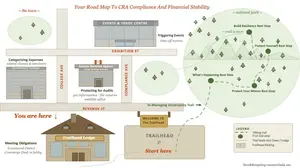
- A Roadmap To CRA Compliance and Financial Stability
- Small Business Tax Obligations
- CRA Compliance Filing: Start Here
Compliance Filing Basics
For Self-Employed Canadians
Start Here When CRA Filing Feels Overwhelming

By L.Kenway BComm CPB Retired
This is the year you get all your ducks in a row! Start by starting ... and keep it simple. Consistency beats perfection.
Published April 15, 2026
WHAT'S IN THIS ARTICLE
Choose Your Path | Why Compliance Matters | What Is Tax Compliance Really? | Compliance Foundation | Before You File | Common Filing Situations | Build The Habit | When It Snowballs
NEXT >> How To File Returns and Pay Taxes Online
BACK TO >> Small Business Tax Obligation Command Centre
RELATED >> How To Make A CRA Payroll Payment Under Protest
 Filing Returns and Paying Taxes Can Be Done After Regular Business Hours
You decided to file online this year instead of mailing paper returns. Smart move. You log into My Business Account, work through the return, and hit submit. Then CRA asks onscreen when you are going to make your payment. The amount owing is more than you can pay and you do not have it sitting in your account right now. Your stomach drops. What do you do?
Situations like this are more common than you think, and they are manageable if you know your options. Once you start filing regularly, other situations come up too. A tax slip arrives in the mail after you already filed. You realize you missed a deduction. You are not sure if you filed correctly in the first place. This page is your starting point for all of it.
Where Are You Right Now?
- I am brand new to this and do not know where to begin.
Start with getting your CRA portal access set up.
Jump to >> Your CRA Portal Access - I understand compliance basics but need to get organized before my next filing.
Start with getting your numbers and payment method ready.
Jump to >> Get Organized Before You Open The Portal - Something has already gone wrong and I need to fix it now.
Start with the situation that matches yours.
Jump to >> Common Filing Situations - I am behind on my books and filing feels impossible right now.
Start with the system that meets you where you are.
Jump to >> When It Snowballs
You Didn't Start Your Business To Become A Tax Expert, But Here's The Reality
Here's something you probably didn't expect when you started your business. To be a successful business owner, you need to have a basic understanding of compliance tax. It's the Big Surprise!
Even if you "don't do taxes" (I heard this a lot from bookkeepers and business owners) as a small business owner, you or your bookkeeper need to understand the basics to prepare a CRA compliant set of books.
What does 'tax' encompass? It's not just income tax. Think GST HST PST, payroll taxes, excise tax, income tax installments ... these are all forms of tax so ... SURPRISE, you do "do tax"!
And here's what matters most. As a small business owner in Canada or as a home-based bookkeeper, YOU know small business tax planning doesn't happen when you file (or not!) your mandatory tax compliance returns ...
Tax planning happens EVERY day throughout the year.
Every time you decide how to categorize an expense (or just lump them into Miscellaneous). Every time you track your mileage (or don't). Every time you keep (or don't keep) a receipt. These small daily decisions either put money in your pocket, leave it on the table, or sometimes toss it out the window!
Good compliance practices don't happen on any one particular day.
They aren't an event; they are a HABIT.
By taking the time to learn and know the rules ... by taking the time to learn fast efficient rituals, YOU CAN do all the little things needed to LEGALLY reduce your net taxable income.
SMALL daily habits CAN move mountains.
Mediocrity is a choice;
it’s not always made consciously, but it is still a choice.
Gary Ryan Blair
Here's what I think separates struggling self-employed business owners from successful ones. The successful ones don't treat compliance as a low priority. They integrate bookkeeping and tax planning thoughtfully and intentionally into their daily operations. It's NOT an afterthought but a part of how they run their business operations.
That's what this site helps you do.
Ready to build that foundation? Start with what you need to have in place before you ever open the CRA portal.
Small Business Compliance Responsibilities
You Are Aiming For Consistency Not Perfection
 Is it ever the right time to get all your ducks in a row? Start now. No more excuses.
Okay, let's get serious for a moment. Does anyone, ANYONE ... know what tax compliance really is?
Owning and operating a business in Canada means you have some legal responsibilities. Canada Revenue Agency (CRA) requires regular reporting of Canadian sales tax, payroll taxes, and income taxes. Each province and territory has their own tax related requirements as well. These regulations collectively are often referred to as government compliance requirements.
Tax compliance returns and payments should be filed on time. Failure to report and remit by due dates leads to costly penalties and interest charges. This site provides information about essential bookkeeping habits for audit ready books you need to know to put more money in your pocket and avoid these charges (i.e., stop flushing your hard earned money down the toilet!).
Isn't it the perfect time to get all your ducks in a row? If not now, when? At first it seems overwhelming. But once you go through the process a few times, you will be able to relax and find it is just another part of your paperwork routine in operating your business.
So where do you actually start? Right here. Before you file anything, make sure the following two things are on your radar and you've put these three items in order.
Compliance Foundation
The strongest compliance foundation is built BEFORE anything goes wrong. That comes down to two things ... (1) knowing your deadlines, and (2) keeping your records organized.
1. Know Your Deadlines Before They Know You
Penalties start the day after the deadline, not when CRA sends you a letter. By the time that letter arrives, the damage is already done. Each return type has its own due dates and missing even one can be an expensive mistake.
🦆 Duck Note
One more thing that is catching people off guard. Beginning in 2026, CRA's notifications / letters default delivery method is your My Account or My Business Account portal. Yes, you heard that right ... CRA has gone digital. Here's how it works ...
An email alerts you that mail is waiting. You must go to your portal to retrieve the notification. CRA considers the notice delivered the day it LANDS in your portal whether or not you have opened it. Your response deadline starts immediately. Check your portal regularly. Better yet, calendarize a monthly check so nothing slips through.
Best practice. Don't guess. Know your dates.
Find Them Here >> CRA Filing Deadlines Summary
2. Your Records Are Your Protection
 This could be you ... chilled out
CRA can audit you up to three years (four for corporations) back under normal circumstances ... longer if they suspect misrepresentation. Your records are your only defence. No records means no deductions, no matter how legitimate the expense was.
The CRA standard is to have all business records available for seven years (six years from the end of the last tax year to which they relate). That includes receipts, invoices, bank statements, contracts, and mileage logs. If you're still managing paper in a shoebox, envelopes, an accordion folder, your wallet or purse now is a good time to rethink that. I use and recommend LedgerDocs as a simple, affordable online filing cabinet that gives you organized, searchable records AND offsite backup.
🦆Duck Drill
Set up one folder, physical or digital, for each tax year. Every receipt, invoice, bank statement, and contract goes in before the end of the month it belongs to. LedgerDocs makes the digital version of 'capture' easy. You send it and it all lands in the 'In' box for you to process. Seven years of organized records means processing your 'InBox' throughout the month to maintain the system once it is running.
Read More >> Business Record Retention in Canada
Learn More >> Data Storage Considerations and Electronic Signatures
Before You File Anything, Get These In Order
Whether you are filing income tax, GST HST, or payroll remittances, showing up to the CRA portal unprepared wastes time and increases errors. Here is what to sort out before you open the portal for any return.
Step 1. Your CRA Portal Access
If you have not already done this, it is step one before anything else.
Do you have a My Account or My Business Account set up? If not, you will need your social insurance number or business number, your most recent notice of assessment, and a registration method such as a CRA security code or sign-in partner through your bank.
Have you registered for online mail? Once you do, CRA correspondence is legally considered delivered when it arrives in your mail portal, whether you open it or not. Check your portal at least monthly. This is not optional, it is protection.
Is your business number correct and linked to all the accounts you need, GST HST, payroll, corporate if applicable? A mismatch causes filing headaches that are entirely avoidable.
🦆 Duck Drill
Log into your portal right now and confirm your access is working, your online mail is activated, and your business number is linked to the correct accounts. Five minutes now saves real stress at filing time.
Read the full guide >> How to File and Pay Taxes Online Using the CRA Portal
Step 2: Know Your Numbers, Get Organized Before You Open The Portal
CRA's portal does not do your bookkeeping for you. You need to arrive with your numbers ready. What that looks like depends on the return you are filing.
- For income tax: your total income from all sources, your expense categories totalled, and all slips received including T4A, T5, and investment slips. Yes, even the ones that arrive late. Personal income tax (which includes your T2125 tax form) is filed through NETFILE, CRA's online filing system for individuals. You will need NETFILE-certified tax software to use it. Your other option is to use a tax preparer to file it for you.
More >> T2125 Line-by-Line Guide - For GST HST: your total taxable sales for the period and your input tax credits. These need to be reconciled to your books before you file, not after.
More >> How To File A GST HST Return - For payroll remittances: your remittance amounts for CPP, EI, income tax withholdings and employer taxes reconciled to your payroll records for the period. Discrepancies between what you remitted and what CRA expects are a common trigger for follow-up PIER (pensionable and insurable earnings review) reports.
More >> Payroll Remittance Form PD7A
Are you wondering, “Do I need to register for anything yet with the CRA?”
Check Out >> Registrations And Thresholds (Quick Summary)
🦆 Duck Drill
Keep your books current throughout the year, not just at filing time. How? Start here ... this is an easy habit to start. I suggest scanning your receipts as you go, right there in the store or restaurant, with notes attached. When CRA comes knocking, everything is organized and accessible. No scrambling. No missing receipts.
Learn more >> Capture Everything
Step 3. Your Payment Method Set Up In Advance
This is the one that catches people off guard, exactly like the scenario at the top of this page. Interac Debit was discontinued by CRA in 2024. Knowing your payment options before you are staring at a balance owing screen removes a last-minute scramble.
Your two most reliable options are direct bank transfer through your financial institution using CRA's account number, or pre-authorized debit set up through the portal itself. I personally love the post-dated pre-authorized payment feature. It lets you schedule payments when you file or anytime through My Account, My Business Account or My Payment.
If you bank online, your financial institution likely already has CRA listed as a payee. Search for Canada Revenue and confirm which account type you need, personal income tax, GST HST, or payroll source deductions. Set it up before your next filing deadline.
🦆 Duck Drill
Before your next filing deadline, confirm your banking information is current in the portal (so refunds can be directly deposited to your account) and your payment method is set up and tested. Do not wait until you are holding a balance owing to figure this out.
Read the full guide >> How to Pay Taxes Online Using the CRA Portal
Common Filing Situations
These explainers cover compliance and filing situations Canadian solopreneurs sometimes run into once they start the filing process. If you're dealing with one of these right now, start here.
Situation 1. How to File Returns and Pay Taxes Online

Small business owners often catch up on their paperwork at night after a long day. Filing and paying online makes an efficient use of your time. Modern technology means more and more small businesses can transition easily and affordably to a paperless system. What's holding you back?
CRA's online portal has improved dramatically since the early 2000s and is now a near-total digital experience.
- You can file returns, check balances, view notices, and make payments anytime, including evenings and weekends.
- Once you register for online mail, CRA correspondence is legally considered delivered whether you open it or not. Check your portal monthly.
- The post-dated preauthorized payment feature lets you schedule payments when you file or anytime through My Account or My Business Account.
- Interac Debit was discontinued in 2024. Direct bank transfer remains the most reliable payment method.
Ready to get started? Read the full guide >> How to File and Pay Taxes Online Using the CRA Portal.
Situation 2. What To Do When You Can't Pay Your Taxes Owing

The most important thing to know. File all your returns on time even if you cannot pay the full amount. Filing on time protects you from expensive late-filing penalties that can reach 17% of the balance owing before interest is even calculated.
Three key actions to take right now:
- File on time even if you cannot pay in full.
- Pay as much as you can manage when you file.
- Arrange a payment plan proactively with CRA for the rest by phone or their new online service Manage Balance.
Yes, you will still owe interest on the unpaid balance. But interest is far less painful than late-filing penalties.
Learn exactly what to do, what the penalties are, and how to make sure this does not happen again.
Read More >> What to Do When You Can't Pay Your Taxes
Situation 3. You Didn't Report All Your Income

Got more tax slips after you filed? Realized you missed a deduction ... or worse didn't report your side hustle income? Made an error on your return?
Don't panic ... AND don't ignore it. CRA allows you to request changes to an assessed return, and in many cases it's the right thing to do before CRA finds the discrepancy themselves. The penalty for unreported income can hit 20% on the second occurrence. Catching it yourself first is always the better option.
Read More >> Why Amend Your Tax Return? Avoid CRA Interest Charges
Build the Habit
The three situations above are reactive. Something has happened and you need to act. But most of those situations are preventable. The next section is about what happens when things have already piled up, and how to get back on solid ground without starting over.
When It Snowballs
Here is something nobody tells you about filing your taxes or 'renovating' your bookkeeping system. You start with one thing and three other things roll out from behind it. You go to file and realize your books are behind. You go to catch up your books and realize your receipts are missing. You go to find your receipts and realize your filing system is a shoebox.
That snowball is not a sign you are doing it wrong. It is actually a sign you are getting organized, the system is shifting, becoming flexible to match your work style, and the gaps that would have cost you money or caused you confusion are surfacing now instead of later. It's BETTER to find them now.
The catch-22 is real. If your books are behind you cannot file accurately. But if you do not file on time you face expensive late-filing penalties. There is no perfectly clean answer to that. Filing on time with your best numbers (not made up numbers, not unreported income) is almost always better than not filing. CRA would rather you file and amend later than not file at all.
I liken the process to ... the dishes are stacked in the sink because nobody unloaded the dishwasher, so you cannot put the dirty dishes in ... yet.
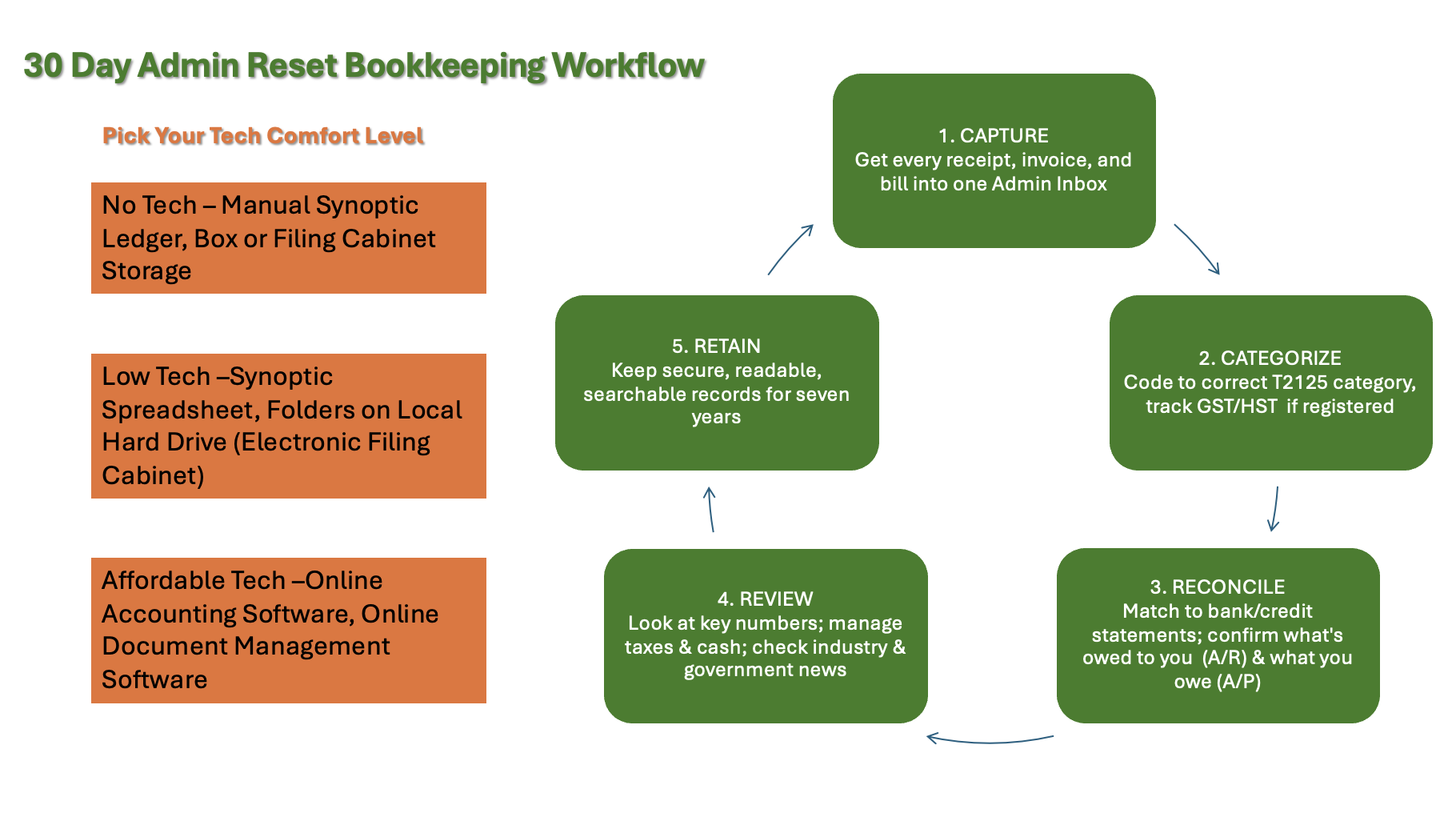
If you are regularly behind at filing time, your back office system needs to change. That is a bigger conversation but you do not have to figure it out alone. The 30-Day CRA Admin Reset meets you where you are and builds simple routines over four weeks that become as automatic as your morning coffee.
Here's an overview of the process:
Start Here >> I'm Months Behind On My Books And Terrified Of An Audit
For now, start where you are. Get your portal access set up. Get your payment method confirmed. Set your deadline reminders. Scan your receipts as you go. Small daily habits really do move mountains, even when the mountain looks like a boulder sitting at the bottom of a hill.
Other Essential Compliance Articles
Why Amend Your Tax Return? Avoid CRA Interest Charges
Unreported income? Canadian solopreneurs, learn how to amend your return before CRA finds the error and avoid a costly 20% penalty. Act fast.
Payroll Tax Filing Deadlines | Canadian Bookkeeping
The CRA requires regular reporting and remitting of source deductions withheld from employee pay cheques. Find your payroll tax filing deadlines here.
Tax Compliance for Small Business | Canadian Filing Deadlines
Tax compliance filing deadlines for small business owners - GST HST returns, payroll remittances, income tax returns and instalment payments, subcontractors