- A Roadmap To CRA Compliance and Financial Stability
- Navigating Change
- Resilient Self-Employed Finances
- Financial Resilience Fundamentals 101
Financial Resilience Fundamentals 101
A Practical Foundation for Canadian Solopreneurs Under Pressure

By L.Kenway BComm CPB Retired
This is the year you get all your ducks in a row! Start by starting ... and keep it simple. Consistency beats perfection.
Published March 17, 2026
WHAT'S IN THIS ARTICLE
Introduction | Why Fundamentals Matter | 6 Fundamentals | 5 Rules | 1 Must Know Number | 4 Mistakes | Starting Point | Terms Used
RESILENCE SYSTEM SERIES
Beginning of Series >> Building Financial Resilience for Canadian Solopreneurs (3 pillars habit-based system)
Next in Series >> Fundamentals Friday - Take Back Control with a Weekly Money Check
 Step back, get altitude, and make the next move with clarity.
Who This Page Is For / Not For
If you’re already self-employed and the business feels wobbly ... cash is inconsistent, costs are up, and CRA obligations are harder to stay ahead of ... this page is for you.
This page is for you if:
- You’re self-employed in Canada (freelancer, solopreneur, sole prop, incorporated owner-operator) and the last few years have left you tired, not lazy.
- You’re not looking for 'growth hacks'. You want stability, clarity, resilience, and fewer unpleasant surprises.
- You’ve been running your business on instinct and effort, and you’re ready to add a simple foundation under it.
- You’re quietly wondering if your current business model still makes sense ... and you want a practical way to check without blowing everything up.
This page is NOT for you if:
- You’re not yet in business and you want a startup checklist (this page assumes you already have revenue and expenses).
- You want a quick tactic to double revenue this month.
- You’re looking for a complex business plan template or an MBA-style framework.
- You’re not willing to look at what’s actually true in your numbers, your invoices, and your client mix.
If you’re behind in your back office work (no judgement)
- If you don’t have the numbers yet (books behind / receipts everywhere)
Start here: Set up the Simple Cash Management System so you can actually pull your key numbers each week. - If your numbers exist but the business feels 'wobbly' (unclear offer, inconsistent cash, creeping exhaustion)
Start here: Business Fundamentals 101 (this page). Skim the Section TOC and start with the one that hits you in the gut.
Then, when you’re ready to maintain what you fixed:
- Use Fundamentals Fridays. It turns the foundation into 8 numbers every week + a CEO Monthly Pulse Dashboard.
And remember ... just breathe ... you've got this!
Introduction
 You are at the 4th rest stop on the journey to Managing Uncertainty.
Welcome to the Building Resilience Rest Stop!
There is a business advisor named Jenifer Bartman who shows up occasionally on the CBC News Network weekend business panel. If you have caught one of those segments, you may have noticed the same thing I did. She does not talk in buzzwords. She talks in fundamentals. Practical ones. The kind that actually hold up when things get complicated.
And right now ... things are complicated.
If you have been self-employed for any length of time in Canada, you have lived through a lot in the last five or six years. The pandemic. Supply chain chaos. The inflation that followed. And now a full-scale trade war with our biggest trading partner, with tariffs landing on Canadian businesses while the CUSMA agreement gets reviewed under pressure. It has been one thing after another, and a lot of solopreneurs are running on fumes.
When things get this uncertain, there is a temptation to either freeze up completely or start chasing every new tactic you read about online. Bartman's approach is the middle path. Go back to the fundamentals. Not because they are exciting, but because they are stable. They give you something solid to stand on when the ground keeps shifting.
That is what this article is about.
I want to walk you through the core fundamentals that I think every Canadian solopreneur needs to have under them ... not as theory, but as a practical working foundation. Whether you are just starting out or you have been at this for years and are starting to feel the cracks, these are the things worth getting right.
Why Fundamentals Matter More Than Tactics Right Now
Here is something worth sitting with for a moment.
Most business advice is written for stable conditions. Grow your audience. Optimize your funnel. Scale your offer. That advice is not wrong exactly, but it assumes a baseline of stability that a lot of Canadian solopreneurs simply do not have right now.
When you are dealing with rising costs, unpredictable demand, and a trade environment that seems to change every few weeks, tactics are not your problem. Your foundation is your problem.
Bartman's thinking, as I understand it, keeps coming back to this idea ... successful small businesses are not necessarily the fastest growing ones. They are the most resilient ones. And resilience is not something you bolt on later. It is something you build into the foundation from the start.
So before we talk about growing anything, let's make sure the foundation is solid so you can be resilient in these uncertain times.
The 6 Fundamentals Every Solopreneur Needs
(And a quick way to check each one in your own business)
Section TOC - jump to the one you need most today:
- Know what problem you actually solve
- Understand your numbers personally
- Have a clear business model
- Think beyond this week
- Stay adaptable
- Don’t try to do everything alone
- Key Takeaway
Successful entrepreneurs spend more time understanding the market and opportunities than focusing only on internal tasks. Here's the 6 core fundamentals they watch:
1. Know What Problem You Actually Solve
When things get expensive and uncertain, 'nice-to-have' work gets postponed. 'Must-have' work survives. So the real question isn’t “What do you sell?” It’s what painful, specific problem do you reliably remove for a specific kind of client?
Desk Check (10 minutes)
Open
- Your last 10 invoices (or e-transfers)
- Your last 10 inquiry emails/DMs
Look for
- Which jobs repeat without you pushing for them?
- Which jobs turn into “can you also …"? That's called scope creep.
- Which clients pay fast and don’t argue price?
🦆 Solo CEO Move (today)
Write one sentence
- “I help [type of client] solve [painful problem] so they can [result].”
- Then sanity-check it with your invoices. If 7 out of 10 invoices don’t match that sentence, that’s not failure ... it’s a signal your offer drifted and needs tightening.
The Fundamental Lesson
In a squeeze, 'must-have' outcomes get funded; 'nice-to-have' tasks get cut. Your offer has to map to a pain that survives pressure. That means knowing what problem your customer actually has, how painful that problem is, and whether they are actively looking for a solution.
2. Understand Your Numbers Personally
You don’t need to become a bookkeeper. You do need a handful of numbers you can pull up without a full Saturday and three spreadsheets. Because in disruption, the danger isn’t 'low revenue' ... it’s making decisions without knowing whether you have room to breathe.
I want to introduce you to cash runway because it is probably the single most important number for a solopreneur to know.
Quick Definition
Cash runway is how long your business can keep operating if no new money comes in. It’s simply the cash you have available divided by what your business spends in a month.
Why It Matters
Runway matters because it tells you how much time you have to make good decisions. When your runway is short, every surprise turns into pressure. When it’s long enough, you can think, adjust, and protect what you’ve built without panicking.
For Example: If you have $10,000 available and your business burns about $2,000 / month in must-pay expenses, you’ve got about 5 months of runway.
Desk Check (15 minutes)
Open
- Your business bank account (and credit card, if you use it for business)
- Your bookkeeping software dashboard (if you have one), or your last 2 months of transactions
Look for
- This month’s money-in (rough is fine)
- This month’s must-pay money-out (the stuff that goes out even if you don’t work)
- Cash sitting in the bank today (the available balance ... the money you could spend today without touching your tax/GST set-aside)
🦆 Solo CEO Move (today)
Calculate two numbers and write them at the top of a sticky note:
- Weekly must-pay total
- Monthly must-pay total (weekly x 4 is fine as a first pass)
- Cash runway = cash on hand ÷ average monthly outflow
That’s it. You’re not 'doing accounting'. You’re giving yourself a real-time oxygen gauge.
The Fundamental Lesson
You can’t steer what you won’t measure. A few simple numbers (runway, must-pay outflow) beat perfect reports you look at once a year.
You do need to understand the difference between revenue and profit, between profit and cash, and between being busy and being financially healthy. Those are not the same things, and confusing them is one of the most common ways small businesses get into trouble.
3. Have a Clear Business Model
A 'business model' can sound like a big MBA thing. At desk-level, it’s whether your business answers four questions without you having to talk in circles:
- Who do I help?
- What outcome do I create for them?
- How do I get paid (and does it actually cover my costs)?
- Why would they choose me instead of another option (or doing nothing)?
If those answers are fuzzy, income tends to be fuzzy too. Not because you’re doing anything wrong, but because the business is harder to buy from.
Desk Check (10 minutes)
Open
- Your website services page (or your last proposal)
Look for
- “What do you do?” written as tasks (bookkeeping, admin, consulting) vs outcomes (clean books before tax time, predictable cash, CRA-ready records)
- Any place where you’re offering 8 different things to 8 different people
🦆 Solo CEO Move (today)
Write your 'four answers' in a single paragraph a client could understand. If you can’t do it in 5–6 sentences, you’ve found tomorrow’s work. Simplify the offer, not your personality.
The Fundamental Lesson
Clarity is a resilience (and growth) engine. If it’s hard to explain, it’s hard to buy. It tends to show up as inconsistent income, clients who do not value your work the way you think they should, and a constant feeling that you are working hard but not getting ahead. Sharpening the model often fixes these issues.
4. Think Beyond This Week
Short-term thinking is normal in solo work. You finish the project, you find the next project.
But in the current environment, “I’ll deal with it later” gets expensive fast ... especially with costs, demand shifts, and CRA obligations accumulating quietly in the background.
Desk Check (20 minutes)
Open
- Your calendar
- Your last 3 months of invoices
Look for
- Client concentration: what % comes from your top 1–2 clients?
- Seasonality: are there predictable “thin” months?
- Pricing pressure: are you discounting more than you used to?
🦆 Solo CEO Move (today)
Do a quick stress-test. “If revenue dropped 20% for 60 days, what would I cut first ... and what would I protect?” Write the answer down. That list becomes your 'not panicking later' plan.
The Fundamental Lesson
Resilience comes from seeing risk early (client concentration, seasonality, pricing pressure) while you still have choices. You need to develop the habit of looking ahead far enough to see trouble coming and plan your response before it arrives.
5. Stay Adaptable (as a habit, not a personality trait)
Adaptability isn’t 'be optimistic'. It’s noticing change early and making small adjustments before you’re forced into big ones. For Canadian solopreneurs right now, that can mean adjusting pricing, tightening scope, shifting who you serve, or changing the mix of what you offer.
Desk Check (15 minutes)
Open
- Your last 5 quotes/proposals (or client conversations)
Look for
- Where you’re regularly over-delivering for free
- Which services are hardest to deliver (time, energy, admin burden)
- Which jobs create the most stable cash (repeat work, retainers, pre-pay)
🦆 Solo CEO Move (today)
Pick one 'adaptability lever' to test for 30 days:
- Raise rates on new work only
- Add a clear scope boundary line to proposals
- Replace one custom task with a standard package
Small test. Clear start date. Clear review date.
The Fundamental Lesson
Adaptation works best as small, timed experiments ... clear lever, clear window, clear review ... so you’re changing by design, not by panic.
You build adaptability by staying close to your market, watching what is changing, and being willing to make decisions before you are forced to.
For a Canadian solopreneur right now, that might mean looking at whether your income is too tied to one sector that is being hit by tariffs. Or whether there is a way to serve clients who are actually benefiting from the current trade disruption. Or whether a digital product or a different service mix might make your income more stable.
6. Do Not Try to Do Everything Alone
Solo doesn’t have to mean isolated. The most fragile setup is when every decision lives in your head, nothing is written down, and you don’t have a place to reality-check your numbers or choices.
This doesn't mean automatically 'hire staff'. It’s building a small support loop so you’re not making high-stakes calls in a vacuum.
Desk Check (10 minutes)
Open
- -Your contacts list / email
Look for
- Who you can ask a 'quick, slightly embarrassing' money question without feeling judged?
- Who you can call when a CRA letter shows up and your brain goes blank?
🦆 Solo CEO Move (today)
Write a 3-person support list:
- Money person (bookkeeper/accountant or trusted peer)
- Business peer (someone also self-employed)
- 'Calm brain' person (mentor/friend who keeps you steady)
If you don’t have one of these yet, that becomes an actual resilience task ... not a nice-to-have.
The Fundamental Lesson
Isolation increases financial risk. A simple support loop (money, peer, calm brain) prevents preventable bad decisions. You do not need a board of directors. You need a few good people in your corner.
And honestly ... that is part of why this site exists. If you are working from home in Canada and you need a plain-language resource you can come back to when you have a question, that is exactly what I built this for. No sales pitch. No upsell. Just practical information from someone who has been in the bookkeeping world for a long time and remembers what it felt like to not know what you did not know.
Bookmark it. Use it. That is what it is here for.
Key Takeaway
Reading fundamentals is helpful. But what actually changes your stress level is catching drift early, before it turns into a problem.
If you want a simple rhythm to keep these fundamentals from drifting again, use Fundamentals Friday. It turns 'being on top of things' into a 30-minute weekly check ... 8 numbers, one short observation, and a monthly CEO Pulse dashboard.
Here’s the full routine ((including what each number is really telling you and what to do when something looks off).
The 5 Rules That Separate Stable Businesses From Struggling Ones
Section TOC - jump to the one you need most today:
- Cash Flow Is Not the Same as Profit
- Know Your Numbers Before Someone Else Has To Tell You
- Validate Before You Invest
- Focus Beats Doing Everything
- Build Systems Before You Need Them
Beyond the six fundamentals, there are five more practical rules that I think are worth building into how you operate. These are the things that tend to separate solopreneurs who stay stable from the ones who are constantly scrambling.
These aren’t motivational rules. They’re operating defaults. The kind that keep you out of trouble when the environment is noisy and your energy is limited.
Rule 1. Cash Flow Is Not the Same as Profit
A business can be profitable on paper and still run out of money. That’s not rare. It’s one of the most common ways solopreneurs get blindsided.
Desk Check (10 minutes)
Open
- Your bank balance today
- Your list of bills due in the next 7–14 days
Look for
- Do you have enough cash to cover what’s about to leave your account, even if one client pays late?
🦆 Solo CEO Move (today)
Write down two numbers:
- Cash in bank today (available balance)
- Cash going out in the next 14 days
If #2 is uncomfortably close to #1, your move this week is not 'work harder'. It’s tighten terms (deposit / pay-on-delivery) or speed collections on one overdue invoice.
The Fundamental Lesson
Profit tells you whether your business model is working. Cash flow tells you whether your business can survive right now. You need both, but cash flow is the more urgent one.
Watch what is coming in, watch what is going out, and know how much runway you have.
Rule 2. Know Your Numbers Before Someone Else Has To Tell You
There is a version of running a business where you hand everything to your accountant once a year and hope for the best. That version works fine until it doesn't.
Desk Check (15 minutes)
Open
- Your last 2–3 months of bookkeeping (or bank statements if you’re behind)
Look for
- Is revenue trending up, flat, or down?
- Are expenses creeping up without you consciously choosing that?
🦆 Solo CEO Move (today)
Pick one number you will personally check every week for the next month:
- cash runway, OR
- accounts receivable (total + oldest invoice age), OR
- weekly must-pay expenses.
Put a recurring calendar reminder for the same day/time.
The Fundamental Lesson
Early awareness buys you options. Late awareness forces damage control. If you can spot those things early, you have options. If you find out at tax time, you are often just managing the damage.
Rule 3. Validate Before You Invest
Before you spend money or time on a new offer, tool, market, rebrand, or pivot, run a quick reality test first. This is especially important when cash is tight and certainty is low.
Desk Check (20 minutes)
Open
- Your last 5 client conversations or inquiries
- Your last 5 invoices
Look for
- Evidence of demand (people asking for the thing)
- Evidence of willingness to pay (not just compliments)
🦆 Solo CEO Move (today)
Write (and answer) these three questions in plain language:
- What problem does this solve?
- Who is already paying to solve this problem?
- Can I deliver it profitably for your business without burning out?
If any answer is fuzzy, your next move is a tiny test, not a full build.
The Fundamental Lesson
Proof beats hope. Small tests beat expensive reversals.
Rule 4. Focus Beats Doing Everything
One of the most consistent patterns in struggling small businesses is trying to serve everyone feels safer. In practice it creates exhaustion, unclear messaging, and inconsistent cash.
Desk Check (15 minutes)
Open
- Your service list (website or proposals)
- Your calendar from the last 2 weeks
Look for
- How many different 'types of work' are you doing?
- Which ones create the most stress per dollar?
🦆 Solo CEO Move (today)
Choose ONE focus constraint for the next 30 days:
- one primary service, OR
- one primary client type, OR
- one primary delivery format (package instead of custom)
Write it down, and treat it like a temporary operating rule.
The Fundamental Lesson
Focus reduces admin load, improves delivery, and makes pricing easier.
Start with one clear offer, one target client, one primary market. Get that working before you add complexity. Especially right now, when your energy is already being stretched by external pressures, focus is not a limitation. It is a competitive advantage.
Rule 5. Build Systems Before You Need Them
When things get busy or stressful (and they will), you don’t rise to the occasion ... you fall to your systems. If there are no systems, everything becomes last-minute and expensive. This is the one most solopreneurs put off until they are overwhelmed.
Desk Check (15 minutes)
Open
- Your receipts / inbox / bookkeeping “to file” pile (whatever your reality is)
Look for
- Are you capturing transactions weekly, or reconstructing them monthly/annually?
🦆 Solo CEO Move (today)
Pick ONE system to install or restart this week:
- a weekly admin capture ritual (Money Monday),
- a simple cash allocation rhythm (Treasury Thursday),
- or a weekly CEO check (Fundamentals Friday).
One system. One start date. Keep it boring.
The Fundamental Lesson
Systems don’t create perfection. They prevent preventable chaos.
Basic systems for tracking your finances, managing your clients, and handling your admin do not need to be complicated. But they need to exist. Because when things get busy or stressful, which they will, you want to be running on habits and systems rather than making everything up as you go.
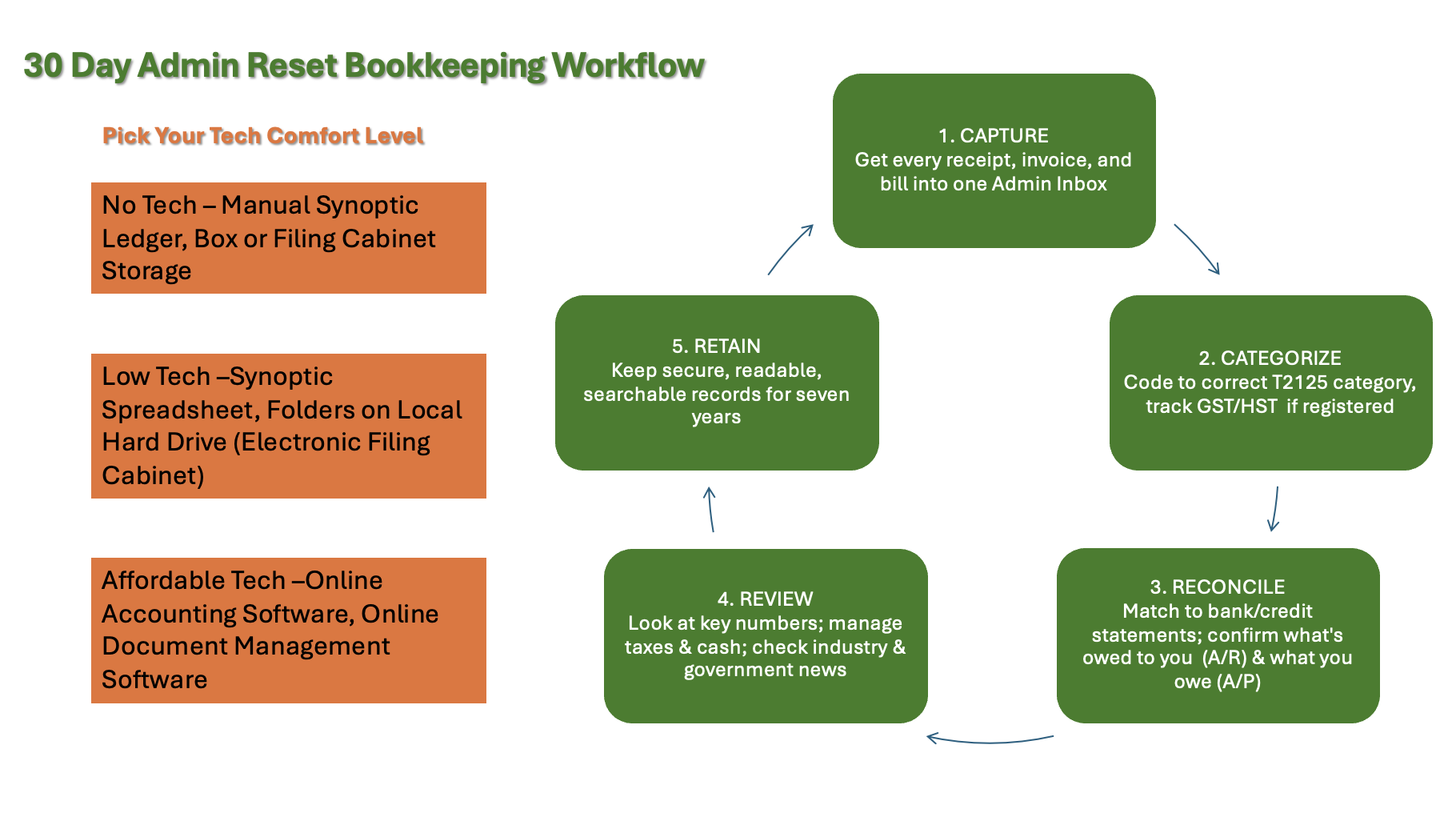
The 30 Day Reset walks you through the 5 step admin flow from inbox to audit-ready. Here is an flowchart of the process:
Key Takeaway
Each of these 5 rules comes with a lesson and a Solo CEO Move, because knowing is not enough. The rules only work if you act on them.
If you are short on time, start with Rule 1 and Rule 5. Know your cash position before someone else has to tell you, and start at least one simple ritual (see the list) before you need it. Those two alone will keep you out of most of the trouble that quietly sinks small businesses.
The One Number To Check Every Week
If I could give every Canadian solopreneur one weekly habit right now, it would be this ... know your cash runway.
What is Cash Runway?
Cash runway is how long your business can keep operating if no new money comes in. It’s not a forecast. It’s not a vibe. It’s a simple reality check.
Why is Cash Runway Important?
In times of high inflation or market instability, weekly checks ensure the business can survive sudden disruptions, such as a major client's late payment or unexpected expenses. Right now, with the trade environment as unpredictable as it is, that cushion is not a luxury. It is a buffer between you and a very stressful situation.
How To Calculate Your Cash Runway (5 minutes)
- Cash available today $10,000
Use your available bank balance. Don’t count money you’re holding for GST, HST, PST income tax set-asides as 'spendable'. - Monthly must-pay outflow $2,000
This is the stuff that goes out whether you have a good week or a bad one ... software, insurance, phone, loan payments, bookkeeping, and other FIXED commitments. - Calculate Your Runway is #1 divided by #2
Cash runway = $10,000 ÷ $2,000 = 5 months of runway
Why this matters (the practical reason)
Runway tells you how much time you have to make good decisions. Short runway creates urgency, and urgency creates expensive choices (discounting, taking bad-fit work, ignoring tax set-asides, using debt as a default). Adequate runway gives you breathing room to adjust without blowing up what you’ve built.
🦆 Solo CEO Move (this week)
Pick one lever to improve runway by even a small amount:
- Speed up cash in like deposits, shorter payment terms, one overdue invoice follow-up
- Slow down cash out like cancel or pause one non-essential subscription, renegotiate one expense
- Protect cash like rebuild or restart your tax set-aside so CRA doesn’t become a surprise bill later
The Fundamental Lesson
Check this number every week. Not because it will change dramatically week to week, but because the habit of checking it keeps you aware. And awareness is what lets you take action early, when you still have options, rather than later, when you are already in trouble.
Most advisors suggest that a stable small business should aim for somewhere between six and twelve months of runway. That gives you enough cushion to handle a slow period, a lost client, an unexpected expense, or a disruption in the market without going into crisis mode.
Key Takeaway
If you want a full weekly rhythm (not just one number), Fundamentals Friday turns this into a simple weekly CEO ritual. 8 numbers, one observation, and one Solo CEO Move, every Friday in under 30 minutes.
The 4 Mistakes That Catch Solopreneurs Off Guard
(And how to spot them early, before they cost you a season)
Section TOC - jump to the one you need most today:
- Confusing Revenue With Success
- Ignoring What the Market Is Telling You
- Avoiding the Financial Details
- Trying to Figure It All Out Alone
Even with the best intentions, there are four patterns that tend to trip people up in the first few years of self-employment. They are worth knowing about because they are all very common and very avoidable.
Pattern 1. Confusing Revenue With Success
Revenue going up feels like 'I'm fine'. Sometimes you are. But revenue growth can actually mask serious problems if your costs are growing faster, your margins are shrinking, or you are taking on more work than you can sustain.
How it shows up
You’re busy, money is coming in … and somehow you’re still anxious every time a bill hits.
Desk Check (10 minutes)
Open
- Last month’s revenue (rough)
- Last month’s total expenses (rough)
Look for
- Did expenses rise at the same speed as revenue?
- Did you take on work that cost you way more time than you priced for?
🦆 Solo CEO Move (today)
Pick ONE recent job and do a 5-minute debrief:
- What did I charge?
- Roughly how many hours did it actually take?
- Would I happily do that exact job again at that price?
If the answer is no, your next move is to tighten scope or adjust pricing on the next quote.
The Fundamental Lesson
Revenue is vanity until you know what it costs you to earn it. The number that actually tells you whether your business is healthy is not revenue. It is what is left after you have paid for everything it took to earn that revenue. Find out how to calculate your monthly 'nut'.
🦆 Your Solo CEO Move (For Today)
Write down your weekly must-pay expenses. Rent or mortgage on your workspace, software subscriptions, loan payments, insurance, phone... whatever goes out whether you work or not.
That list is your survival number. It is the floor your business has to clear before anything else matters. Most solopreneurs have never written it down in one place. Once you do, a lot of other financial decisions get simpler.
Pattern 2. Ignoring What the Market Is Telling You
Markets talk quietly first ... slower replies, more hesitation, more price sensitivity, more “we’re going to wait".
How it shows up
You find yourself explaining harder, discounting more, or feeling like clients have 'changed'.
Desk Check (15 minutes)
Open
- Your last 10 inquiries or sales conversations
Look for
- How many went quiet?
- What objections repeat?
- Are people asking for smaller, safer versions of what they used to buy?
🦆 Solo CEO Move (this week)
Send 3 short check-in messages to good past / current clients:
“I’m doing a quick market check. What’s changed for you this quarter? What are you being more careful about spending on?”
Then adjust ONE thing based on what you hear (offer, terms, packaging, messaging).
The Fundamental Lesson
Staying close to the market prevents surprise droughts.
It is easy to fall in love with your own business idea or your current way of doing things. It is harder to stay honest about whether the market is responding the way you hoped.
If clients are slow to commit, if you are discounting more than you used to, if the work that used to come easily is now harder to find ... those are signals worth paying attention to. They are not necessarily signs that something is wrong. But they are worth investigating rather than explaining away.
Pattern 3. Avoiding the Financial Details
Avoidance feels like relief. Then it turns into a CRA surprise, a cash crunch, or a “how did it get this messy?” moment.
How it shows up
You don’t look until you have to. You tell yourself you’ll catch up 'when it’s quieter'.
Desk Check (10 minutes)
Open
- Your business bank account
- Your receipts / inbox where financial paperwork lands (you've got one, right?)
Look for
- Are you behind by weeks or months?
- Do you know what you owe (GST/HST, tax set-asides), or are you hoping?
🦆 Solo CEO Move (today)
Choose the smallest possible win that creates traction:
- Scan 10 receipts, OR
- Download your last twelve months of bank and credit card statements, OR
- Create one 'CRA Funds' savings account and move a starter set-aside into it.
Small win. Same time next week. That’s how the avoidance breaks.
The Fundamental Lesson
Regular, small attention prevents large, painful cleanups.
Most people who go into self-employment do it because they are good at something. Bookkeeping and financial management are rarely that thing.
But avoiding the financial side of your business does not make it simpler. It just means problems develop quietly until they are big enough to be impossible to ignore. A little regular attention to your numbers prevents a lot of year-end panic.
If you avoid your business finances, you can use the RAIN method to figure out a way through this block.
Pattern 4. Trying to Figure It All Out Alone
Isolation doesn’t just feel bad. It increases business risk because you lose perspective and delay decisions.
How it shows up
You’re stuck in your head, second-guessing, or waiting too long because you don’t want to bother anyone.
Desk Check (5 minutes)
Open
- Your phone contacts or email
Look for
- Do you have a “money person,” a peer, and a calm outside brain?
🦆 Solo CEO Move (this week)
Make one reach-out:
- Book a quick call with your bookkeeper / accountant, OR
- Ask a peer, “Can I run one decision by you?”, OR
- Join one local / online group where people actually talk numbers and reality.
One connection beats a month of spinning.
The Fundamental Lesson
Support is a stability tool, not a luxury.
We touched on this in the fundamentals section, but it is worth repeating here because it shows up so consistently as a factor when things go sideways.
Self-employment can be isolating. And when you are isolated, your own perspective is the only one you have. That makes it easy to stay stuck in patterns that are not working, simply because there is no one around to offer a different view.
Find your people. Even informally. Even just one or two other self-employed people you can talk honestly with. It makes more difference than most solopreneurs expect.
Key Takeaway
If you want a simple way to catch these mistakes early, Fundamentals Friday is your guardrail. 8 numbers, one observation, one Solo CEO Move ... every week.
Getting Your Ducks In A Row: A Simple Starting Point
If this article has surfaced a few things you want to look at more closely, here is a simple place to start.
Three questions worth sitting with this week:
- Do I know my weekly must-pay expenses ... the ones that go out whether I work or not? That number is your survival floor. Everything else gets built around it.
- Do I have a tax set-aside habit? In Canada, there is no employer withholding tax for the self-employed. What you owe to the CRA accumulates quietly all year. Setting aside a percentage of every payment you receive, before you spend anything else, is one of the most important financial habits towards resilience you can build.
- Do I check my cash position on a regular schedule? Not just when something feels off, but as a standing weekly habit?
These three habits will not solve everything. But they will give you a foundation that makes everything else easier to manage.
Terms Used in This Resilience Series
These are the terms used specifically in this resilience series. For broader context used across the wider 'Managing Uncertainty' section, see the main terms guide.
Series Definitions
Financial Resilience: the capacity to absorb financial shocks and bounce back through sound, proactive money management.
Solo CEO Move: signals a single, specific action needed that moves one number in the right direction. Watch for the 🦆 throughout this series.
Tax Set-Aside: reserve a portion of income for tax obligations
Cash Management Strategies
NSF Fees Canada 2026: New $10 Cap | Cash Management for Solopreneurs
In March 2026, NSF fees capped are at $10 for Canadian personal accounts. What's changing, why it affects your business, and how to avoid these fees entirely.
Understanding Your Investment Tax Slips | T3 T5 T5008
Guide to T3, T4, T5, T5008 tax slips for Canadian business owners. Understand salary vs dividends, investment income, and why retirement planning matters.
Safe And Simple Payment Methods | Canadian Solopreneurs
Use safe and simple payment methods to send and receive online payments in Canada. How do Canada's digital banking processes work?