- A Roadmap To CRA Compliance and Financial Stability
- The Concierge Desk
- The Backgrounder Library
- What the Recession Headlines Aren't Telling You
What Recession Headlines Aren't Telling You
A Backgrounder Article | Drawer E: The Economy - What's Behind The Headlines

By L.Kenway BComm CPB Retired
This is the year you get all your ducks in a row! Start by starting ... and keep it simple. Consistency beats perfection.
Published June 2, 2026
WHAT'S IN THIS ARTICLE
Introduction | Why the pushback? | What caused the dip in the first place? | What does this mean for your small business? | Why this matters for your bookkeeping
RETURN TO >> How Tariffs Impact Canadian Small Business
BACK TO >> The Backgrounder Card Catalogue
 When is a technical recession not a recession?
Yes, Canada meets one technical recession definition. No, that does not automatically mean a broad-based economic collapse. Here’s what the headline leaves out.
Statistics Canada reported Friday, May 29th that GDP in the first quarter of 2026 fell 0.1 per cent on an annualized basis, following a revised one per cent annualized decline in the fourth quarter of 2025. Two consecutive quarters of negative growth meets the most commonly cited definition of a technical recession ... the same one Canada last hit during the COVID-19 pandemic in 2020. [Global News]
But here's the thing. Economists at three of Canada's largest banks are urging caution before drawing sweeping conclusions from a headline number they say significantly overstates the economy's weakness. Their argument is the math of annualizing a tiny quarterly dip makes a minor stumble look like a serious fall. [Wealth Professional]
Bank of Canada Senior Deputy Governor Carolyn Rogers put it plainly: "Two quarters of annualized contraction in GDP does meet one definition of a recession, but simply the fact that you have to put the term 'technical' in front of it sort of tells you that you really need to look past that one indicator."[ Global News]
"This government's been in the process of laying the foundations for a stronger, more resilient, more independent Canadian economy ... That process is settling in during that time as we make major investments, major changes to how the government operates, how we do major projects, how we have new trade agreements with other countries."
Prime Minister Carney
June 2, 2026
Why the pushback?
Several economists point to what the headline number misses:
- Population is shrinking, not growing. On a per-capita basis, real GDP actually increased 0.2 per cent in the first quarter of 2026, as Canada's population declined for a second consecutive quarter. RBC's Nathan Janzen called this a meaningful distinction for how individual households actually experience the economy. [Dominionlending]
- The contractions weren't steady. The last two quarterly contractions were mostly due to real GDP declines in October and March. Growth was either flat or modestly positive for the four months in between. That's not the broad, sustained deterioration economists typically associate with a true recession. [Yahoo!]
- Consumers kept spending. Household spending rose 0.4 per cent, led by financial services and food purchases — a sign that Canadian households, while under pressure, have not stopped participating in the economy. [CMP]
- A rebound may already be underway. Bradley Saunders, North America economist at Capital Economics, said the "trade-induced" technical recession was likely already over, as rising oil and gas activity means the second quarter of 2026 is tracking for a solid rebound. StatCan's early estimates for GDP in April call for a sharp rebound of 0.4 per cent growth in the month as the mining, quarrying and oil and gas sectors returned to growth. [BOE Report]
What caused the dip in the first place?
Business capital investment fell for a fifth consecutive quarter, which economists largely chalked up to uncertainty surrounding U.S. tariffs. It's hard for many firms to draw up spending plans without clarity on what that trade relationship will look like. U.S. tariffs contributed to declines in Canadian goods exports, a pullback in business investment, and job losses in tariff-exposed sectors. The underlying economy, in other words, was not collapsing on its own ... it was reacting to external trade uncertainty. [BNN Bloomberg, Government of Canada]
What does this mean for your small business?
The "technical recession" label will likely dominate headlines for the next few weeks, and your clients and customers will have seen it. Dan Kelly, president of the Canadian Federation of Independent Business, acknowledged that many small business owners have put investments on hold due to uncertainty in the economy and rising costs. Most businesses "are basically in a holding pattern, they're treading water, hoping for brighter days," he said. If that describes your situation, you're not alone ... and you're not wrong to feel uncertain. But the data does not yet paint the picture of a broad economic collapse. The recession, such as it is, was narrow, tariff-driven, and may already be reversing. [CBC News]
Why this matters for your bookkeeping
Maybe not yet, but check your trends. For most solopreneurs, this does not require immediate action. But it does warrant a quiet look at your own numbers.
Start by looking at:
- Revenue Trend
Pull your last three to six months of revenue. Are sales flat, drifting down, or already softening? - Cost Trend
Now look at your costs ... supplies, subscriptions, any imported inputs. Are they creeping up even as revenue holds steady? That squeeze ... sales flat, costs up ... is often one of the earliest financial signals of a broader slowdown. - Accounts Receivable Trend
Next, check your receivable timing. Are payments arriving later than they used to (maybe they have a cash flow shortage or changed their payable policy to slow down payments), or are receivables starting to stretch (are your customers taking longer on average to pay than usual)?
If your numbers look fine, file this under "watching the landscape." If you're already seeing the squeeze, that's your signal to revisit your pricing, tighten your variable costs, and make sure your receivables are coming in on time.
Recessions, technical or otherwise, reward the business owners who look at their numbers honestly ... and early. They rarely appear suddenly in small business books. They usually show up first as small shifts in timing, margins, and spending patterns before they become obvious in revenue.
Sources
- Statistics Canada, Gross Domestic Product by Income and Expenditure Accounts, Q1 2026, May 29, 2026
- The Canadian Press, Economists pour cold water on recession talk after Canada's economy stalls in Q1, published by Yahoo Finance / BNN Bloomberg / CTV News, May 29, 2026
- Bradley Saunders, North America Economist, Capital Economics, analyst note, May 29, 2026
- Nathan Janzen, Assistant Chief Economist, RBC Economics, analyst note, May 29, 2026
- Carolyn Rogers, Senior Deputy Governor, Bank of Canada, public statement, June 2026 - reported by Global News
- Dan Kelly, President, Canadian Federation of Independent Business, as quoted by CBC News, May 29, 2026
- Government of Canada, Spring Economic Update 2026 - Economic and Fiscal Overview, budget.canada.ca, April 28, 2026
- Dominion Lending Centres / Dr. Sherry Cooper, Canada enters a technical recession as Q1 2026 GDP fell by 0.1% on an annualized basis, May 29, 2026
- Wealth Professional, Big bank economists push back on Canada recession label despite back-to-back GDP contractions, May 30, 2026
Other Backgrounder Articles
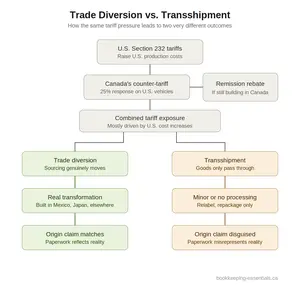
Cheating the System: How Transshipment Works
Not every rerouted shipment is trade diversion. Learn how transshipment works, why businesses do it, and how Canada's rules tell the two apart.
What Is a Certified Professional Bookkeeper? And Why It Matters
What does CPB mean after a bookkeeper's name? Find out what the CPB designation tells you about a bookkeeper's knowledge, standards and current standing.
What Triggers Tax Audits in Canada?
We'll look at three issues that might trigger audits in Canada plus recent CRA audit projects and their findings