- A Roadmap To CRA Compliance and Financial Stability
- The Concierge Desk
- The Backgrounder Library
- Why GST/HST Was Introduced
Why Was GST Introduced in Canada?
A Backgrounder Article | Drawer C: Sales Tax - How It Works

By L.Kenway BComm CPB Retired
This is the year you get all your ducks in a row! Start by starting ... and keep it simple. Consistency beats perfection.
Published May 9, 2026 | Originally published on Bookkeeping-Essentials.com in 2010
WHAT'S IN THIS ARTICLE
Introduction | Why Canada Introduced GST | Where HST Fits In | Is GST/HST a Regressive Tax? | Is GST Actually Good Tax Policy? | Why Does This Matter To A Small Business Owner?
RETURN TO >> GST HST In Canada
BACK TO >> The Backgrounder Card Catalogue
 Good records, accurate tracking, and a GST/HST refund ... that’s a nice combination.
I don't know about you, but I like to understand the why of things. It helps me better understand the issue. I think it's also important for a business owner to understand the Canadian sales tax system because it may influence your prices, especially if you import-export goods and services.
So why was GST/HST introduced in Canada?
Why Canada Introduced GST
Canada adopted the GST in 1991 to replace the manufacturers' sales tax, which taxed the total resale value of a manufacturer's goods, not just the value added.
GST is a value-added tax (VAT). That means it is designed to tax final consumption, while businesses generally recover the GST/HST they pay on eligible purchases through input tax credits. In other words, the consumer is the one who ultimately pays the tax.
This was a significant change. It meant the tax was no longer hidden in the price of products upstream and downstream in the supply chain. GST made the tax more visible and reduced the problem of tax being built on top of tax which is called cascading.
Where HST Fits In
The HST came later, when some provinces combined their provincial sales tax with the federal GST into one harmonized tax.
The idea was to simplify administration and move toward a more consistent value-added tax system in participating provinces. Like GST, HST is designed so that input tax credits flow through the system and make the tax neutral for most commercial activities.
Is GST/HST a Regressive Tax?
VAT is often seen as a regressive tax ... if it is not combined with other tax strategies.
Wikipedia describes a regressive tax as one that “imposes a greater burden (relative to resources) on the poor than on the rich” and that there is an inverse relationship between the tax rate and the taxpayer’s ability to pay.
Given that definition, I find it interesting that VAT would be considered a regressive tax in Canada.
I have always thought of GST as a fairer tax than income tax because, unlike income tax, everyone has to pay it ... rich or poor. The rich have more discretionary income, so they spend more and pay more tax. The poor and working poor have less to spend, so they pay less.
When you factor in other tax strategies in place in Canada, such as:
- zero-rated and exempt goods and services, which include many basic needs; and
- the GST/HST credit (now called the Canada Groceries and Essentials Benefit) lower-income taxpayers receive if they file a tax return,
GST/HST in Canada is applied mainly to discretionary income that the consumer has control over. That makes the tax more progressive than regressive, especially when compared to income taxes.
It is also a transparent tax. It is not hidden in the price of products the way some older sales taxes were. For me, that visibility matters.
Is GST Actually Good Tax Policy?
If you are still not convinced, it helps to know that GST is not just a political compromise. It is broadly considered good tax policy.
And I think that matters.
It matters because a well-designed tax raises government revenue without creating as much distortion in the economy. It is more transparent, more neutral for business, and less likely to hide tax in the final price of goods and services. For a small business owner, that matters because you are the one dealing with the pricing, the bookkeeping, and the compliance.
If you are interested in a more theoretical debate on GST HST in Canada, I have found two articles of interest.
The first is a great article written by David Sherman, a leading GST tax expert in Canada and a tax lawyer. One of the points in his introduction explains that the United States is one of the few countries in the world that does not have a value-added tax. Later in his article, in the section entitled Tax-Included Pricing Is Better for the Economy, Mr. Sherman explains that tax experts and economists almost universally agree that GST is a "good" tax because it is broad-based, more neutral for business, and less damaging to the economy than many other forms of taxation. He also argues that how the tax is presented to consumers matters, because tax-included pricing may make the system work better economically.
The article is on page 839 of the October 2009 Canadian Tax Journal publication titled Policy Forum: Tax-Included Pricing for HST-Are We There Yet?. It is available at
https://www.ctf.ca/common/Uploaded%20files/Documents/CTJ%202023/2009_CTJ_4_2009_20ctj_204_20839.pdf.
Jack Millar authors the second article. He wrote an article for the Canadian Tax Foundation presenting his case for maintaining tax-exclusive pricing. His point is that showing the tax separately helps create greater tax awareness and political accountability, because taxpayers can clearly see how much tax they are paying.
The article is titled Policy Forum: The Case for Maintaining Tax-Exclusive Pricing. It is available at:
https://www.fcf-ctf.ca/common/Uploaded%20files/Documents/PDF/2010ctj/10ctj1-millar.pdf.
I think these two articles are useful because together they show that the debate is not really about whether GST is a sound type of tax. It is more about how the tax should be presented to consumers.
Why Does This Matter To A Small Business Owner?
Understanding why GST/HST was introduced helps explain why it works the way it does today. It replaced a tax that was embedded invisibly in the cost of goods, distorting prices and putting Canadian businesses at a disadvantage.
The new system was designed to be transparent, traceable, and neutral for businesses. That design is exactly why registrants can claim input tax credits, why accurate bookkeeping matters, and why the tax is structured to land with the consumer rather than accumulate along the supply chain.
For small business owners, that history is not just background. It explains the rules you are working with right now.
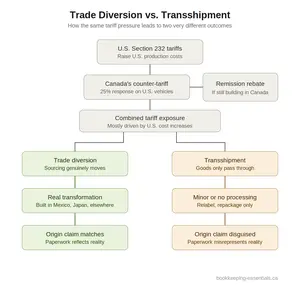
One more thing worth noting in the current environment. If you import goods from the United States, tariffs are calculated on the duty-paid value of those goods, and GST/HST is then calculated on top of that. Unlike GST/HST, tariffs are not recoverable through input tax credits. They are a straight cost. That means when tariffs go up, your landed cost goes up, and so does the GST/HST you pay at the border. Understanding how the two interact matters more right now than it did a few years ago.
Other Backgrounder Articles
What Is a Certified Professional Bookkeeper? And Why It Matters
What does CPB mean after a bookkeeper's name? Find out what the CPB designation tells you about a bookkeeper's knowledge, standards and current standing.
Can Canadian Solopreneurs Use Excel for Bookkeeping?
The best bookkeeping system isn't the fanciest; it's the one you use to stay organized, meet CRA rules, and clearly understand your business's financial health.