Capital Asset Purchases: What Your Business Owns and Uses Up
Learning to Read Your Financial Statements

By L.Kenway BComm CPB Retired
This is the year you get all your ducks in a row! Start by starting ... and keep it simple. Consistency beats perfection.
Published October 8, 2026
WHAT'S IN THIS ARTICLE
Introduction | What Is A Capital Asset? | Where Does It Appear In Your Financial Statements? | Why Does This Matter To Your Business? | How It Connects To Other Financial Statements | Getting Curious About What's Next | Building The Full Picture | 3 Questions To Ask About Capital Assets | Takeaway | 🦆 Solo CEO Move | Buy This Lesson
BACK TO >> Small Business Bookkeeping
 Office furniture and equipment are capital assets, not expenses.
In A Nutshell
- A capital asset is not an expense. When a business buys something it will use for more than one year, the cost goes on the Balance Sheet as an asset, not on the Profit & Loss Statement as an expense.
- One question helps decide. Will the business use this for more than one year? A box of pens gets used up and is expensed. A computer or a desk lasts for years and is capitalized.
- A capital asset is used over time, so its cost is recognized over time. That is what depreciation does. Each period, part of the cost becomes an expense, and the asset's book value shrinks by the same amount.
- Depreciation is a non-cash expense. The cash left the bank account once, on the day of the purchase. Recording depreciation later doesn't pay for the asset again, and it doesn't touch the bank balance.
- The books and the tax return can use different timelines. The books reflect a realistic estimate of the asset's life. CRA uses its own Capital Cost Allowance (CCA) rules to determine the tax deduction.
- This lesson follows Alex, a home-based web designer, through the purchase of computer equipment, office furniture, and small tools ... from the decision to buy, to the bookkeeping entries, to what Alex learned.
- This lesson plus bonus tools is available for sale at $14.95 CAD at the end of the lesson.
A capital asset isn't an expense, even though the money leaves your bank account like an expense does.
This lesson follows Alex, a home-based web designer, through the other side of the $5,000 equipment loan from the Loans and Debt lesson: the computer equipment it bought, and what that purchase does (and doesn't do) to the books over time. We'll also walk through the purchase of office furniture, paid for from a set-aside account instead of borrowed money.
We will see how Alex decided the computer equipment was worth buying. Then follows the asset itself, from the moment the funds leave the bank account, gets recorded in the books, to the moment Alex sees how it affects all three of the business's financial statements.
If you need help as you work through this lesson … you don't have to figure everything out on your own.
Start with the purchase receipt and any warranty or asset documentation you received. They tell you what you bought, when, and for how much. For the bookkeeping side, follow the related Bookkeeping-Essentials articles linked throughout this lesson. If your situation is more complicated…for example, mixed personal/business use, trade-ins, or questions about CCA classes for tax…this is where your accountant or bookkeeper can help.
During the last year, Alex adopted Bookkeeping-Essentials.ca's Money Monday routine. Every Monday, Alex clears the admin inbox and catches up the books. There is one thing Alex keeps noticing after buying the new computer equipment. The $5,000 is sitting right there on the Balance Sheet, unchanged, months after the purchase. It isn’t getting used up the way a $200 supply purchase would. Alex wants to understand why the balance doesn’t change, and what's supposed to happen to it over time because computer equipment often needs to be updated every 3-5 years.
1. What Is A Capital Asset? What Kinds Are There?
Current Day:
It's Monday morning and Alex is doing the Money Monday routine. Alex looks at the Computer Equipment line on the Balance Sheet, still sitting at $5,000 three months after the purchase. Is
that right? Shouldn't it have gone down (or up) by now, the same way the loan balance has?
Alex remembers Julie (CPA) mentioning that not everything the business buys is an expense
right away. Some purchases are capital assets. Alex isn't entirely sure what separates a capital
asset from a regular business expense, so digs a little further and finds there are really two
questions that decide it.
- How long will it be used?
A capital asset is something the business expects to use for more than one year. It gets classified differently than an expense because it provides a benefit to your business over time. Good examples are equipment, office furniture, machinery, software licenses that span years. A box of pens gets used up in weeks. A computer gets used for years. - How much did it cost?
Even something that lasts years might be small enough to expense outright. For simplicity, many self-employed businesses use the CRA's CCA class 12 (currently at $500) as their capitalization threshold for bookkeeping. This keeps the books simpler and can make tax time easier. You can also establish a different threshold if it makes sense for your business, as long as you can justify the threshold (materiality principle) and apply it consistently. We'll chat about this in more detail later in the lesson.
Alex's computer equipment cleared both tests easily. Alex knows from chatting with peers
that this particular professional grade computer should last 5-7 years (not the usual 3-5 years), the monitor and ergonomic keyboard 7-10 years, and the ergonomic mouse 3-5 years. The $5,000 spent is well above any reasonable expense threshold.
Alex also learns capital assets come in more than one flavour:
- Tangible capital assets are physical things you can touch: computers, furniture & fixtures, machinery, vehicles.
- Intangible capital assets have no physical form but still provide value over time: software licenses, patents, trademarks.
- Capital assets that don't lose value the same way: land is the classic example. Unlike a computer, land isn't depreciated, because it doesn't wear out or become obsolete the way equipment does.
Alex's purchase was straightforward ... tangible, physical. It’s definitely going to lose value over
time as newer models come out and the hardware ages.
A key question Alex needs to ask before buying assets for the business is “How will this
purchase benefit my business over time?”.
Takeaway
- A capital asset is something the business buys to use, not resell.
- The business expects to use it for more than one year.
- Unlike an expense, a capital asset’s cost is allocated over the years it is used.
- The cash leaves the bank account when the asset is purchased.
- The full cost does not appear on the Profit and Loss Statement all at once.
2. Where Do Capital Assets Appear In Your Financial Statements?
Flashback: Three months earlier
The computer equipment was purchased three months ago. Alex flashes back to the day of
the purchase. At that time, Alex could see the retail store withdrawal in the business bank account
and opened the accounting software to record it.
Alex pauses before coding the entry. The money spent is showing in the accounting software’s
bank feed. Julie had given Alex a one-page tip sheet about best practices for using bank feeds
when they first started using the accounting software. Alex pulls it out and looks at the bank
feed handout from Julie.
Once Alex reads the best practice handout, realizes the purchase should have been booked the day the purchase was made (or the first bookkeeping date that came up like Money Mondays). So Alex sets to post the entry not relying on the bank feed. Unsure how to record this entry, Alex pulls up the Bookkeeping-Essentials.com cheat sheet.
What was received?
Looking at the chart, Alex asks, "What was received?" Computer equipment.
Alex sees on the cheat sheet that equipment is an asset and increases the business’s Capital Assets on the balance sheet. It does not affect the Profit & Loss Statement. It will help the business earn income over multiple years, not just this month.
Where did the money for the purchase come from?
Alex's next question, per the cheat sheet, is "Where did the money come from?" The money came from a cash withdrawal from the bank account.
Cheat sheet for debits and credits
| Normal Account Balance |
Item* | DEBIT Entry What was received |
CREDIT Entry Where it came from |
Colour Accounting** |
|---|---|---|---|---|
| Debit (+) | Assets | Increases Account | Decreases Account | Green |
| Credit (-) | Liabilities | Decreases Account | Increases Account | Yellow |
| Credit (-) | Equity | Decreases Account | Increases Account | Yellow |
| Credit (-) | Sales Revenue | Decreases Account | Increases Account | Yellow with Purple outline |
| Debit (+) | Expenses | Increases Account | Decreases Account | Green with Purple outline |
*Examples of where various items belong on the balance sheet:
- Assets : Cash, Bank, Short/Long Term Investments, A/R, Prepaids, Fixed/Capital Assets
- Liabilities: A/P, Tax Payable, Accruals, Short/Long Term Loans
- Equities: Retained Earnings, Common Shares, Contributed Surplus
**If you learned colour accounting, I've added the colors as a references. In color accounting, debits are green and credits are yellow while purple represents profit/income statement.
Reprinted with permission from Bookkeeping-Essentials.com
Now Alex has enough information to book the purchase of equipment. In the accounting software, Alex adds a new account called Computer Equipment, a long-term asset, to the chart of accounts. Then Alex opens the expense window and books the computer purchases to the new Computer Equipment account. (I’ll have a tip for you later in the lesson about setting up this account.)
Alex's business is located in Alberta so 5% GST will apply. Alex is a GST registrant meaning Alex will be able to claim the input tax credits on the sales tax paid making it a neutral tax.
Debit Capital Asset: Computer Equipment $5,000
Debit GST Payable $250
Credit Cash: Bank Account $5,250
To record purchase of computer, monitor, ergonomic keyboard and mouse
Alex goes back to the bank feed and, after a refresh, sees that the bank feed has a match for the payment. That is exactly what Julie’s handout said should happen.
What Does Capitalizing A Purchase Mean?
- Capitalizing means recording a purchase as an asset on the Balance Sheet instead of as an expense on the Profit & Loss Statement.
- The cost doesn’t disappear. It moves into a different bucket called depreciation.
- Depreciation will be recognized as an expense over the periods the assets are used rather than hitting profit all at once at the time of the purchase.
Current day:
Alex is pleased the matching on the bank feed worked … but it still doesn’t answer what’s bothering Alex today … unlike the Loan Payable account, the Computer Equipment amount is still $5,000 three months along. If the computer is going to be used for several years, does that mean the $5,000 will just sit on the Balance Sheet for all those years?
Not quite.
The computer is being used up over time. Its usefulness to the business won't last forever, and accounting needs a way to recognize that cost as the asset helps the business earn income.
That's where depreciation comes in.
Depreciation is the accounting process of allocating the cost of a depreciable capital asset over the periods it is expected to be used. The cash isn't leaving the bank again. That was a one-time event and happened when Alex bought the computer. Depreciation expense will show up in the same periods as the income the equipment helped generate. In accounting jargon, this is called the Matching Principle.
Alex doesn't need to work out the depreciation entry yet. Alex just needs to know what a depreciation journal entry is doing.
3. Why Does This Matter to Your Business?
If Alex had expensed the full $5,000 the month it was purchased, the Profit & Loss Statement would show a terrible month that didn't really happen that way. Profit would look artificially low in the purchase month, and artificially high in every month after, since none of the ongoing cost of using the computer would show up at all.
Alex thinks about what this means for understanding the business's real performance. The question isn't just “what did I spend this month?” It's also “what did it actually cost me to run the business this month, including using up equipment I already paid for?” The thought strikes differently than Alex expected, because Alex had been assuming a strong profit month meant a strong month.
Alex starts to see why this matters. If the full cost of the computer were treated as an expense when it was purchased, that one month would take the whole $5,000 hit to profit. But Alex didn't buy a computer to use up in one month. The computer is going to help Alex do the work and earn income for several years.
Depreciation gives the books a way to recognize that cost over the time Alex is using the computer. That means the Profit & Loss Statement isn't simply telling Alex when the cash left the bank. It's showing an expense for the portion of the computer's cost that belongs to that period.
What does a non-cash entry mean?
Depreciation is a non-cash expense. What does that mean?
The cash left Alex's bank account when the computer was purchased. The depreciation expense that appears on the Profit & Loss Statement later doesn't represent another payment.
A non-cash entry represents matching the USE of the Computer Equipment with the EARNING of revenue without movement of cash.
Alex hadn't thought about it that way before. The bank account answers one question “Where did my cash go?”. The Profit & Loss Statement is answering a different question. “What did it cost me to operate my business during this period?”
Alex caught the bigger point. Depreciation isn't a cash outflow. The cash already left the bank when the computer was purchased. Depreciation is bookkeeping catching up to reality. Depreciation allocates a cost that already happened across the time-period it benefits.
4. How It Connects to Other Financial Statements
Capital assets make more sense when you stop looking at them as a static Balance Sheet number. Alex was spot on to wonder why the balance wasn’t changing. So let's see where we are:
Capital Asset Details
- Original cost: $5,000
- Estimated useful life: 5 years
- Depreciation method: Straight-line
- Annual depreciation: $1,000 ($83.33/month)
Fill in your own numbers as you go, using your own capital asset's cost and estimated useful life, if you have one.
A. This is what the Balance Sheet looks like right after the purchase.
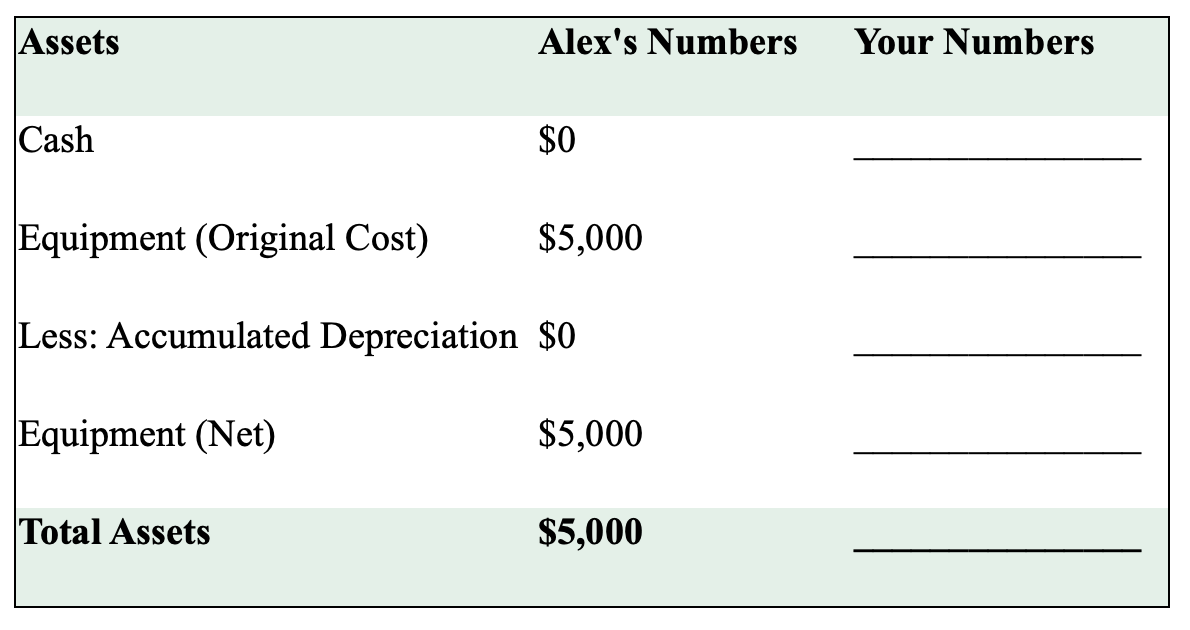
The presentation of Computer Equipment has been condensed from how it would be presented in Alex’s chart of accounts.
B. This is what the Balance Sheet looks like after 3 months of depreciation
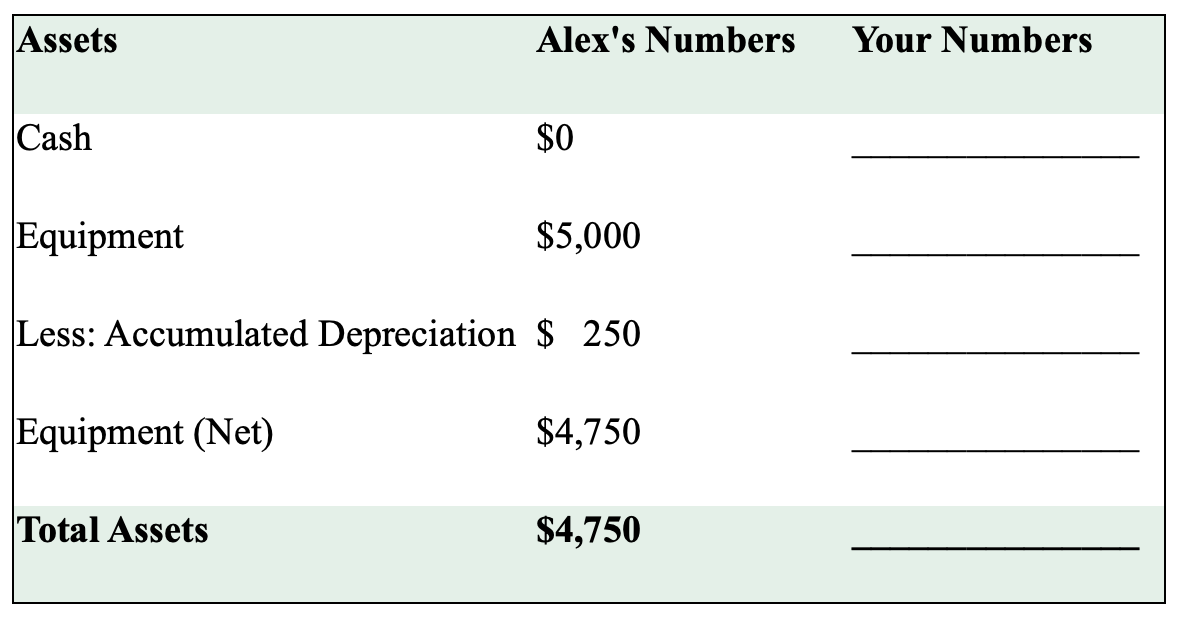
Now, let's look at the relationships between your three financial statements one at a time. (See the diagram below.)
- Alex checks the bank account and sees the withdrawal from the account. It’s for the computer equipment purchased by debit card. Alex sets up a Computer Equipment account in the books right away. A capital asset cannot be expensed at the time of purchase. It must be capitalized. That means there is no effect on profit yet.
- After speaking with Julie, Alex sets up two sub-accounts under Computer Equipment. One is called Original Cost and the other Accumulated Depreciation. Alex also sets up a recurring entry in the accounting software.
Debit Depreciation Expense $83.33
Credit Computer Equipment: Accumulated Depreciation $83.33
To record monthly depreciation expense for computer equipment. - Each month, the accounting software will automatically post the recurring depreciation entry. Alex will be able to see the Accumulated Depreciation account grow while the Computer Equipment (Net) shrinks by the same amount. Depreciation Expense shows up on the Profit & Loss Statement and will decrease profit.
The next few items show the relationships between the financial statements: - Alex spots Depreciation on the Cash Flow Statement (under Investing Activities in QBO - QuickBooks Online). Due to QBO programming, it does not appear in the ASPE (Accounting Standards for Private Enterprises) category as an add-back to net income under Operating Activities.
- Scanning the Balance Sheet, Alex notices Cash (and its sub-accounts), Accounts Receivable, and Capital Assets are sitting together. These are different types of assets that are common for self-employed workers.
- Alex traces the accounting equation across the page: Assets (what Alex owns) = Liabilities (what Alex owes) + Equity (what Alex has invested in the business).
- Alex follows the line from Net Income on the Profit & Loss Statement over to Equity on the Balance Sheet. The Profit & Loss Statement is like a detailed schedule supporting the equity section of the balance sheet.
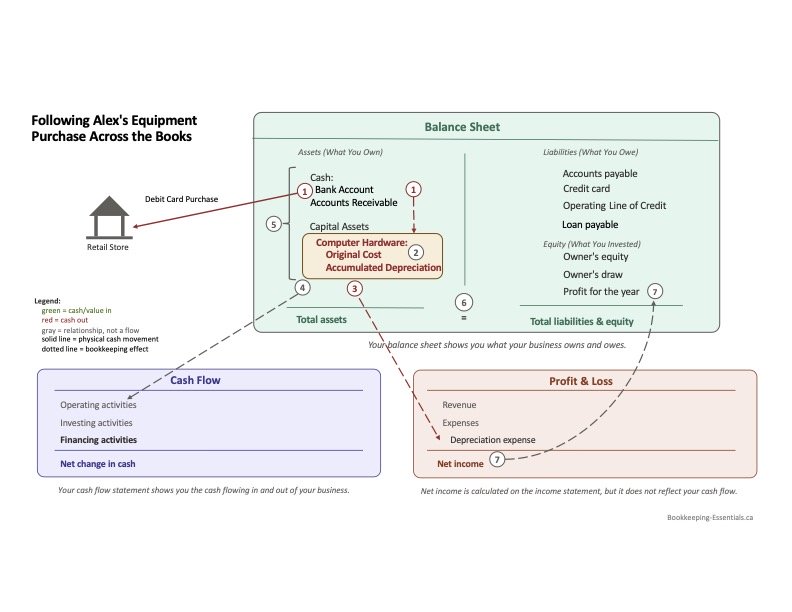 Diagram of the flow of a capital asset purchase across financial statements
🦆 Duck Wisdom
Alex makes an important connection. Depreciation reduces profit on the Profit & Loss Statement, but it does not reduce cash. The Cash Flow Statement adds depreciation back when showing cash generated by the business.
5. What Alex Got Curious About Next
A few months into using the new equipment, Alex loves it and starts thinking about why the purchase made sense in the first place.
Flashback: 3 months earlier
Alex's old laptop still worked. There was nothing wrong with it. It handled the smaller web-design projects Alex has been doing, and Alex can take it along when working away from the home office.
The problem was that some of the larger projects Alex wanted to take on required more processing power than the laptop could comfortably handle.
Alex had already turned down a couple of projects because the existing equipment wasn't up to the job. That’s when Alex started considering whether buying professional computer equipment was the right business solution. Or were there other options?
Alex went over three possibilities that came to mind. Repair was not going on the list, since the laptop wasn't broken.
A. Keep using the laptop
Alex could simply keep using the laptop for everything.
There would be no new purchase and no new payment to worry about. The laptop still worked, and it handled the work Alex was currently doing.
But that choice came with a trade-off. Alex would continue turning away larger projects that required more powerful equipment. The equipment was becoming a constraint on the business's ability to grow.
This led Alex to ask, “What is my current equipment preventing my business from doing?”
Alex could see the answer was becoming pretty clear. The issue wasn’t that the laptop had stopped working. It's that the business was starting to outgrow what the laptop could do.
Alex called friends, Brian and Maggie, to meet up for coffee to bounce ideas off them.
B. Upgrade the laptop
A few days later, Alex met Brian and his girlfriend Maggie for coffee. Maggie had recently taken over the bookkeeping and administration for Brian’s writing business after he received a CRA educational letter scare. Alex was really looking forward to their perspective.
After explaining the problem, Alex asked, “If the laptop still works, would it make more sense to upgrade it rather than buy new equipment?”
Maggie thought about it. “What would the upgrade actually get you?” she asked.
Alex explained that there were upgrades available that might improve the laptop's performance. They would cost considerably less than buying a new computer.
“But would it handle the larger projects you’ve already had to turn down?” Maggie asked.
Alex wasn't sure.
That was the problem. An upgrade might improve the laptop, but Alex didn't know whether it would give the business the capability it needed.
Brian chimed in. “So you could spend the money and still find yourself saying no to the same projects?”
“Exactly,” Alex said. “That's what I'm trying to avoid.”
C. Buy more powerful professional equipment
“So what would you get if you bought new equipment?” Brian asked.
Alex had already been looking.
“A professional computer and good monitor as well as an ergonomic mouse and keyboard. Something powerful enough to handle the larger projects and that I could use for several years.”
“Would you keep the laptop?” Maggie asked.
“Yes. It still works. I use it when I'm working away from home, and it's perfectly fine for smaller projects.”
Brian nodded. “So you're not really replacing something that's broken. You're adding equipment because the business needs more capability.”
Alex hadn't thought about it quite that way before. The three of them talked it through. Each option had something going for it, and each had a catch.
Maggie pulled a napkin across the table and took a pen from her bag. "Let's put this on paper," she said. She drew three columns: keep the laptop, upgrade it, buy the new equipment. Then she added rows for cost, what each option solves, and the main risk.
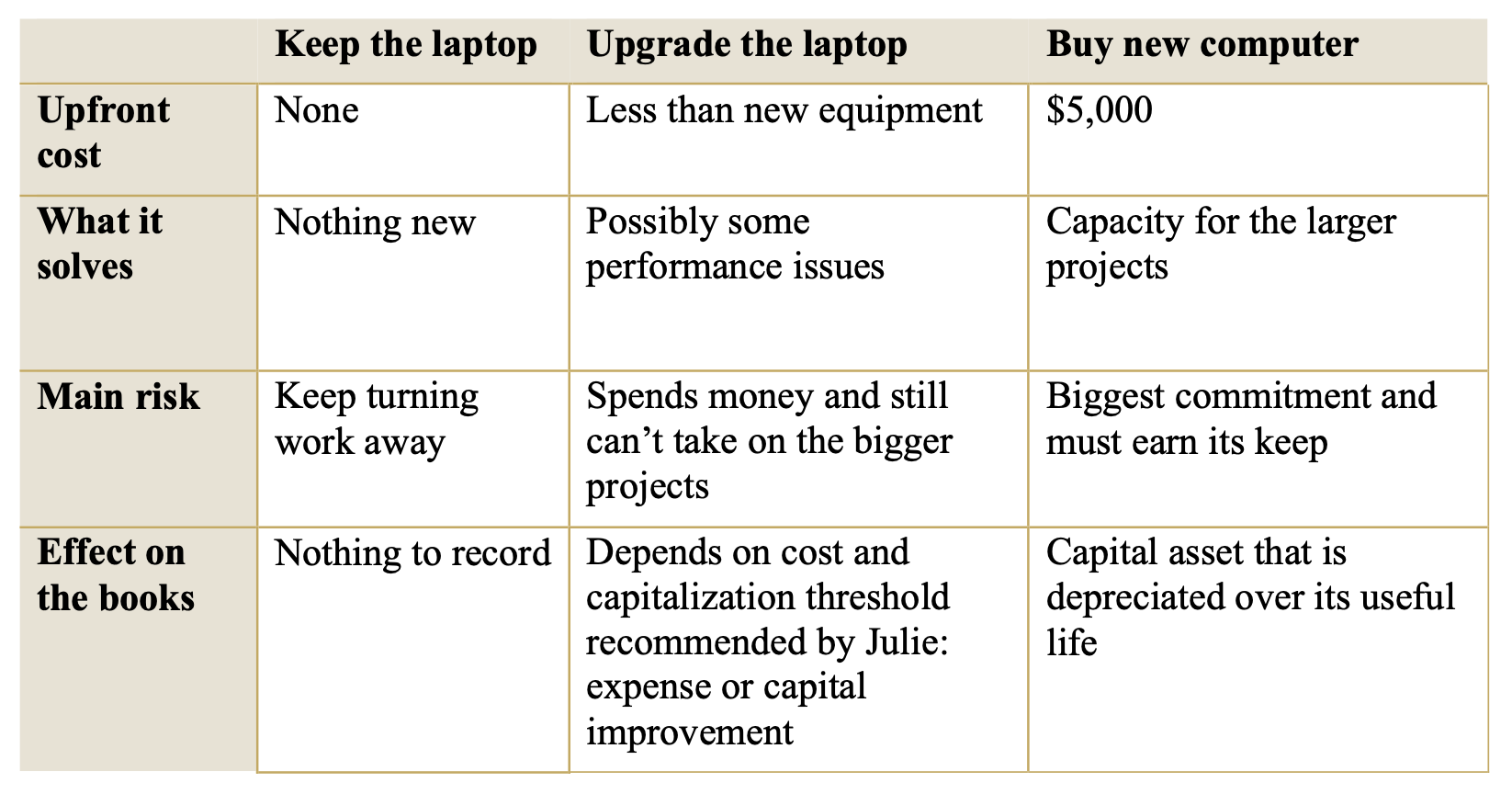
Brian tapped the last column. "That one costs the most."
"It's also the only one that changes your Balance Sheet," Maggie said. She added a line at the bottom of the napkin. "If you keep the laptop, nothing changes. An upgrade might be a repair-type cost that goes straight to expenses. But new computer equipment would show up as something the business owns."
"So it wouldn't be an expense like the printer paper?" Alex asked.
"Not in the same way. You'd still get the deduction, but the timing works differently. The cost is allocated over the years you use it, so your profit doesn't take the whole hit at once."
Alex nodded. It made sense at the table. The details wouldn't really sink in until a few months later while doing the bookkeeping.
Alex went back to the question that started the whole discussion. What does my business need this equipment to do? The discussion with Brian and Maggie helped sort out Alex’s thinking. The business needed equipment that could handle the larger projects the business was ready to take on.
What Alex did
- Alex decided to keep the laptop and add professional computer equipment. The laptop wasn't obsolete. It still had a job.
- The new equipment had a different job. It would give the business capacity to take on larger, more demanding projects.
- The decision wasn't simply a matter of buying a more expensive computer because it was newer or better. It was a business decision based on what Alex needed the equipment to do.
Current Day:
After three months of using the new computer, Alex is very pleased about the $5,000 purchase. The business was growing with a new client base.
6. Building the Full Picture
Alex now understands that the computer purchase isn't an expense. It's a capital asset. Its cost will gradually become an expense, a little at a time, as it's used up.
But there is another piece of the puzzle worth understanding. How does the $5,000 cost get allocated over the years Alex uses the equipment? Back when Alex first bought the computer, the whole $5,000 went onto the Balance Sheet as Computer Equipment. Nothing hit the Profit & Loss Statement because the equipment hadn't been used up yet.
Now three months have passed. The computer has been doing its job every day. It's helping Alex take on larger projects and earn revenue. But the books need to recognize that the equipment is being used up over time. That's what depreciation does.
Let's see what is happening when you allocate use
A depreciation schedule is simply a way of showing how an asset's book value changes over time.
For bookkeeping purposes, Alex (with Julie’s help) decided to use a conservative estimate for the useful life of the computer equipment of five years even though there is the possibility it will last as long as seven years.
If Alex uses straight-line depreciation and assumes there is no residual value, the calculation is straightforward:
$5,000 ÷ 5 years = $1,000 depreciation per year … or … $1,000 ÷ 12 months = $83.33 per month
Alex can now see why the $5,000 wasn't removed from the books when the equipment was purchased. The asset's original cost remains recorded at its historical purchase price. Instead of lowering the equipment account directly, depreciation gradually accumulates in a separate Accumulated Depreciation account reducing the net book value of the equipment over time.
Let’s create a depreciation schedule so Alex can clearly see how the computer equipment will be expensed over the next five years.
You don't have to be an accountant to create this schedule, for straight-line depreciation at least. An online calculator (or a spreadsheet) can do the calculations for you. You need the original cost, the estimated useful life, and, if applicable, the estimated salvage value at the end of that life (I'm assuming $0 salvage value here, for simplicity).
For Alex's $5,000 computer equipment with straight-line depreciation over 5 years, the schedule might look something like this:
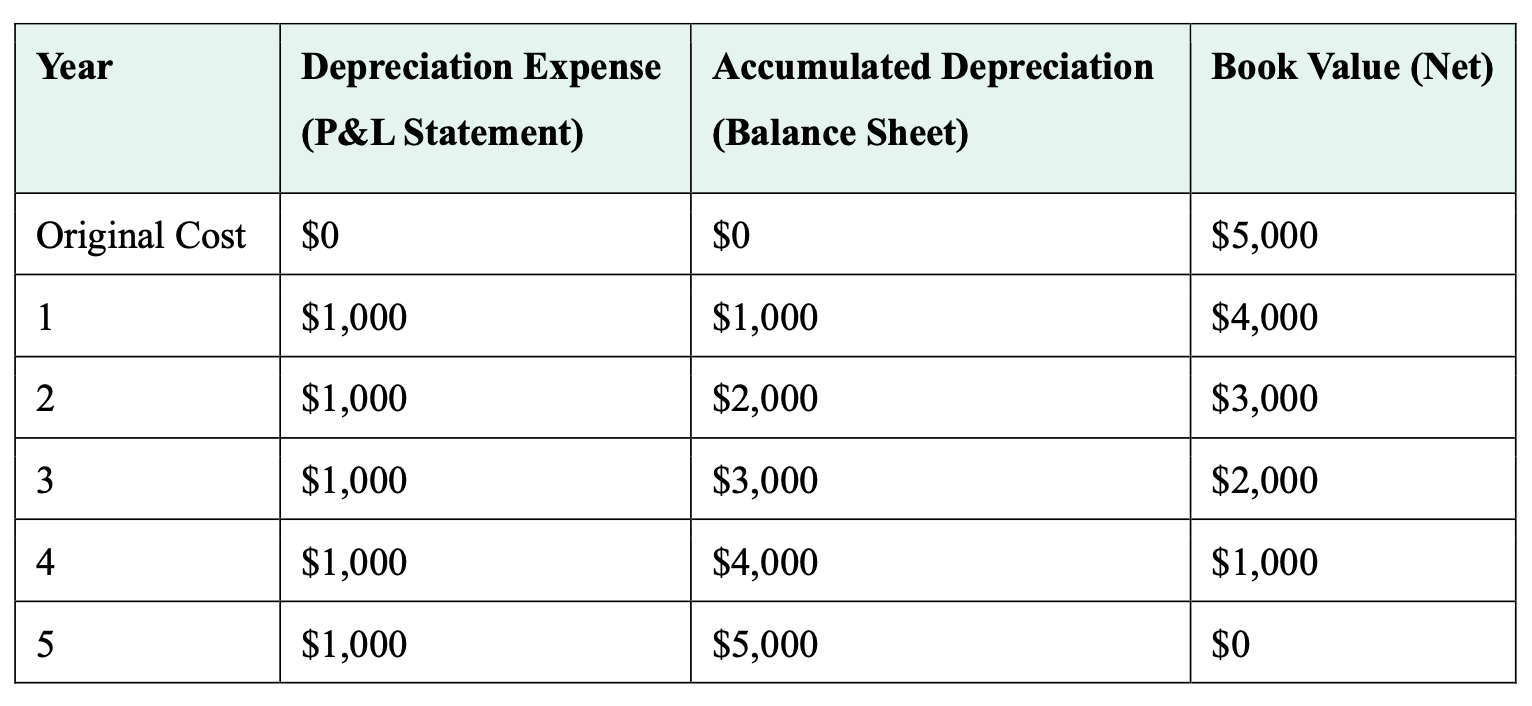
Look at what happens.
Unlike the loan payment, where the split between principal and interest changed every month, straight-line depreciation stays the same each year. It's the simplest method to use, and it can be a practical choice for many self-employed businesses when it reflects how the asset is being used.
🦆 Duck Wisdom
The part I want Alex (and you) to notice is the $5,000 purchase is not a $5,000 expense in year one. It's a $1,000 expense in year one, and again in year two, and again in year three, four, and five … or $83.33 ($1,000 /12) a month for five years. No cash moves in years two through five.
Now connect that to the bookkeeping
Always keep in mind when thinking about depreciation, no cash moves when depreciation is booked. The cash already left the bank account back when the computer was purchased. Each month (or each year, if booked at year-end), Alex sets up this journal entry as recurring transaction in the accounting software:
Debit Depreciation expense $83.33
Credit Accumulated depreciation $83.33
To record monthly depreciation on computer equipment over five years.
Let's Recap
Depreciation Expense is a non-cash expense.
- It lives on the Profit & Loss Statement.
- It reduces profit.
Accumulated Depreciation is not a liability.
- It is not a reduction of cash.
- It is a running total on the Balance Sheet. In accounting jargon, it’s called a contra-asset.
- It reduces the equipment's book value.
Nothing leaves the bank account when the depreciation entry is made.
The Equipment line alone doesn't tell the whole story. Three numbers work together:
- Original cost: what Alex paid.
- Accumulated depreciation: how much of that cost has already been recognized as an expense.
- Net book value: original cost minus accumulated depreciation. This is what's theoretically left, not necessarily what it could be sold for.
One more thing to think about
A quick heads-up before we go any further. I’m now going to introduce an advanced concept … the difference between book depreciation and its tax treatment counterpart CCA.
You don't need to understand this advanced concept to understand how capital assets work or how depreciation affects your books. If you're not interested in the tax side right now, feel free to skip ahead to Section 7: Three Questions to Ask About Purchases.
If you're curious about why the depreciation on your P&L doesn't necessarily match what's reported on your tax return, keep reading.
So far, we have been looking at book depreciation. That’s accounting jargon for the way Alex’s bookkeeping records allocate the cost of the computer over the years Alex expects to use it.
Julie recommended Alex use straight-line depreciation over 5 years. But there's another system Alex needs to understand when tax time comes around.
Flash forward to tax time
In March of the next year, Julie has finished Alex's tax return. After getting a copy of the filed tax return, Alex flips through to the T2125 tax schedule - the Statement of Business or Professional Activities. The task for today is to make sure what was reported to the CRA matches what the books say. They can differ sometimes for several reasons, one of which are adjusting journal entries (AJEs) made by Julie when preparing the tax return.
Alex is expecting the numbers on the T2125 to be different than the P&L Statement. One item catches Alex's attention. The computer equipment isn't being treated on the tax return the same way it has been treated in the books.
The books show $1,000 of depreciation expense for the year. Alex can’t find it anywhere on the T2125 schedule. Instead, the tax return has a line called Capital Cost Allowance (CCA) that is not on the P & L. Alex googles CCA. This is what showed up …
Book depreciation and CCA serve different purposes.
The depreciation Alex has been recording in the books is an accounting estimate of how much of the computer's cost belongs to the current accounting period.
CCA is a tax deduction governed by Canadian tax rules. It determines how much of the capital cost of qualifying property can be deducted when calculating taxable business income. This matters because taxable business income determines Alex’s tax bill for the year.
The depreciation on the P&L doesn't match the CCA on the tax return. When Julie prepared the return, she replaced the book depreciation with the CCA calculation, as the tax rules require. Put simply. The two systems use different rules.
So let’s take a more detailed look at how Canada’s tax system uses a different method than book depreciation. Governments, including Canada, often use tax law for more than collecting revenue. They also use it to encourage the activities they want to support, such as business investment, hiring, or clean technology. Faster write-offs on certain equipment are one of those tools. These write-off rates are called Capital Cost Allowance (CCA).
Currently, computer equipment falls under CCA class 50. The usual rate is 55% on a declining balance. However, for equipment acquired after April 15, 2024, and available for use before January 1, 2027, Parliament enacted a 100% CCA deduction in the first year. This is referred to as immediate expensing. Alex’s 2026 computer equipment purchase qualifies for this rate.
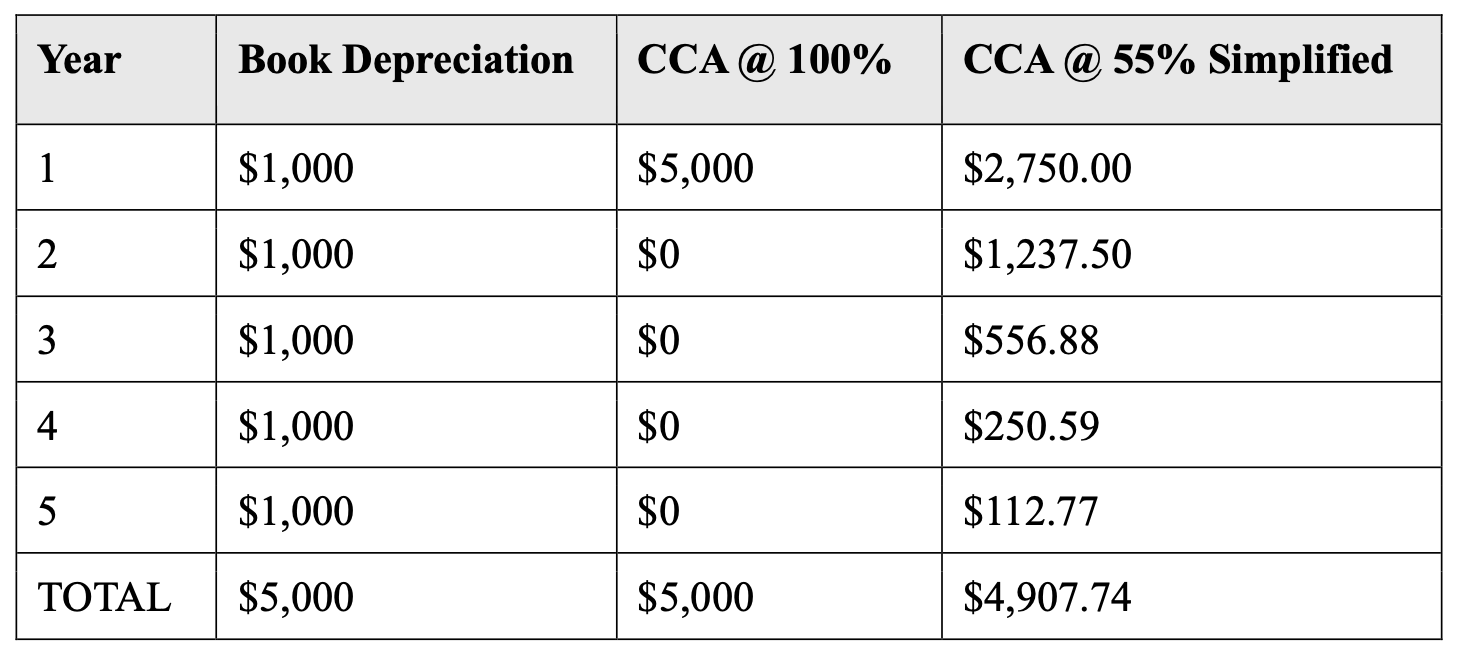
For Alex's $5,000 computer, the table shows how the three scenarios affect Alex’s books and tax return differently. I’ve kept the table simple for illustrative purposes. No half-year rule. Assumes capital asset was purchased at the beginning of the year. CCA is determined on a declining balance.
Looking at the table, Alex can now see why the number on the P&L doesn't match the number on the tax return. The same $5,000 computer can have one treatment in the books and a different treatment for tax purposes because the two systems are answering different questions. Accountants call this a ‘temporary timing difference’. The table shows that by year 5, the ‘temporary timing difference’ is gone.
How CCA reduces tax payable
CCA is deducted on the T2125 from the income Alex's business earns. A bigger deduction means lower net business income. Lower net business income means less income tax payable.
Read more >> How Sole Proprietors Are Taxed
You don't need to understand the accounting theory behind it to understand what's happening here. The same $5,000 computer can have one treatment in the books and a different treatment for tax purposes because the two systems are answering different questions.
- Book depreciation asks: How much of the computer's cost belongs to this accounting period?
- CCA asks: How much of the computer's cost can be deducted under the tax rules?
That's the important distinction for Alex to remember.
Let's Recap
Book depreciation and CCA aren't supposed to match.
- The books are telling Alex how the cost of the computer is being recognized over time.
- The tax return is applying the tax rules for determining how much of that cost can be deducted when calculating taxable business income.
- Same computer. Same $5,000 cost. Different rules for different purposes.
Also remember … tax rules shift as government priorities and the economy change. This is why CCA rates and timing windows are often temporary.
7. Three Questions to Ask About Purchases
Alex has booked the computer equipment. The accounting software has been set up with a monthly recurring entry to book the depreciation expense. The loan payments associated with the purchase are rolling out of the bank account every month.
Now Alex can turn attention to the purchase of the office equipment that has been pushed aside a few times.
A decision guide for purchases
Alex has stopped treating every purchase as an expense just because money was spent on the business. What matters, Alex understands now, is (a) what the business bought, (b) how long it will be useful, and (c) whether it meets the business's threshold for a small tool under $500.
That's why Alex's three questions work as a decision guide for purchases:
- Capitalizing: Will the business use this for more than a year, and does it meet the threshold for a 100% write-off?
- Expensing: Is this something the business will use within the year?
- Using up a capital asset: How will capital assets that cost over $500 be recognized as an expense over the years as the business uses it?
For months, Alex has been moving money into a separate set-aside account opened at the online bank. A little at a time. The goal was simple. Buy a standing desk and an ergonomic chair without borrowing a dollar. Long days at the computer were creating ongoing issues with tech neck and the beginnings of carpal tunnel syndrome. The current office furniture was a contributing factor.
Today the set-aside account holds $2,300. Alex looked around and got the following estimate from a local store:
- Adjustable standing desk $1,000
- Ergonomic chair $650
- Noise-cancelling headphones $450
- External backup drive $150
- Total $2,250 before sales tax
Alex decides to move forward and orders the office furniture and equipment and pays for it using the business’s debit card. As mentioned earlier, Alex’s business is located in Alberta so 5% GST will apply. As a GST registrant, Alex can claim input tax credits on the sales tax paid.
Now Alex must figure out how to book these purchases. Here are the questions Alex asks.
A. Capitalizing
What is it? A purchase the business will use for more than a year.
Alex's first instinct is to code the whole purchase to an expense account. The money is spent, the receipt is in hand, and that feels finished. Alex stops and realizes one shopping trip can contain capital assets, small tools, and office expenses.
That means Alex switches gears and runs the purchase through the same test from Section 1. Will it last longer than one year? Yes, all 4 items will last for years. Does the cost clear the business's capital asset threshold set at $500? Yes for the desk and chair; no for the headphones and backup drive. That makes two items to be capitalized and two items to be classified as small tools under $500.
Notice what wasn't part of the test question. How Alex paid for it. Cash from a savings account, a loan, or a credit card would all get the same answer. The desk is still a desk. The payment method changes the other side of the entry, not the decision about the purchase.
Referencing The Bookkeeper’s Cheat Sheet, here is the journal entry to record the purchase of office furniture and small tools.
Debit Capital Assets: Office Furniture $1,650.00
Debit Capital Assets: Tools Under $500 600.00
Debit GST Payable 112.50
Credit Cash: Bank Account $2,362.50
To record the purchase of office furniture and tools.
🦆 Duck Wisdom
Going through this whole process, Alex is keenly aware now of the difference between being an operating expense and a capital asset.
B. Expensing
What is it? A purchase the business will use up (consume) within the year.
Back from the store, Alex empties the bag onto the desk. While Alex was checking out, a display of pens caught Alex’s attention. Alex threw them into the cart. The desk and chair are already sorted. The headphones and backup drive are small tools. That leaves one item.
A box of pens, $20.
Will the business use (consume) this purchase within the year? Yes. The pens will be used up in a few months. This is the only direct write-off in the purchase. There is nothing to track and nothing to depreciate. Alex revises the previous journal entry to include the box of pens.
Debit Capital Assets: Office Furniture $1,650.00
Debit Capital Assets: Tools Under $500 600.00
Debit Office Expenses 20.00
Debit GST Payable 113.50
Credit Cash: Bank Account $2,383.50
To record the purchase of furniture, tools, and office supplies.
Alex notes this purchase went a bit over budget. The set-aside account covered most of the purchase. The extra $83.50 came from Alex's regular operating account, which was fine and manageable.
🦆 Duck Wisdom
Not everything a business buys becomes a capital asset. Some purchases are used up in the normal course of doing business. Think copy paper, toner, pens, envelopes, cleaning supplies, packaging, or drill bits. These are expenses. The cost belongs to the period when the supplies are used, rather than being allocated over several years like a capital asset.
C. Using Up A Capital Asset
What is it? The process of recognizing a capital asset’s cost as an expense over the years the business uses it.
The capital assets sit on the balance sheet. Alex understands that the cost does not stay there forever. Over time, it moves from the balance sheet to the profit & loss statement as an expense by booking depreciation.
The bookkeeping treatment and the tax treatment aren't always the same
If a self-employed worker wants audit ready books, some knowledge of CRA is necessary. Oftentimes CRA sets its own rules and veers away from accounting standards. This can change how something gets booked. Alex learns that lesson here.
The furniture will last for years, so its cost is allocated over those years. Alex will book a depreciation expense each month, the same way it was set up for the computer equipment. The small tools work differently.
CRA has different rules for small tools under $500. The headphones and backup drive fall under what CRA classifies as CCA Class 12, which allows a 100% write-off.
🦆 Duck Wisdom
CCA is an optional claim, so Alex does not have to claim it all in the first year. If Alex doesn't need the deduction in the current year, the unclaimed amount can be carried forward for use in a future tax year. Alex’s tax preparer decides which tax year makes the most sense while preparing the tax return.
How to classify small tools
Because audit ready books are one of the business's goals, Alex wanted to remember this CRA rule. Alex found the information about small tools on the Bookkeeping-Essentials.ca website and put it into a table for future reference
Here is the table Alex created for comparing the bookkeeping treatment of small tools. It will help keep things straight in Alex’s mind.
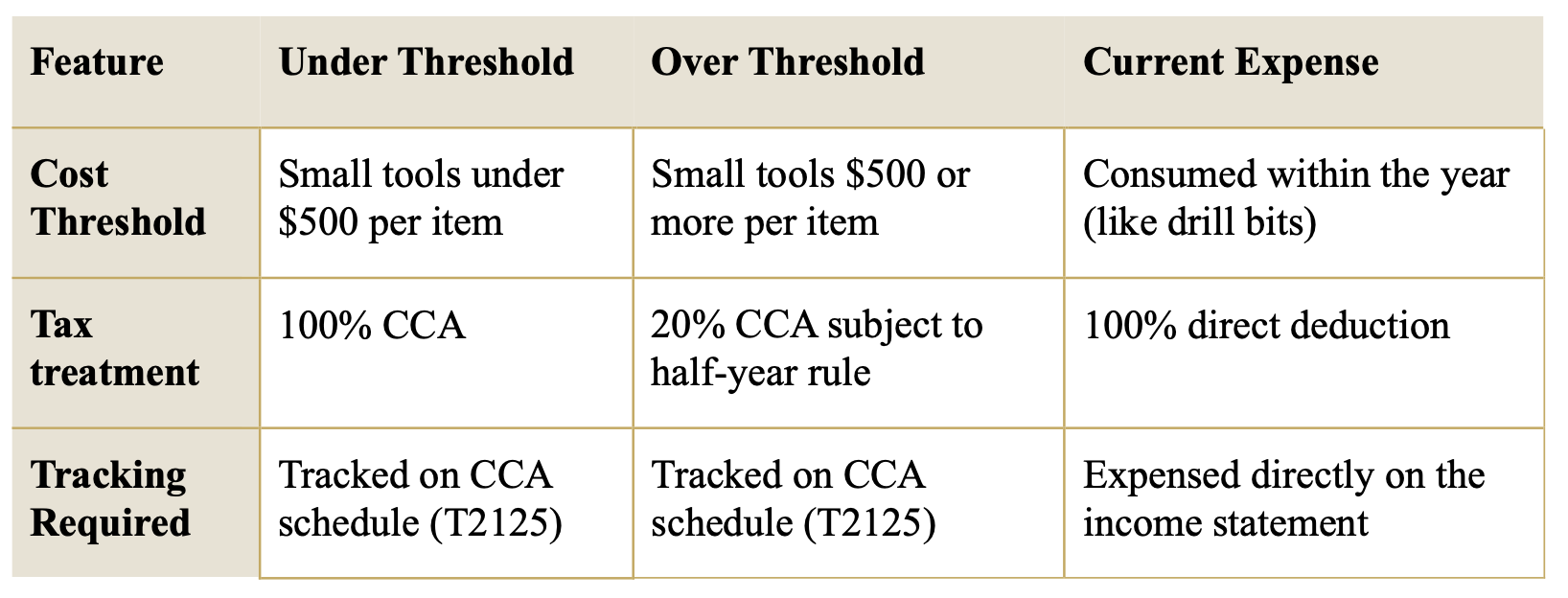
What Alex learned about purchases
Alex has stopped treating every purchase as an expense just because money was spent on a business purchase. How the purchase was paid for doesn't decide how it is booked. Cash, a loan, or a credit card can all result in the same asset being recorded.
Instead, Alex looks at what the business bought and how the business will use it. Note to self: Ask the right questions first.
🦆 Duck Wisdom
Alex’s takeaway about capital assets is that the purchase price is only the starting point. What matters is what the business bought, how long it will be useful, and how that cost will be recognized over time.
8. What Alex Takes Away
- Furniture, equipment, and tools are not expenses. They are capital assets. Alex records them on the Balance Sheet rather than treating the full purchase price as a day-to-day operating expense at the time of purchase.
- Before posting a purchase in the accounting software, Alex needs to ask one question … will the business use this for more than one year? If yes, it goes on the Balance Sheet as a capital asset, not on the Profit & Loss Statement as an expense.
- A capital asset is something the business uses over time, so the cost is allocated over the time it is used. Alex doesn't treat the whole purchase price as an expense on the Profit & Loss Statement right away. Instead, part of the cost becomes an expense called depreciation over time as the asset is used.
- Depreciation is not a cash outflow. It is what accountants call a non-cash expense. Alex doesn't pay for the asset again when depreciation is recorded. The cash left the business when the asset was purchased. Depreciation allocates that cost to the periods in which the asset is used without affecting cash.
- The business's books and tax return can use different timelines. Alex's bookkeeping records reflect a realistic estimate of the asset's life. CRA uses its own CCA rules for income tax preparation, based on the asset's CCA class. The CCA calculation is unrelated to the asset's estimated useful life.
9. 🦆 Solo CEO Move
Take a look at your Balance Sheet. Find the Capital Assets section. Does each Capital Asset show its own Original Cost and Accumulated Depreciation separately, or just one net number?
This is the step Alex was missing at first. Alex's chart of accounts (COA) was set up with each of the three capital asset groups as single net figures, with no visibility into the original cost or how much had been depreciated so far. By adding sub-accounts, Alex can see the full history at a glance, not just where things stand today. So can anyone else who looks at the books, including a tax preparer at year end or a banker.
If your books only show a net number, here's what Alex, and you, could do instead.
How I book depreciation
Because I want efficiency in my bookkeeping routine, here's how I book depreciation:
- Set up the asset with sub-accounts from day one. Create sub-accounts for Original Cost and Accumulated Depreciation under each major capital asset category. Nowadays, most accounting software supports this structure directly. It will look something like this:
Capital Assets:
Computer Equipment
Original Cost
Accumulated Depreciation
Office Furniture
Original Cost
Accumulated Depreciation
Tools Under $500
Original Cost
Accumulated Depreciation - Decide on a depreciation schedule and stick to it. Monthly is more accurate for internal reporting; however quarterly or annually recording is simpler if monthly precision matters less for your business.
My preference is monthly, booked as a recurring transaction … using the same reasoning as the recurring loan payment in the loan lesson … it posts an entry I'm expecting, so if it doesn't show up, I notice.
If you are using QuickBooks Online’s (QBO) EasyStart or another brand’s entry-level plan, it does not have the recurring transaction feature … a pet peeve of mine. In this case, I’d book depreciation as one adjusting entry as part of year-end.
Here’s Alex’s monthly recurring bookkeeping entry:
Debit Depreciation Expense $97.08
Credit Computer Equipment: Accumulated Depreciation $83.33
Credit Office Furniture: Accumulated Depreciation $13.75
To record monthly depreciation – computer over 5 years, furniture over 10 years.
Here’s Alex’s bookkeeping entry for the one-time write-off of the small tools:
Debit Depreciation Expense $600.00
Credit Tools Under $500: Accumulated Depreciation $600.00
To record depreciation of small tools under $500 at 100% CCA rate. - At year end, confirm with your accountant whether your financial statements are booked according to ASPE or on a tax basis. Ask for any adjusting journal entries you need to book so your accounting records match your tax submission.
- When an asset is eventually sold, traded in, or disposed of, record a journal entry to remove both the Original Cost and its Accumulated Depreciation from the books in the same entry, and record any proceeds received.
🦆 Duck Wisdom
Alex learned a lot about capital assets when purchasing items for the business. At the next Money Monday appointment, Alex updated the recurring entry in the bookkeeping software. Going forward, it will record the monthly depreciation for the computer and furniture in one efficient entry.
10. Purchase This Lesson
Some people like having their own copy of a lesson to work through. So I put together a personal copy for you to mark up, plus a few extra tools that go beyond what's on this page.
$14.95 CAD
The Capital Asset Purchases Companion Set includes:
- Your own markable copy of the lesson complete with a What You'll Learn overview up front and a closing quiz with answer key to check your understanding.
- A one page summary of all capital asset purchase bookkeeping entries for quick reference. I suggest you file it in your bookkeeping binder or get it laminated. On the back side is a condensed version of The Bookkeeper's Cheat Sheet and a quick recap of reminders about purchases.
- A fill-in-your-numbers Balance Sheet template so you can follow along. For this lesson, the back page zooms in on the Capital Assets section.
- An expanded Debits and Credits Cheat Sheet for reference at your desk which includes decision guides for debt and for purchases on the back side. I suggest you laminate it for easy access.
- A Best Practice For Bank Feeds handout.
Want a personal copy of this lesson to mark up, plus the tools that go beyond what's on this page?
To Get Your 4 Bonus Tools and Quiz
Trusting Your Numbers
CRA-Grade Records System | Self-Employed Canadians
A classic accountant's workflow built for the digital age. Keep records CRA can follow five years from now - even if your bookkeeping software is gone.
The Solo CRA-Ready Workflow | Gather Process Results
A three-step bookkeeping workflow for Canadian solopreneurs. How Gather Process Results keeps your books current and CRA-ready.
Loans and Debts | Understanding What Your Business Owes
A loan is not income. Follow along as Alex learns what debt is and where all the related affects show up on your financial statements.