Loans and Debt: Understanding What Your Business Owes
Learning to Read Your Financial Statements

By L.Kenway BComm CPB Retired
This is the year you get all your ducks in a row! Start by starting ... and keep it simple. Consistency beats perfection.
Published September 21, 2026
WHAT'S IN THIS ARTICLE
Introduction | What Is Debt? What Kinds Of Debt Are There? | Where Does It Appear In Your Financial Statements? | Why Does This Matter To Your Business? | How It Connects To Other Financial Statements | Getting Curious About What's Next | Building The Full Picture | 3 Questions To Ask About Debt | Takeaway | 🦆 Solo CEO Move
BACK TO >> Small Business Bookkeeping
 A business loan is not income. It's cash today in exchange for a repayment obligation.
In A Nutshell
- A business loan is not income. It's cash today in exchange for a repayment obligation, and it belongs on the Balance Sheet as a liability, not on the Profit & Loss Statement as revenue.
- Not all debt is the same. Leveraging debt helps the business earn more, Bridging debt covers a short timing gap with a confirmed payment coming, and Consuming debt funds something the business can't yet afford. Know which one you're taking on before you sign.
- One loan touches all three financial statements differently: the Balance Sheet, the Profit & Loss Statement, and the Cash Flow Statement. Only the interest portion of a payment is an expense. The rest reduces what you owe.
- Being profitable and having cash on hand are not the same thing. A business can show a profit and still come up short at the bank.
- This lesson follows Alex, a home-based web designer, through a $5,000 equipment loan and a $2,300 line of credit draw for office furniture ... from the decision to borrow, to the bookkeeping entries, to what Alex learned.
A business loan isn't income, even though it lands in your bank account like income does.
This lesson follows Alex, a home-based web designer, through deciding whether to take on a $5,000 equipment loan, and then through what that loan does (and doesn't do) to the books.
We'll see how Alex arrived at the decision to take out a loan. Then follow the loan itself, from the moment the funds land in the bank account to the moment Alex sees how it affected all three of the business's financial statements.
If you need help as you work through this lesson …you don't have to figure everything out on your own.
Start with your own loan documents and your own lender's statement. They tell you what you borrowed, what you owe, and what interest has been charged. For the bookkeeping side, follow the related Bookkeeping-Essentials articles linked throughout this lesson. If your situation is more complicated … for example, refinancing, unusual loan terms, or questions about tax treatment … this is where your accountant or bookkeeper can help.
During the last year, Alex adopted Bookkeeping-Essentials.ca's Money Monday routine. Every Monday, Alex clears the admin inbox and catches up the books. Alex keeps noticing one line shows up regularly. It's the monthly payment on a $5,000 loan to buy new equipment. (The payment works out to $155.42 per month at Prime + 3%, which for this lesson equals 7.45%. I'll round it to $155 throughout, for simplicity.)
1. What Is Debt? What Kinds Of Debt Are There?
It's Monday morning and Alex is doing the Money Monday routine. Alex looks at the $5,000 sitting in the business bank account and wonders where to code this entry. Is it income? It doesn't feel like income. It's borrowed money, and borrowed money comes with obligations. Those obligations matter, since keeping up with them is part of what keeps the business's credit rating intact.
Alex remembers reading somewhere that there's good debt and bad debt. Is the loan Alex took out "good debt"? Alex still isn't sure. While weighing financing options, Alex learned there are three types of debt.
- Debt leveraging is good debt. This is borrowing money to increase your cash return almost immediately. Alex had already been turning down larger client projects for lack of the right equipment. The new computer and monitor would let Alex say yes to work that was already waiting.
- Debt bridging is neutral debt, a tool. It covers timing gaps in cash between work completed and payment received. Every business should have an operating line of credit, a bank overdraft, or both. Many solopreneurs, like Alex, use a business credit card as bridge financing, but it is more expensive than a true operating line of credit.
- Debt consuming is bad debt. It means borrowing to cover operational inefficiency, to buy assets before the business's revenue can support them, or to fund hoped-for growth. A common example is taking out a loan to build a new website or hire a salesperson before the business is even profitable, betting it will generate growth rather than knowing it will.
With three types of debt in mind, Alex went to the bank with the simple goal of getting a loan to cover both new computer equipment and home office furniture. Alex had done some other homework as well before the meeting and asked the loan officer about the Canada Small Business Financing Program (CSBFP). Alex wondered if that would help get approved for the loan.
What is CSBFP financing?
- The Canada Small Business Financing Program (CSBFP) isn't free government money.
- It's a federal program that helps small businesses qualify for loans at banks and credit unions. How? The government guarantees part of the loan if the business can't repay it.
- The bank still makes the lending decision and still charges interest. The government just makes it easier to get approved.
- CSBFP loans carry a mandatory 2% registration fee.
- The paperwork for the bank can be onerous so most banks set a minimum threshold to qualify for a CSBFP term loan.
After the loan officer (Josh) explained that the CSBFP wasn't the right program for this type of loan, Josh had other ideas that were more suitable for Alex's situation. Josh recommended a line of credit (LOC) rather than a term loan, plus a bank overdraft as a safety net in case a customer payment was charged back due to non-sufficient funds. Josh explained an LOC is flexible, easy to draw against, and Alex could pay each purchase down at its own pace.
Alex left the meeting with the paperwork submitted for the line of credit and overdraft. The next day, Alex got notification. Both the line of credit and the overdraft were approved.
Once approved, Alex went online to research the computer and monitor purchase first. While browsing, Alex noticed the supplier offered financing ... 0% interest, a $150 cash-back incentive, spread over 12 months.
It looked almost too good to pass up. Alex ran the numbers anyway. At $416.67 ($5,000 / 12 months) a month, the payments would eat into cash flow way more than a three year term would. Alex was thinking the equipment would last about 5-7 years. Alex felt it would be too risky for the business, make cash flow too tight.
There was something else nagging at Alex too. These 0% supplier financing plans sometimes work differently than they first appear if the balance isn't cleared by the deadline. Reading the fine print, if you don't repay on time, interest is applied to the loan. Alex ran a few worst case scenarios and thought it would take just one customer to not make a payment on time to create a problem.
Alex also thought about the line of credit Josh had just arranged. It was flexible, and that was exactly the problem. Alex knew from experience how easy it was to let a flexible balance linger, paying the minimum and telling yourself you'll catch up next month. A line of credit with no fixed due date depended entirely on Alex's own discipline to pay it down, and Alex wasn't ready to trust that discipline with $5,000. That felt closer to consuming debt than the leveraging debt Alex intended this to be, borrowing without a firm plan to pay it back.
After reviewing the types of debt again, Alex felt sure a fixed-term loan would be the better fit because it would be 'good' debt. Alex decided to put off the purchase of the office furniture for now.
So Alex went online to the bank and applied for a straightforward business term loan instead. Alex asked for $5,000, repayable over 3 years, fixed payments, a fixed end date. Alex understood this was still borrowed money, not free money, and it came with repayment obligations including interest charges. But a fixed schedule meant Alex couldn't quietly let the balance drift the way an LOC balance could. And the payment was manageable.
Takeaway
- Debt is the broader term. Any money the business owes, whether it's a loan, a credit card balance, accounts payable outstanding, or something else financed over time.
- Borrowing gives the business cash today, but it also creates an obligation to repay that money later.
- What's affordable now may not stay that way. A future tariff, a jump in inflation, or a supply chain disruption can squeeze day-to-day cash flow, and the loan payment doesn't shrink to make room. Debt taken on today can narrow the choices available tomorrow.
2. Where Does Debt Appear In Your Financial Statements?
The loan comes through. Alex sees $5,000 land in the business bank account and opens the books to record it.
Alex pauses before coding the entry. The cash is showing in the bank feed, sitting right there in the bank account. Alex isn't sure how to record this entry, so pulls up the Bookkeeping-Essentials.com cheat sheet.
What was received?
Looking at the chart, Alex asks, "What was received?" Cash.
Alex sees on the cheat sheet that cash is an asset, and this increases the cash coming into the business.
Where did the money come from?
Alex's next question, per the cheat sheet, is "Where did the money come from?" The money was not from a sale, so it could not be revenue. The money was loan proceeds from the bank.
Cheat sheet for debits and credits
| Normal Account Balance |
Item* | DEBIT Entry What was received |
CREDIT Entry Where it came from |
Colour Accounting** |
|---|---|---|---|---|
| Debit (+) | Assets | Increases Account | Decreases Account | Green |
| Credit (-) | Liabilities | Decreases Account | Increases Account | Yellow |
| Credit (-) | Equity | Decreases Account | Increases Account | Yellow |
| Credit (-) | Sales Revenue | Decreases Account | Increases Account | Yellow with Purple outline |
| Debit (+) | Expenses | Increases Account | Decreases Account | Green with Purple outline |
*Examples of where various items belong on the balance sheet:
- Assets : Cash, Bank, Short/Long Term Investments, A/R, Prepaids, Fixed/Capital Assets
- Liabilities: A/P, Tax Payable, Accruals, Short/Long Term Loans
- Equities: Retained Earnings, Common Shares, Contributed Surplus
**If you learned colour accounting, I've added the colors as a references. In color accounting, debits are green and credits are yellow while purple represents profit/income statement.
Reprinted with permission from Bookkeeping-Essentials.com
So now Alex has enough information to book the bank deposit. In the accounting software, Alex adds a new account called Loan Payable, a long-term liability, to the chart of accounts. Then Alex opens the bank deposit window and books the loan proceeds to the new Loan Payable account.
3. Why does this matter to your business?
If Alex had mistakenly booked the $5,000 as income, the books would show a great month that never really happened. The bank balance would look healthy, but unlike revenue, the loan must be repaid. Revenue also attracts GST/HST, which means reporting that 'revenue' to the CRA and remitting the GST 'collected' in trust.
Alex thinks about what this means for spending decisions ahead. The question isn't just "how much cash do I have?" It's also "how much of the cash in the bank account is available for day-to-day operations like paying bills?"
The thought startled Alex, because truthfully, seeing the $5,000 sitting there was tempting. A client was late paying their bill, and the business was a bit short of cash. The plan that went through Alex's mind was to put the computer and monitor purchase on the business credit card, and pay it off in 30 days once the other money came in.
Alex discarded the thought as fast as it appeared. That $5,000 already had a job. It was there for the computer equipment, not for smoothing cash due to a slow-paying client. And Alex didn't even need to touch it for that. Josh had set up the line of credit and overdraft for exactly this kind of moment. That was the whole point of having the LOC.
Alex exhaled and was glad managing the cash for the business was so much easier since implementing Bookkeeping-Essentials.ca's simple cash management system.
It was a small moment, but a telling one. There was no guarantee that other money would arrive in time. Without a confirmed payment date from the client, using the loan funds to cover it wouldn't have been Bridging debt. It was Consuming debt wearing a Bridging costume, exactly the kind of debt Alex was trying to avoid.
🦆 Duck Wisdom
Cash sitting in the bank doesn't announce what it's for. Without a system to remind Alex where every dollar was already spoken for, it would have been easy to quietly blur the loan into general spending money ... entering unconsciously into Consuming debt.
4. How it connects to other financial statements
Loans and debt make more sense when you stop looking at them as an isolated Balance Sheet number. So let's see where we are:
Loan Details
● Loan amount: $5,000
● Rate: Prime + 3% (7.45% for this example)
● Payment: $155.42
● Term: 36 payments (3 years)
Fill in your own numbers as you go, using the balance from your own loan or line of credit, if you have one.
A. This is what the Balance Sheet looks like when the loan proceeds are received.
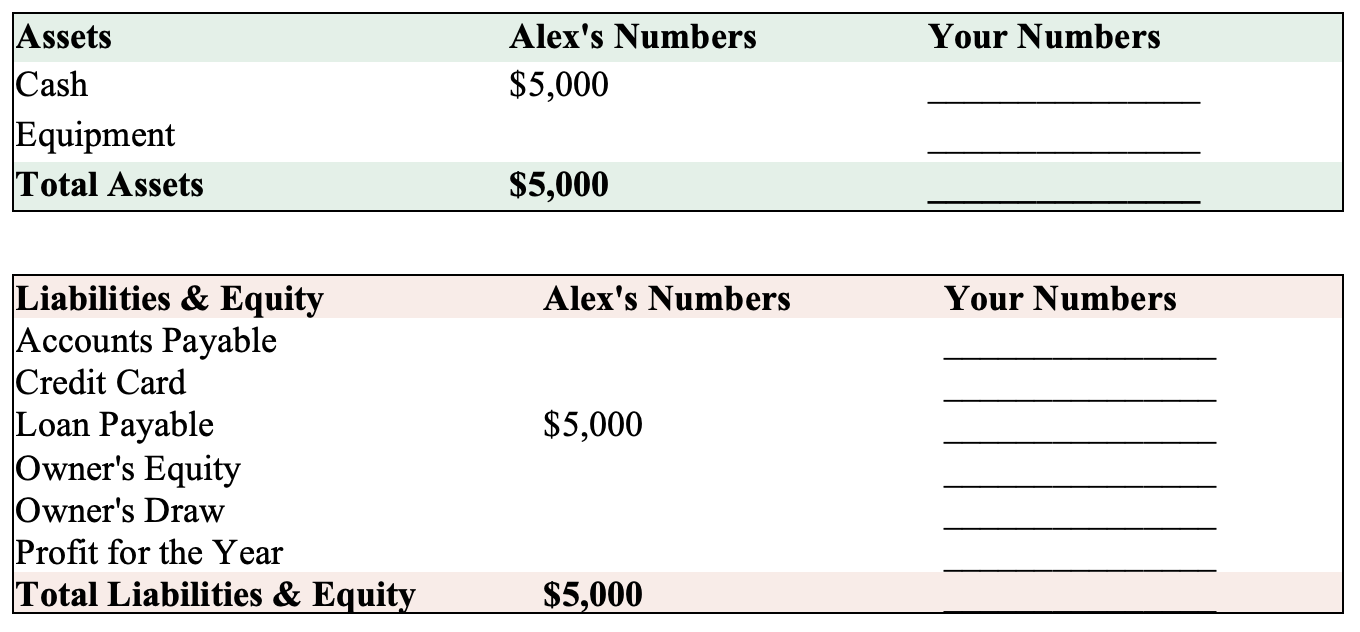
Notice that Total assets = Total liabilities and equity. This is the accounting equation in action.
B. This is what the Balance Sheet looks like after the computer and monitor have been purchased.
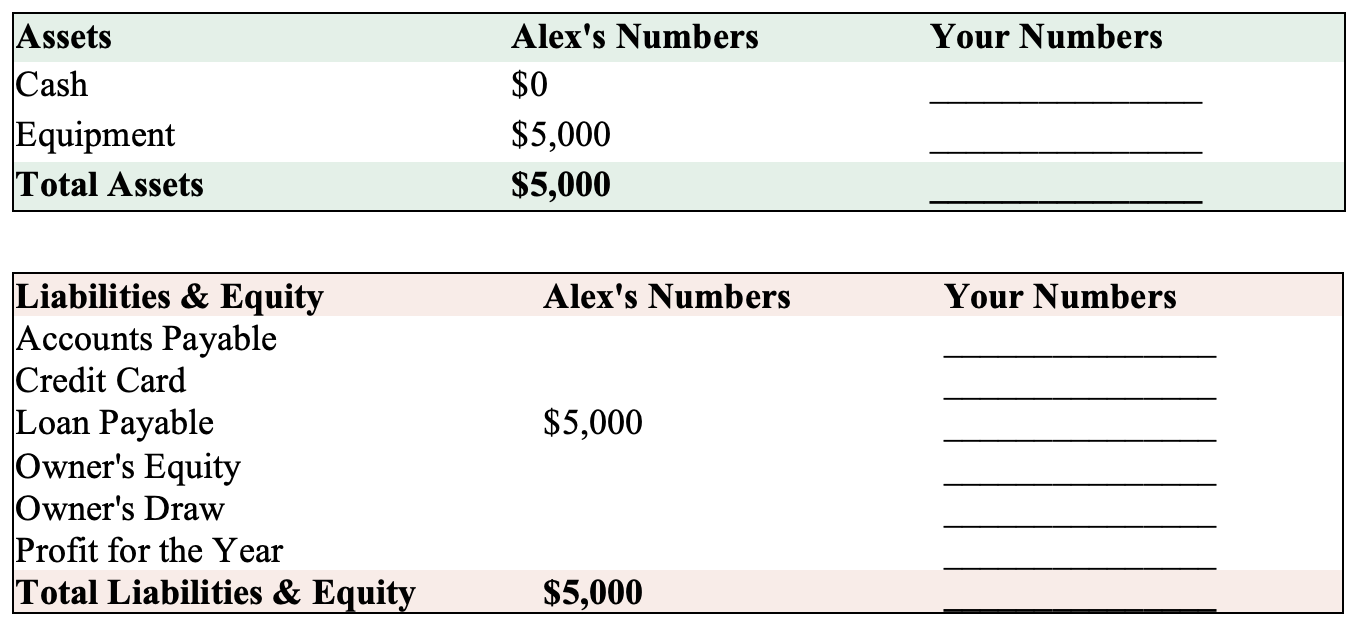
Now, let's look at the relationships between your three financial statements one at a time.
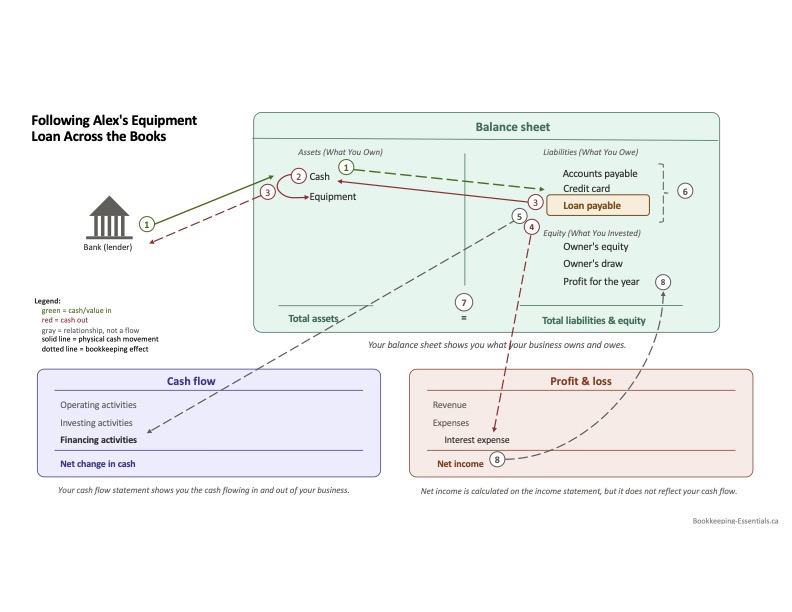 Diagram of the flow of equipment loan funds across the financial statements
- Alex checks the bank account and sees $5,000 sitting in the account. It's the term loan funds coming through. Alex sets up a Loan Payable account in the books right away. A loan is not revenue.
- Alex spends the cash on a new computer and a monitor for the business. The old laptop couldn't keep up with larger client projects anymore. After speaking with Julie (CPA), Alex sets up a new account under Capital Assets called Computer Equipment (long term asset) to record the purchase.
- Every month, Alex makes the loan payment and watches the loan balance drop a little. This will continue until the loan is paid off.
- Alex downloads the monthly loan statement from the bank and books the interest expense. Then Alex reconciles it against the Loan Payable account. (More on exactly how to do this in the Solo CEO Move below.)
The next few items show the relationships between the financial statements: - Alex spots the loan funds on the Cash Flow Statement, filed under financing activities. The monthly payments will show up here too in the future.
- Scanning the Balance Sheet, Alex notices Accounts Payable, Credit Card, and Loan Payable sitting together. These are different types of debts most solopreneurs have.
- Alex traces the accounting equation across the page: Assets (what Alex owns) = Liabilities (what Alex owes) + Equity (what Alex has invested in the business).
- Alex follows the line from net income sitting on the Profit & Loss Statement over to Equity on the Balance Sheet. The Profit & Loss Statement is like a detailed schedule supporting the equity section of the balance sheet.
🦆 Duck Wisdom
Alex noticed there was no line between profit and cash. In an uh-oh moment, Alex finally got what this meant. Alex could be profitable and still be short on cash. We'll talk more about that when we study the Profit & Loss Statement in another lesson. Alex decided to pay more attention to cash flow.
5. What Alex Got Curious About Next
A few months into the loan, Alex hits a rough patch. While work is up as anticipated, a couple of new clients on the bigger projects are now slow paying their invoices, and the loan payment is due regardless.
Alex starts asking some questions, hoping to find a solution to smooth out the cash flow gaps before they become a bigger problem. While trying to solve this problem, this is what Alex got curious about:
A. What if Alex had gone with the supplier's 0% financing instead?
The slow-paying clients had Alex thinking back to opting for a term loan. If Alex had gone with the supplier's 12-month plan, this would have been the moment the $416.67 loan payment a month met a client who hadn't paid ... and not for the first time!
 Read the fine print of 0% supplier financing plans. They work differently than they first appear. If you don't repay on time, interest is applied to the loan.
Phew! Alex felt a wave of relief. The $155.42 term loan payment was manageable even with cash being a bit tight this month. And the line of credit and overdraft Josh had recommended meant Alex didn't have to scramble, or wonder whether a purchase should go on a credit card. The tools were already there to use, already decided on, before Alex needed them under pressure.
That was the part Alex hadn't fully appreciated back at the bank. Deciding calmly, ahead of time, meant there was nothing left to decide now, stressed and short on time. Who knew taking the time to prearrange for cash flow gaps would reduce decision fatigue in the future?
B. What if Alex hadn't understood the difference between a line of credit and a term loan?
A few weeks later, Alex was having coffee with Brian and his girlfriend. Since Brian's scare with the CRA, his girlfriend had taken over the business side of Brian's writing business. She was getting more comfortable with the bookkeeping, but she was still learning how to think about the money side of the business.

This morning, they had a cash-flow problem of their own. Brian had a large royalty payment coming, but it wasn't due for several weeks. In the meantime, an unexpected business expense had come up.
“We have the money coming,” Brian's girlfriend explained. “It's just not here yet.”
Alex nodded. “That's exactly what my line of credit (LOC) is for.”
“Your line of credit?” Brian asked.
“Yeah. Josh explained it to me when I was at the bank. It's there to bridge a short-term gap between money going out and money coming in.” Alex explained how the LOC worked and how Alex planned to repay anything borrowed as soon as the expected client payments arrived.
Brian's girlfriend thought about it for a moment. “That sounds useful. But how do you decide what should go on the line of credit and what should be financed with a regular loan?”
Alex stopped. It was a good question. “I've actually been trying to figure that out myself.”
Alex explained what had happened with the $5,000 computer and monitor purchase. The equipment was going to help Alex take on larger projects that were already being turned away. That was the kind of borrowing Alex thought of as Leveraging debt. A fixed-term loan gave Alex a manageable payment and a definite end date.
“But I didn't buy the office furniture,” Alex continued. “I decided I was going to save up for it.”
“Why didn't you finance it?” Brian asked.
“Because I'm not sure it's Leveraging debt. A desk and chair aren't going to bring in a new client or directly increase revenue. I didn't want to borrow money to buy something the business hadn't earned yet.”
Alex paused. “Except things are starting to change.”
Alex explained sitting at the computer for long stretches was taking a toll. Alex was getting tech neck and noticing some early symptoms that could be carpal tunnel in the wrist. The current setup wasn't working well anymore.
“I think I need a standing desk and an ergonomic chair,” Alex said. “They won't directly generate revenue, but being able to work more comfortably and stay productive matters too.”
Alex looked at Brian. “Actually, would you want to meet up a couple of times a week and work out? I think I need to get out from behind the computer more often.” Brian laughed. “Sure. That might be good for both of us.”
Alex smiled, then returned to the problem of the furniture.
“I've been saving for furniture. All I need is $2,300. But every time I get close, another client is slow paying and the money gets diverted to keep the business running.”
Brian's girlfriend nodded. “So why not use the LOC?”
Alex thought about that before answering. “Because I don't want to use it just because it's available.” And that was the moment Alex realized where the logic about tapping the LOC (or not) may be slightly off kilter.
“But talking about this with you, I realize I've been looking at this backwards,” Alex said. “The furniture purchase isn't the problem. The slow-paying clients are. And that's what Josh told me the line of credit is for.”
Alex had been saving for the desk and chair. But every time a client payment was late, those savings got pulled back into the business to pay the bills.
“If I stop diverting the furniture savings to cover operating expenses, I'll have enough to buy the furniture. I can pay the business's monthly operating bills with the LOC. It can cover the short-term day-to-day operating cash gap until the client payments arrive.”
The distinction suddenly made sense. Alex wasn't borrowing to buy furniture. Alex was borrowing to bridge the timing gap created by slow-paying clients. The furniture savings could stay where they were, and any LOC balance from working capital shortages could be paid down as the overdue client invoices were collected.
“I'm borrowing because the timing is wrong,” Alex said. “Not because I suddenly have a credit balance to spend.” Alex could make the required interest payments each month (hopefully only one month) and then pay down the principal as client payments arrived.
“That actually makes sense,” Brian's girlfriend said. “You're using the line of credit to bridge the timing problem. You're not taking out a loan because you suddenly decided you wanted to do some unplanned spending.”
What is the difference between a line of credit vs. a term loan?
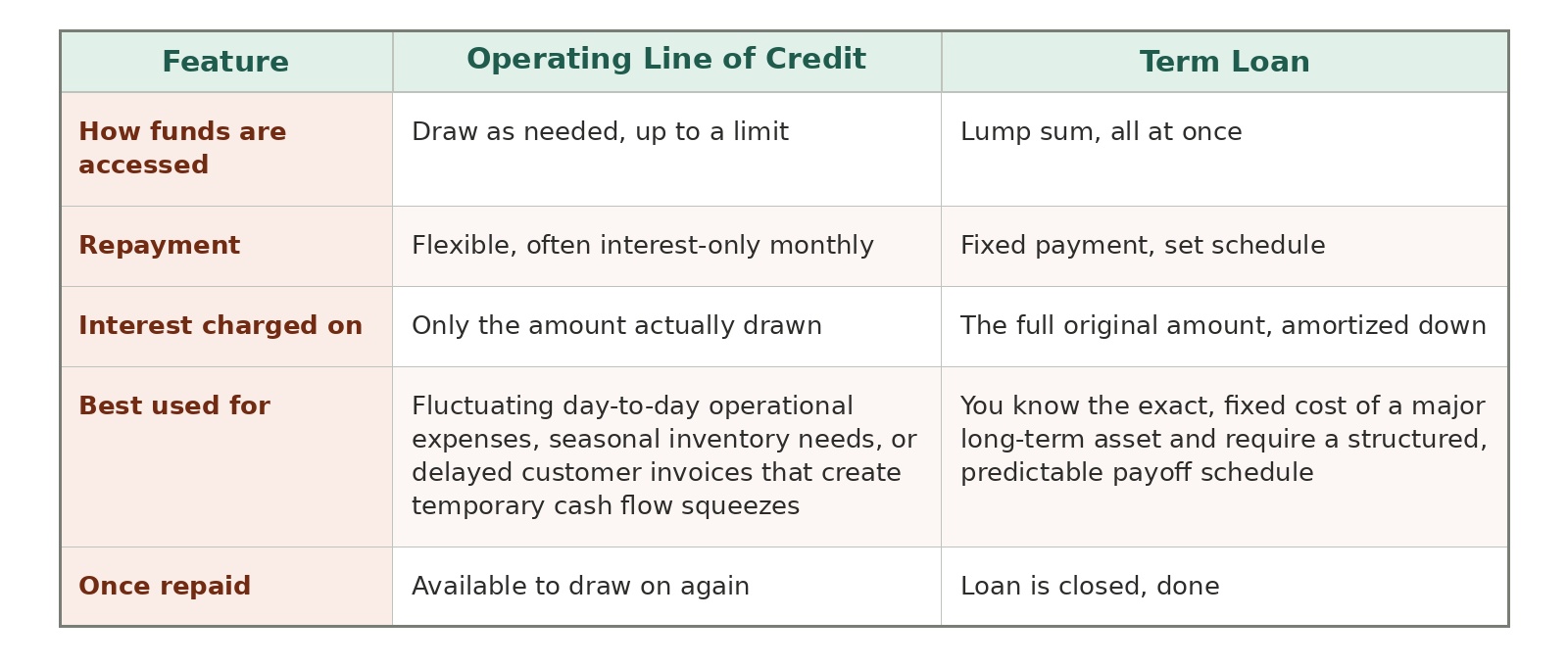
Alex made the decision. Using the LOC to pay the operating bills was exactly what Bridging debt was for. It was a good decision to not put the office furniture on the term loan. Because Alex had been saving for it, the office furniture could be purchased with the cash set aside, instead of continually diverting it to cover bills.
Different debt. Different job. And, Alex realized, that was the point. Alex realized it was time to figure out how to make late payments less costly to the business.
C. Was the credit card ever really an option?
Now that Alex understands the three kinds of debt (leverage, bridge, and consumption) ...
 Consider setting a credit card purchase policy ... and follow it.
Alex starts to formulate a plan and business policy about what should and should not be paid by credit card.
- One part of the policy for certain is no purchase can be put on the card if the funds are not available to pay off the credit card balance in full and on time every month.
- If cash is tight, Alex needs to implement a spending freeze. Why? To determine if the business is spending money in the most efficient way possible.
What Alex did
- After exploring supplier credit financing, Alex opted for a bank term loan to purchase the computer equipment.
- Alex also created some rules for what type of purchases could go on the operating line of credit the bank approved.
- In addition, the bank recommended a bank overdraft to ensure payments made didn't bounce if a customer's payment was rejected or charged back.
- And finally, the credit card policy put in place is now working great once a few tweaks were made.
- Alex was also really pleased with the result of the spending freeze. It feels good to be in control of cash flowing through the business instead of the business acting like a spoiled child and calling the shots.
6. Building the Full Picture
By now, Alex understands that the $5,000 loan isn't income. It created a liability that will gradually disappear as the loan is paid back.
But there is another piece of the puzzle worth understanding. What happens to each $155 payment? The loan agreement tells Alex the payment amount. An amortization schedule tells Alex what is hiding inside that payment.
Let's see what is happening inside the payment
An amortization schedule is simply a way of showing how a loan balance changes over time.
You don't have to be an accountant to create one. An online calculator (or a spreadsheet) can do the calculations for you. You need the amount borrowed, the interest rate, and the number of payments. The calculator will tell you your monthly payment and create an amortization schedule.
For Alex's $5,000 loan, the schedule might look something like this:
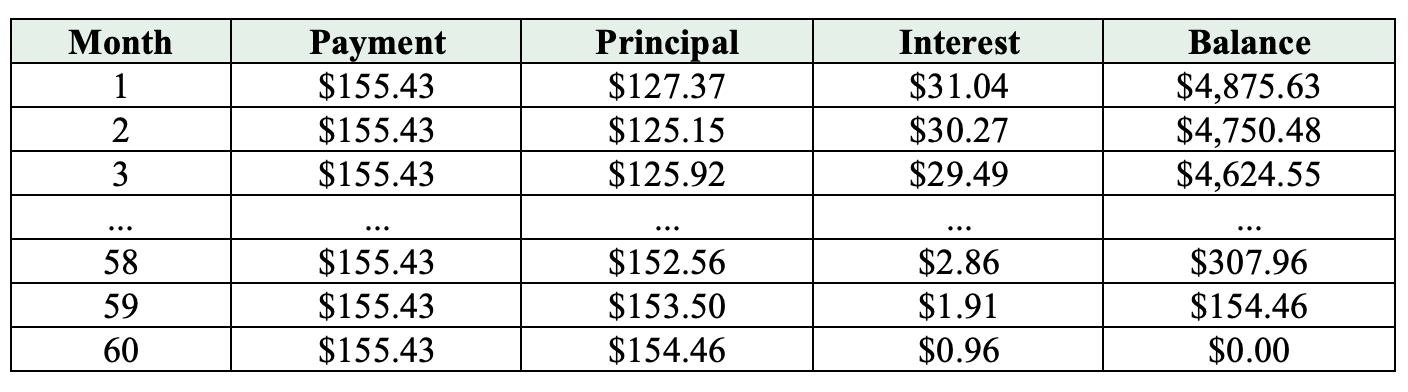
Look what happens. Alex's payment stays the same, but the mix changes.
At the beginning of the loan, a larger portion of the payment goes toward interest. As the outstanding balance gets smaller, less interest is charged. More of each payment can then go toward reducing the principal. By the time Alex makes the final payments, almost all of the $155 is paying down the loan itself.
🦆 Duck Wisdom
The part I want Alex to notice is ... a $155 loan payment is not the same thing as a $155 expense.
Now connect that to the bookkeeping
Remember the loan payment Alex makes each month? The amortization schedule explains why the bookkeeping entry has two pieces. Alex's second payment consists of:
- $30.27 interest
- $125.15 principal
- $155.42 total payment
The interest is an expense. It lives on Alex's Profit & Loss statement. The principal is not an expense. It reduces the Loan Payable liability on the Balance Sheet. And the whole $155.42 leaves Alex's bank account. So, in simple bookkeeping terms, the journal entry in Alex's books look like:
Debit Interest expense $30.27
Debit Loan Payable $125.15
Credit Bank account $155.42
Let's recap
- Looking only at the amount that left the bank doesn't tell the whole story.
- The bank statement tells Alex how much cash went out.
- The amortization schedule helps explain where that payment went.
- The bookkeeping puts the two pieces into the right places in Alex's financial picture.
One more thing to think about
There's also a useful business-planning question hiding at the end of that schedule.
Eventually, Alex will make the final loan payment. And then what? The $155-ish payment that has been leaving the business bank account every month will no longer be required for that loan.
Alex could simply let that money disappear into the general spending of the business. Or Alex could decide now what that freed-up cash will do later. Some possibilities:
- Maybe it will build a cash reserve.
- Maybe it will become the beginning of the fund for the next computer or other major purchase.
- Maybe it will go toward another debt.
- Maybe it will simply strengthen the business's financial cushion.
The important part isn't which choice Alex makes. It's that Alex makes the choice deliberately rather than discovering six months later that the extra $155 a month got gobbled up in the day-to-day operations without building wealth.
🦆 Duck Wisdom
That's another way of trusting your numbers. The loan tells Alex what must happen with the money today. Understanding the loan gives Alex a chance to decide what happens with that money tomorrow.
7. Three Questions to Ask About Debt
Alex circles back to the beginning of our initial discussion about debt ... to the three ways debt can behave. Having lived through this loan from start to finish, Alex wants to solidify what was learned to take forward into the business for future debt decisions. Alex wonders if it's possible to create a kind of cheat sheet to refer to next time the business is short of cash. Alex runs through a recap of what was learned.
- Alex didn't stumble into leveraging debt by accident.
- After weighing all three types of debt back at the start, Alex chose the equipment term loan deliberately.
- Alex determined the new computer and monitor would let the business take on work it was already turning away.
Looking back over everything since, the supplier financing Alex rejected as a borrowing solution, the monthly term loan payments, the line of credit, the credit card policy, the spending freeze ... Alex realizes the three categories of debt deserve a second look. Why? Knowing which bucket a debt falls into is one thing. Knowing what to ask before taking it on is another.
A. Leveraging debt
What is it? Borrowing to acquire something that can help the business produce more income or become more productive.
Alex remembers choosing this loan on purpose. It was leveraging debt, and Alex knew that going in. The equipment purchased with the borrowed money was intended to help the business take on larger projects and earn income. But that raises another question Alex hadn't really considered before:
"If a lender will lend me the money, does that mean I can afford it?"
Alex is aware the answer is ... not necessarily. The bank or the supplier financier is looking at the loan from the lender's perspective and criteria. Alex needs to look at it from the business's perspective.
Will the business have enough cash flow to make the payments and still pay its other bills? A loan approval tells Alex that a lender is willing to provide the money. It doesn't tell Alex that borrowing it is the best decision for the business.
🦆 Duck Wisdom
Going through this whole process, Alex is keenly aware now of the difference between being able to borrow and being able to afford the debt.
B. Bridging debt
What is it? Borrowing to get through a temporary timing problem, with a reasonable expectation that cash will be available to repay it.
Alex asks something that has been like an itch you can't scratch since being approved for a line of credit. The urge to buy stuff for the business is strong and all that credit is just sitting there.
"Once I've been approved for a business line of credit, is it part of my available money?"
Alex realizes this is a hard no. A line of credit isn't money sitting in Alex's bank account. It's money that Alex COULD borrow. That is the distinction Alex needs to keep in mind now that the bank approved the line of credit and bank overdraft.
Alex knows what happens if that line blurs. Treating available credit as part of the business's normal spending capacity turns a bridging tool into consuming debt without noticing the shift into 'bad debt'.
🦆 Duck Wisdom
A line of credit and a bank overdraft are a source of cash ... but only when it is planned for, needed, and quickly repaid. It's cash that needs to be MANAGED responsibly and purposefully.
C. Consuming debt
What is it? Borrowing to pay for something the business can't really afford, without a clear path to repayment.
Alex no longer has an unpaid credit card balance and the line of credit balance is at zero. This month though, Alex is flush with cash. Everyone paid their bills on time. For the first time in a while, there is money sitting in the bank beyond what is needed for this month's expenses. That makes Alex wonder:
"Is paying off debt the best use of available cash?"
Alex has figured out that the answer is ... not necessarily. There might be enough cash sitting in the bank to make an extra loan payment. But if that cash is also the business's only cushion against a slow-paying customer, an unexpected bill or next month's operating expenses, using all of it to pay down the loan faster is probably not a prudent use of the funds. Keeping cash available for the day-to-day operations of the business is a cushion. That's more important than paying debt down faster.
🦆 Duck Wisdom
Alex realizes the question isn't simply "Can I pay off this debt?" Alex needs to also ask, "What job does this cash need to do?"
A cheat sheet for debt
Alex has stopped seeing debt as automatically good or bad. What matters, Alex understands now, is (a) why the business is borrowing, (b) how the debt fits the cash flow picture, and (c) what the business expects to accomplish with the money.
That's why Alex's three categories are a useful cheat sheet for debt:
- Leveraging: What will this debt help my business do?
- Bridging: What temporary cash-flow gap am I solving, and when do I expect the cash to arrive? Can I repay it quickly?
- Consuming: Am I borrowing because I'm always running short of cash and don't have the money to pay for something like rent, utilities, insurance? If yes, freeze spending and do an audit to uncover the cause.
Alex's takeaway about debt is the label of 'good' or 'bad' shouldn't dictate your financial choices. Instead, analyze the specific numbers and risks behind it. Ask the right questions first.
8. What Alex Takes Away
- A loan isn't income, it's debt. Alex codes it to a liability account on the Balance Sheet called Loan Payable, not revenue that sits on the Profit & Loss Statement.
- Before taking on debt, ask what kind it is and if it is in the business's best interest. Some debt is good debt and some debt is bad. Alex weighed all three types before saying yes to the equipment loan.
- A lender saying yes to a loan isn't the same as being able to afford it. Check how the repayment terms will affect cash flow, since keeping a good credit rating matters too. Alex ran the numbers against the business's own cash flow before signing.
- Credit card spending, lines of credit and bank overdrafts are safety nets, not cash available to dip into at any time ... unless it is preplanned and can be repaid quickly. Alex learned this the hard way, making purchases on the credit card and not being able to pay off the balance when it came due. It constrained the business's future cash flow.
- Reconcile the bank's loan statement every month so the books match the bank's statement. Alex books the interest expense during this process.
9. 🦆 Solo CEO Move
Take a look at your latest loan statement. Find the outstanding principal balance and compare it with the Loans Payable balance on your Balance Sheet. Do they agree?
This is the step Alex was missing. Alex saw the balances did not, in fact, match. They were way off. The last time it looked right was in December of the previous year. Alex took a closer look and saw that Julie (CPA) had Alex book what Julie called an adjusting journal entry (AJE). One of the entries Alex booked at that time was an interest expense journal entry. It reclassified a portion of the prior year's loan payments to interest expense on the Profit & Loss Statement. Alex had been leaving that reclassification to Julie. But here's what Alex, and you, could do instead.
If the balances don't match, download your bank loan statements. Every bank or credit union statement in Canada reports the interest expense applicable to that month, right on the statement.
Because I want efficiency in my bookkeeping routine, here's how I book loan payments:
- Book the entire loan payment to the loan payable account. Nowadays, that's usually done through a recurring transaction or through the bank feed. My preference is a recurring transaction. Why? Because it posts an entry I'm expecting. If the entry doesn't show up in the bank feed, it won't clear. I can track down the issue right away.
Debit Loan Payable $155.42
Credit Bank $155.42
To record loan payment. - When your monthly loan statement is available (usually around the 5th or 6th of the month), download it.
- Find the interest charged for the month on the statement. Make a similar journal entry based on your statement:
Debit Interest Expense $30.27
Credit Loan Payable $30.27
To record interest expense. - Formally reconcile your loan payable account in your bookkeeping software. Use the same procedure as your bank account reconciliation to accomplish this task.
🦆 Duck Wisdom
As a result of all Alex has learned about debt and loans, Alex made a slight adjustment to the Money Monday routine. On the first Monday of each month, Alex added 'book loan interest expense journal entry' to the list of tasks. Then Alex added reconciling the Loan Payable account to the list of reconciliations.
Trusting Your Numbers
Small Business Bookkeeping | Basic Bookkeeping
Small business bookkeeping is an age old system designed to keep financial records in an organized way. Technology has made it easier than ever to learn.
The Solo CRA-Ready Workflow | Gather Process Results
A three-step bookkeeping workflow for Canadian solopreneurs. How Gather Process Results keeps your books current and CRA-ready.
CRA-Grade Records System | Self-Employed Canadians
A classic accountant's workflow built for the digital age. Keep records CRA can follow five years from now - even if your bookkeeping software is gone.