- A Roadmap To CRA Compliance and Financial Stability
- The Concierge Desk
- The Backgrounder Library
- The Six Stages of a Trade Deal
The Six Stages Of A Trade Deal: From First Contact To Implementation
A Backgrounder Article | Drawer E: The Economy - What's Behind The Headlines

By L.Kenway BComm CPB Retired
This is the year you get all your ducks in a row! Start by starting ... and keep it simple. Consistency beats perfection.
Published July 23, 2026 | Edited July 27, 2026
WHAT'S IN THIS ARTICLE
Introduction | Diplomatic Outreach | Framework | Negotiation | Signing | Ratification | Implementation | Gaps Between Signing and Implementing | FAQ | The Takeaway
BACK TO >> Backgrounder Library
RELATED >> Why Canada Is Changing Its Trade Strategy
 A handshake may make headlines, but a trade deal isn't official until it clears six distinct stages ... from first outreach to full implementation
When a government announces a 'new deal' with another country, it could mean almost anything ... a leader's first visit, a joint declaration of shared goals, or a fully ratified agreement already changing tariffs at the border. All three may get described as 'deals' in headlines, but they're nowhere near the same thing.
The Six Stages Of A Trade Deal
Here's the actual pipeline a trade relationship moves through, and why knowing which stage something is at matters more than the announcement itself. Keep in mind, that not every trade relationship goes through every stage in exactly this order.
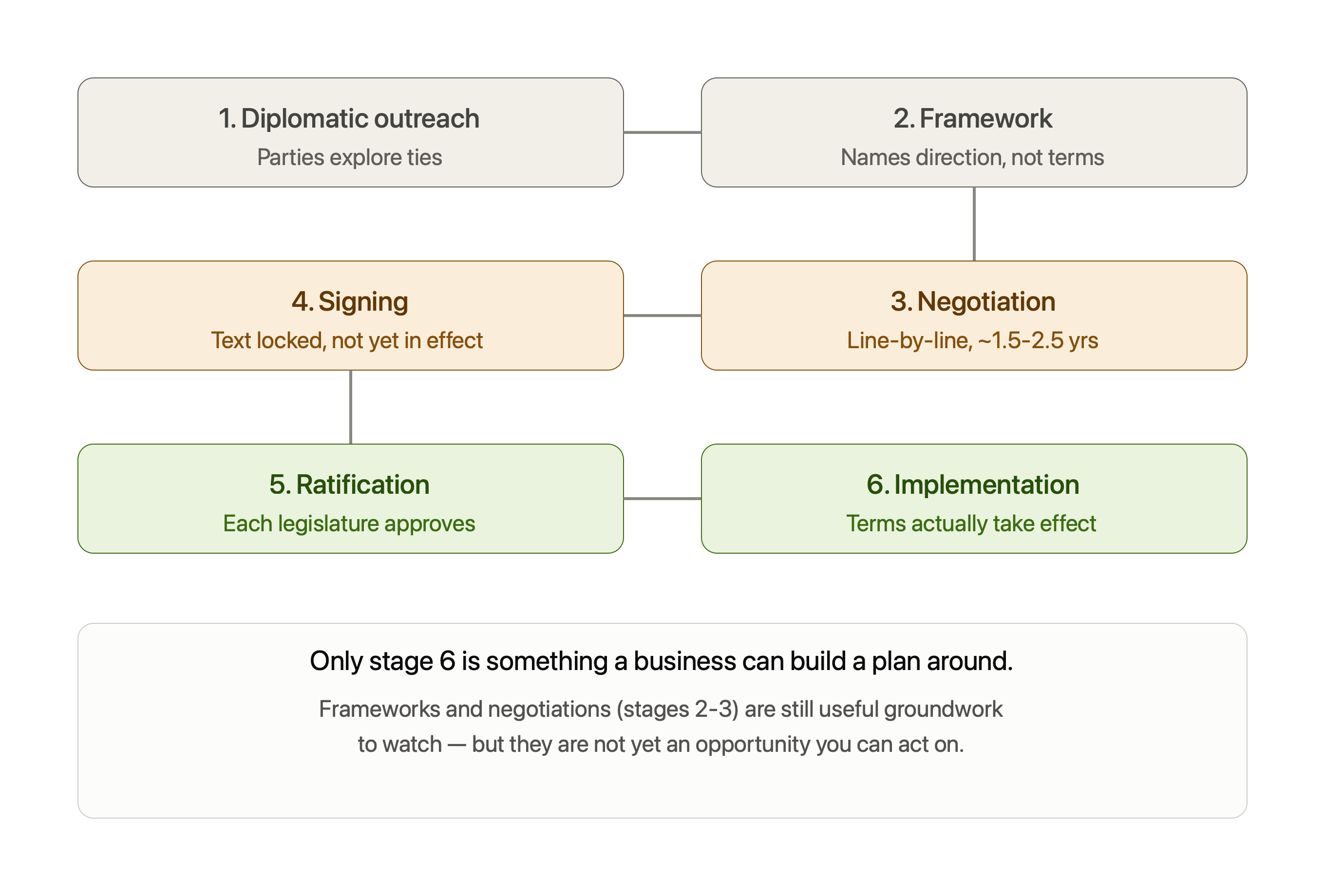 Diagram: A framework and a ratified agreement both get called a 'deal.'
Only one changes what a tariff costs you tomorrow.
1. Meet & Greet / Diplomatic Outreach
Two countries begin exploring closer economic ties. This may involve meetings between heads of government, trade ministers, or senior officials, along with diplomatic outreach and exploratory discussions.
Nothing is committed to yet. This stage simply establishes that both sides are willing to explore further cooperation.
2. Framework / Statement of Intent
The two sides agree on what they want to cooperate on ... trade, energy, defence, critical minerals, and so on ... often with a target date to begin formal negotiations.
This stage is often formalized through a 'strategic partnership framework' or a similar joint declaration. It names direction, not terms. No tariffs change. No market access opens. Nothing is enforceable. But it's the necessary first agreement that makes everything after it possible.
Before formal negotiations begin, governments often conduct feasibility studies, consult domestic industries, and establish negotiating mandates.
3. Negotiation
This is where the real, time-consuming work happens. Negotiators go through what each country imports from the other, tariff line by tariff line, determining how each product category will be tariffed ... everything from t-shirts to pharmaceuticals to cars.
Alongside that, they negotiate rules of origin, intellectual property protections, labour and environmental standards, dispute resolution mechanisms, digital trade rules, and government procurement access.
Much of this work is highly technical, with lawyers translating political compromises into legally enforceable treaty language.
My general research (sorry I wasn't diligent on documenting as I was scanning) on past agreements puts average negotiation length at roughly a year and a half to two and a half years ... though this varies enormously depending on how many issues are contentious and how many countries are at the table.
4. Signing
Negotiators reach a final agreed text, and leaders formally sign it. This is usually the moment that generates headlines and photo-ops ... BUT a signed agreement is not yet a working one.
Signing means the text is locked in; it doesn't mean it's in effect.
5. Ratification
Each country follows its own constitutional approval process.
In Canada, treaties are typically tabled in Parliament. Agreements requiring changes to domestic law must pass implementing legislation before Canada can fully carry out its obligations.
6. Implementation / Entry Into Force
The agreement finally takes effect. Tariffs change, quotas open, businesses can actually operate under the new terms.
But 'entry into force' isn't always one clean cutoff moment. Some commitments are implemented immediately while others are phased in over several years. For example, some commitments may apply immediately, tariff reductions are phased in over years. Tariff reductions often step down gradually rather than dropping to zero overnight, and quotas may expand in stages.
Entry into force isn’t necessarily the end of the story. Most major trade agreements include review mechanisms and may later be amended, expanded, or renegotiated as economic conditions change. Our current CUSMA review process, or where new members join a larger regional agreement are good examples of how agreements evolve after entering into force.
Even with those caveats, this is still the only stage where a deal becomes something a business can act on with real terms. It's just worth checking the fine print on timing before assuming full benefits apply on day one.
Why the Gap Between Signing and Implementation Is Often Years, Not Months
Historical data on completed agreements shows negotiation alone averages about a year and a half, but reaching full implementation after that takes over three and a half years on average.
The gap between signing and implementation alone has averaged close to four years in recent agreements. The fastest deal on record for Canada took under four years start to finish (Canada-U.S. Free Trade Agreement, 1985–1989); the slowest, CETA (Canada-EU, launched 2009), took eight years just to reach provisional application in 2017 — and still isn't fully ratified today.
Notice these are averages and depend heavily on what implementation means, whether negotiations stalled, or if it was a bilateral or multilateral agreement.
Frequently Asked Questions
Do businesses need a free trade agreement to do business in another country?
Do businesses need a free trade agreement to do business in another country?
No. FTAs (Free Trad Agreements) make trade easier and cheaper, but they aren't a prerequisite for market access. Companies sell into, invest in, and sign contracts with other countries all the time without one ... that's ordinary international commerce under WTO (World Trade Organization) baseline rules.
What an FTA adds is preferential tariffs, legal protections, and a competitive edge over suppliers who don't have one. Cameco's recent $2.6 billion uranium supply contract with India is a good example. It was signed before Canada and India's CEPA was finalized, because the deal made sense under existing rules ... it didn't need to wait.
What's the difference between a Memorandum of Understanding and a framework or statement of intent?
What's the difference between a Memorandum of Understanding and a framework or statement of intent?
They're related but not the same thing. One's a document type, the other's a stage.
A framework describes where a relationship is in the pipeline ... both sides have agreed on what they want to cooperate on and are heading toward negotiation.
An MOU (Memorandum of Understanding) is a type of document ... often how that Stage 2 intent gets written down. But MOUs also show up completely detached from any pipeline. For example: a research partnership, an info-sharing arrangement, a one-off cooperation pledge that was never heading toward a trade agreement at all.
Every Stage 2 framework is often expressed as an MOU, but not every MOU is a Stage 2 framework ... some are the whole relationship, start to finish.
Why isn't CETA - Canada European Union Trade Agreement, a deal signed back in 2016, fully in force yet?
Why isn't CETA - Canada European Union Trade Agreement, a deal signed back in 2016, fully in force yet?
CETA has been provisionally applied since 2017, meaning most of it already works day to day. But full, permanent entry into force requires all 27 EU member states to individually ratify it through their own domestic processes.
As of recent reporting, 10 states still hadn't ratified it, including France, Italy, and Belgium. The holdup isn't one single objection. It clusters around a few recurring concerns: CETA's investor-dispute-resolution mechanism, which critics worry lets foreign companies challenge domestic laws outside normal courts; protection for domestic farmers from Canadian agricultural competition; and worries that the deal could pressure EU environmental and food-safety standards, even though CETA's text leaves those standards unchanged. In several countries, ratification votes have also become tangled up in domestic political fights that have little to do with the agreement itself.
That's not a sign the deal failed. It's a reminder that 'signed' and 'ratified' and 'in force' can be three very different milestones, sometimes separated by many years, even for a deal both sides already benefit from.
The Takeaway
When you read that a government has 'signed 20 deals' over a certain time period, ask which stage each one is actually at. A framework from stage 2 and a ratified agreement from stage 6 both get called deals ... but only one of them can change what a tariff costs you tomorrow.
As mentioned at the start, that not every trade relationship goes through every stage in exactly this order. Governments sometimes announce negotiations immediately, update existing agreements instead of negotiating from scratch (think CUSMA), or negotiate sector-specific agreements (something the U.S. Administration is currently trying to achieve with bilateral agreements with Canada and Mexico.)
It's a bit like courtship before a wedding ... the flowers, the dinners, the dates all matter, but no one signs a marriage contract on the first date. So when you hear 'nothing has been done', it's worth asking which of these six stages of 'nothing' is it being measured against. A framework is not nothing. A negotiation is not nothing. They're just not a ring on the finger yet either.
Moral of the story? The earlier stages aren't meaningless; they're the groundwork every later-stage agreement had to pass through first. But groundwork is not the same as an opportunity you can act on yet.
Other Backgrounder Articles
Canadian Bookkeeping Compliance Resource | Site Blueprint
A structural blueprint for the website making it easier for visitors to find what they are looking f
How Are Sole Proprietors Taxed In Canada | Marginal Tax Rate Explained
Knowing how sole proprietors are taxed provides motivation to have audit ready books. You're in a high risk group for getting audited. Learn about your marginal tax rates as well.
How Governments Raise Revenue | A Backgrounder
Discover the three ways governments raise revenue and why understanding Canadian tax policy helps you make better strategic decisions for your business.