- A Roadmap To CRA Compliance and Financial Stability
- Navigating Change
- What's Happening
- Interprovincial Trade Barriers
Interprovincial Trade Barriers
An Explainer for Canadian Solopreneurs

By L. Kenway BComm CPB Retired
Research and first draft by A.P. Kenway
Images designed by S.A. Kenway, with AI-assisted drafting
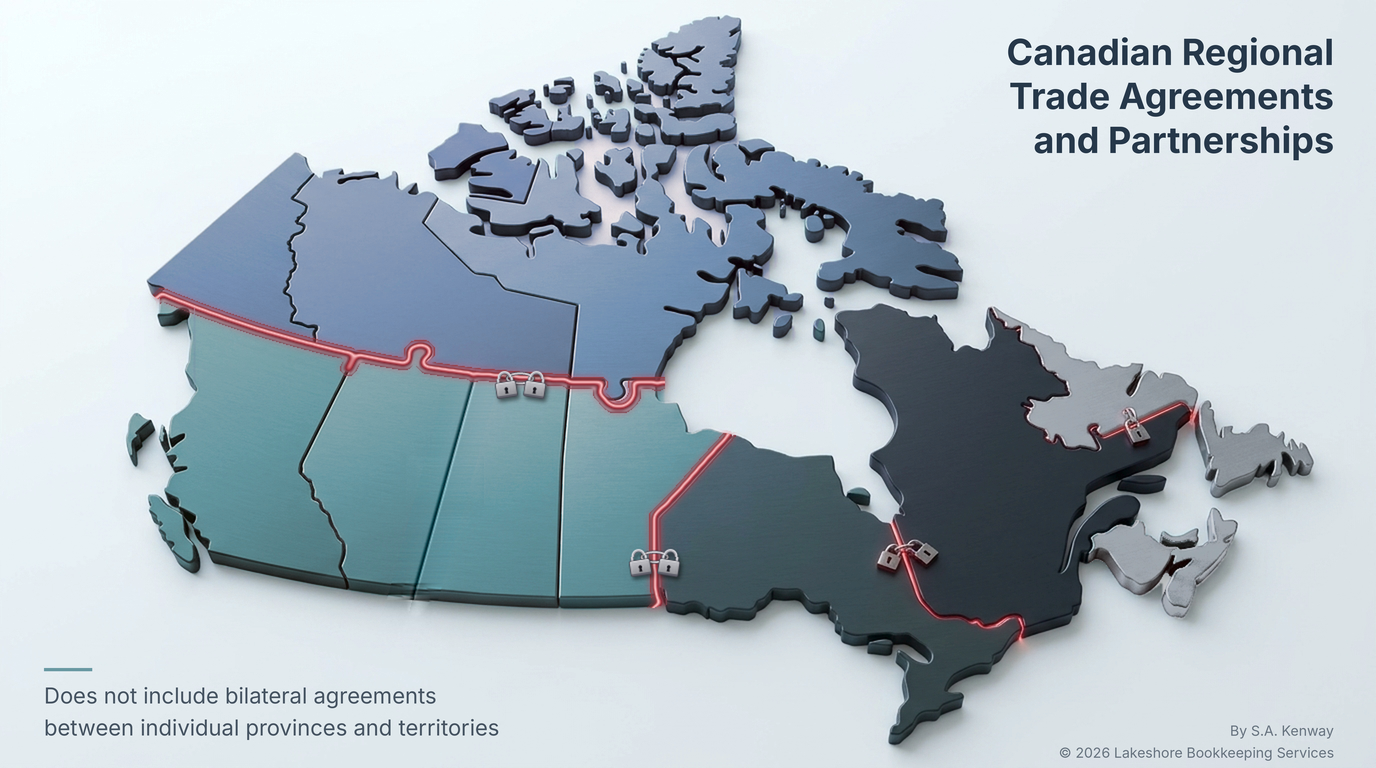 Canada’s regional trade groupings.
Red borders and padlocks show where one region ends and the next begins.
WHAT'S IN THIS ARTICLE
Who Is This Page For? | Introduction | Questions This Page Answers | Summary | A. The Basics | B. The Mechanics | C. Next Steps | Takeaways | 🦆 Solo CEO Move | Methodology
BACK TO >> What’s Happening: Canada’s Trade Shifts
RELATED >> Tracking Canada's Trade Deals | Canada-U.S. Tariff Timeline: Tracking Tariff Changes | What’s Next? Building a 10-Year Plan in an Era of Trade Uncertainty
Who Is This Page For?
- Canadian solopreneurs, self-employed workers, freelancers, and home-based business owners who sell or want to sell outside their home province within Canada.
- If you ship products, bill clients, bid on contracts, or offer a service in another province, the rules covered here may affect you.
- Anyone who wants to know how the rules work.
This page is general information. It does not replace advice from a professional.
Introduction
By the end of this page, you should be able to talk about interprovincial trade barriers at a holiday party and sound like you know what you’re talking about!
Since the trade war with the USA began, Canadians have been pulling together. 'Buy Canadian' has grown from the grassroots. For some, it has even changed where they go on holiday.
But have you noticed? It takes work to 'buy Canadian'. I tried to buy Canadian-sourced lettuce in the early spring. Canadian lettuce was priced at double the Mexican lettuce, so I bought the Mexican. Seasons matter in Canada. In the summer, Canadian lettuce was competitively priced, so I was able to buy it on my budget.
That got me wondering about the other side of the counter. We say we are one country, but how easy is it for a small Canadian business to sell into another province? I had no idea before I started researching it. That is why I wrote this article.
This is a reference page, not an article to read from the top. Where to start? Short on time? Read the summary, then jump to the tracker in Section 3 ... or start with questions below.
Within each section, this article is structured to read in two ways. The short version is at the top of each section. The 'Go deeper notes' holds the detail and the sources. Use them when you want to check something or want to know more. Skip them if you don’t.
Questions This Page Answers
Pick the question you need answered, and read only that section. The 18 questions below are grouped into Basics, Mechanics, and Next Steps.
A. The Basics (5 questions)
A. The Basics (5 questions)
B. The Mechanics (6 questions)
B. The Mechanics (6 questions)
Summary
- What they are: Interprovincial trade barriers are rules, registrations, and licensing differences that can make selling into another province harder than selling at home. Provinces and territories set many of them.
Jump To >> Why can’t Canada simply remove them? - Why you should care: A larger company can hand this work to staff. In a one-person business, the owner does it. The extra time can decide whether a sale happens at all.
Jump To >> See four examples of how this plays out - Where things stand: Some barriers have eased. Four of the twelve on my tracker have not moved at all. Many of the next steps are still targets or proposals.
Jump To >> Check the tracker Jump To >> What’s coming next - What this page helps you do: See which barriers touch your business today, and plan around them while governments keep working on the rest.
Jump To >> What To Watch Right Now
A. The Basics
Jump To >> What are interprovincial trade barriers? | Who controls the barriers?
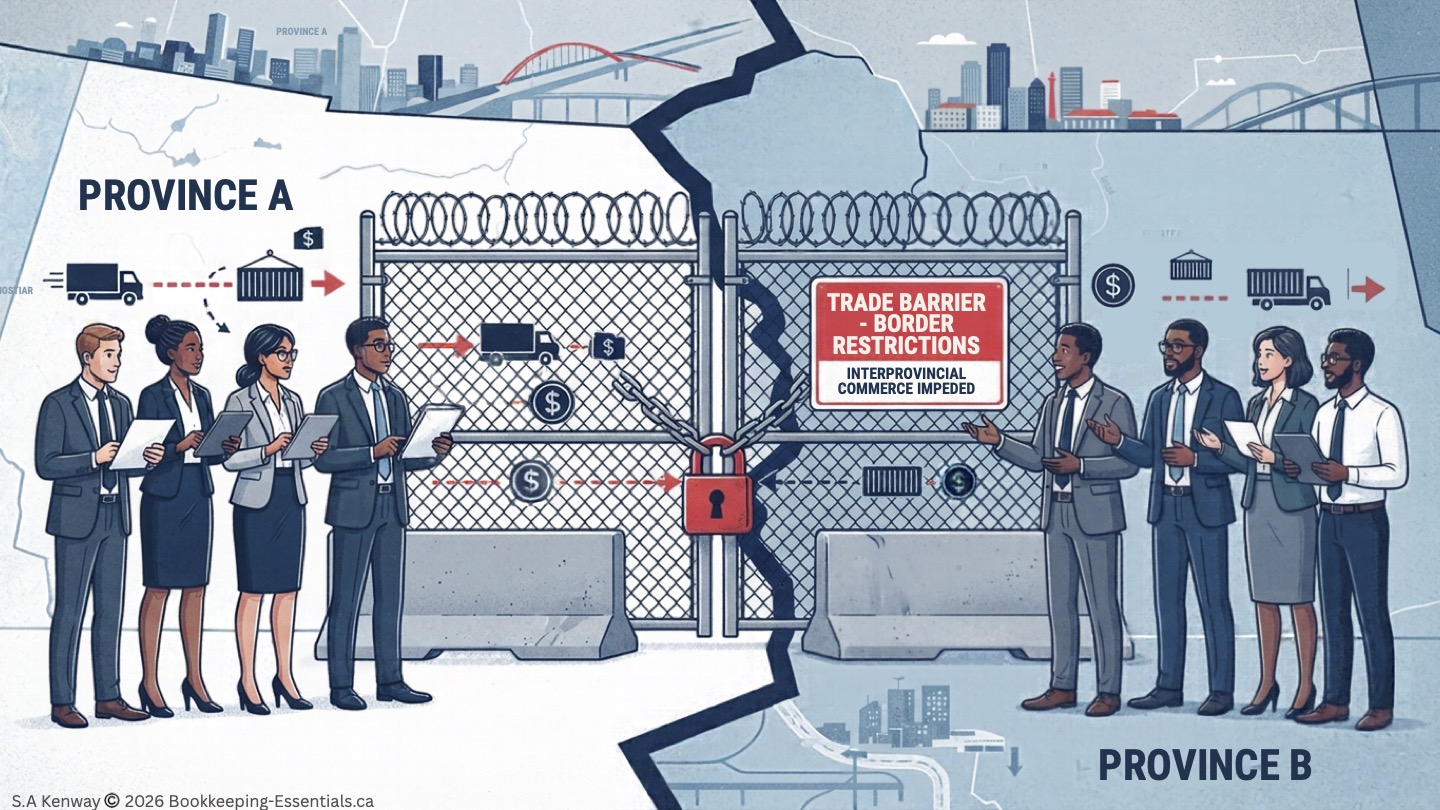 Rules that differ from province to province can act like a locked gate.
Goods, money and services pile up at the border.
1. What are interprovincial trade barriers?
Interprovincial trade barriers are rules, registrations, and licensing differences that can make it harder to sell from one province into another.
- Canada is one country, but each province and territory sets its own rules in many areas.
- Barriers take several forms. They include licensing requirements, registration rules, product standards, and rules for bidding on government contracts.
- Each of these can vary from one province to the next. The differences add up.
- A barrier can stop a sale. Complying with another province’s rules can cost a one-person business more time and money than the sale is worth. I'm calling this extra time, expense, and effort friction.
In Section 3, I've created a tracker that shows which barriers have changed and which remain.
Why can't Canada simply eliminate these barriers?
Governments have worked on reducing them since at least the 1995 Agreement on Internal Trade. But Canada's constitutional structure makes eliminating barriers more complicated.
Consider how three different systems handle internal trade:
- The United States. Courts use the Constitution's Commerce Clause to limit states from blocking trade between states.
- The European Union. Treaties set up a single market, and EU courts enforce it.
- Canada. The Constitution limits some provincial barriers, but not every rule that affects trade. Provinces retain authority over many areas of business regulation.
📚 Go deeper notes
- Trucking - how friction adds up. A truck travelling from British Columbia to Newfoundland can encounter different standards in each province it enters. Some trucking rules have been aligned for years, but differences remain. Governments are working to reduce this friction through further agreements. These sources describe that work:
✔ The Council of Ministers Responsible for Transportation and Highway Safety, which brings together the federal, provincial, and territorial governments, publishes a summary of its agreement on weights and dimensions.
✔ The trade publication Truck News reported on an interprovincial trucking agreement aimed at cutting red tape.
✔ The Treasury Board of Canada Secretariat describes the wider effort on regulatory cooperation and mutual recognition.
Sources: Council of Ministers Responsible for Transportation and Highway Safety [15], Truck News [16], Treasury Board of Canada Secretariat [17] - The 1995 agreement. This effort is older than you might expect. Torys LLP, a Canadian law firm, traces it back to the 1995 Agreement on Internal Trade in its February 2025 overview of the topic. The same overview describes how each province and territory sets its own rules for licensing, certification, technical standards, and health and safety.
Source: Torys LLP [24] - Further reading on internal trade systems. The comparison above is short, so here is a little more.
In the United States, the Constitution gives Congress the power to regulate trade between the states. Cornell Law School’s Legal Information Institute explains that courts have read that power as limiting what a state can do to block trade.
The European Union took a different route. Its founding treaties promise free movement of goods, services, capital, and people. The European Commission describes how that single market is kept in place.
Sources: Cornell Law School [44], European Commission [46]
2. Who has the authority to change the rules?
Three levels of government shape these rules. Provinces and territories set many of them. The federal and municipal governments add their own layers.
- Federal. Ottawa can regulate trade and commerce, but only on matters that are national in scope, due to constitutional limits. That leaves most licensing and product standards regulations within provincial jurisdiction.
- Provincial and territorial. Provinces control licensing, most business regulation, liquor, and many product and technical standards. They create much of the friction, so they are the ones who need to change it.
- Municipal. Cities and towns control zoning, business licences, local permits, and some procurement. A province can change or override what a municipality does.
How do governments work together to reduce barriers?
Because different governments control different rules, reducing barriers often requires cooperation.
- The Canadian Free Trade Agreement (CFTA). This is an agreement among the federal, provincial, and territorial governments. It establishes rules for trade within Canada, but governments can maintain certain exceptions. It replaced the Agreement on Internal Trade (AIT) from 1995. (In force 2017)
- The Canadian Mutual Recognition Agreement on the Sale of Goods (CMRA). Goods sold legally in one province can generally be sold in another. Food, alcohol, cannabis, tobacco, live animals, and plants are excluded. Services are next, targeted for the end of 2026. (Signed 2025, implemented mid-2026)
- The Free Trade and Labour Mobility in Canada Act. This is a federal law that addresses certain federal requirements for goods, services, and occupational licences. It applies only to Ottawa’s own rules. It does not change provincial rules. (In force 2026)
Can Ottawa override the provinces?
In most cases, no. Ottawa can change its own rules, but many barriers fall within provincial jurisdiction. That is why agreements among governments are important.
📚 Go deeper notes
- Canada's constitutional division of powers. Section 91(2) of the Constitution gives Parliament authority over trade and commerce. Section 92(13) gives provinces substantial authority over property and civil rights, including many business regulations.
In R. v. Comeau (2018), the Supreme Court ruled that Section 121 prohibits tariffs and similar restrictions whose primary purpose is to impede interprovincial trade. It does not prohibit every provincial law that incidentally restricts trade.
Sources: Supreme Court of Canada [45], Torys LLP [24] - Why municipalities answer to the province. You may wonder why a province can override a city or town. The reason is that municipalities are not a separate level of government in the Constitution. Each province creates its own municipalities and passes laws that give them their powers. A city can license your business or require a permit, but only because the province allowed it. For a business from another province, those local rules can still be one more thing to check before a sale.
- The CFTA and its exceptions. The 2017 Canadian Free Trade Agreement covers most areas of economic activity, including labour mobility and government procurement. Governments can maintain exceptions to its rules.
Ottawa removed all 53 of its own exceptions in 2025, but that did not automatically remove provincial exceptions or change provincial legislation.
Sources: CFTA Labour Mobility chapter [1], Advancing Internal Trade [20], Torys LLP [24] - What the federal Act actually changes. Under the Free Trade and Labour Mobility in Canada Act, comparable provincial requirements for goods and services can satisfy certain federal requirements.
Federal regulators must also recognize comparable provincial occupational licences where the Act applies. The legislation does not require provinces to recognize each other's rules.
Source: Free Trade and Labour Mobility in Canada Act, Justice Laws Website [47] - Alcohol - why federal action wasn't enough. Ottawa moved to remove its own barrier on interprovincial alcohol shipments in 2019. However, provincial liquor regulations remained.
Each province still sets its own rules, and liquor boards earn billions for provincial governments. In 2024-25, the LCBO returned $2.13 billion to Ontario, while Quebec's SAQ returned $1.401 billion to its provincial government. Together, that's more than $3.5 billion.
Section 6 explains the newer direct-to-consumer shipping agreement. As they said in Jerry Maguire, “Show me the money!”
Sources: Government of Canada [48], LCBO [41], SAQ [42]
B. The Mechanics
Jump To >> What has changed? | The Tracker | What hasn't changed? | What does this mean for a small business? | Regional agreements in place
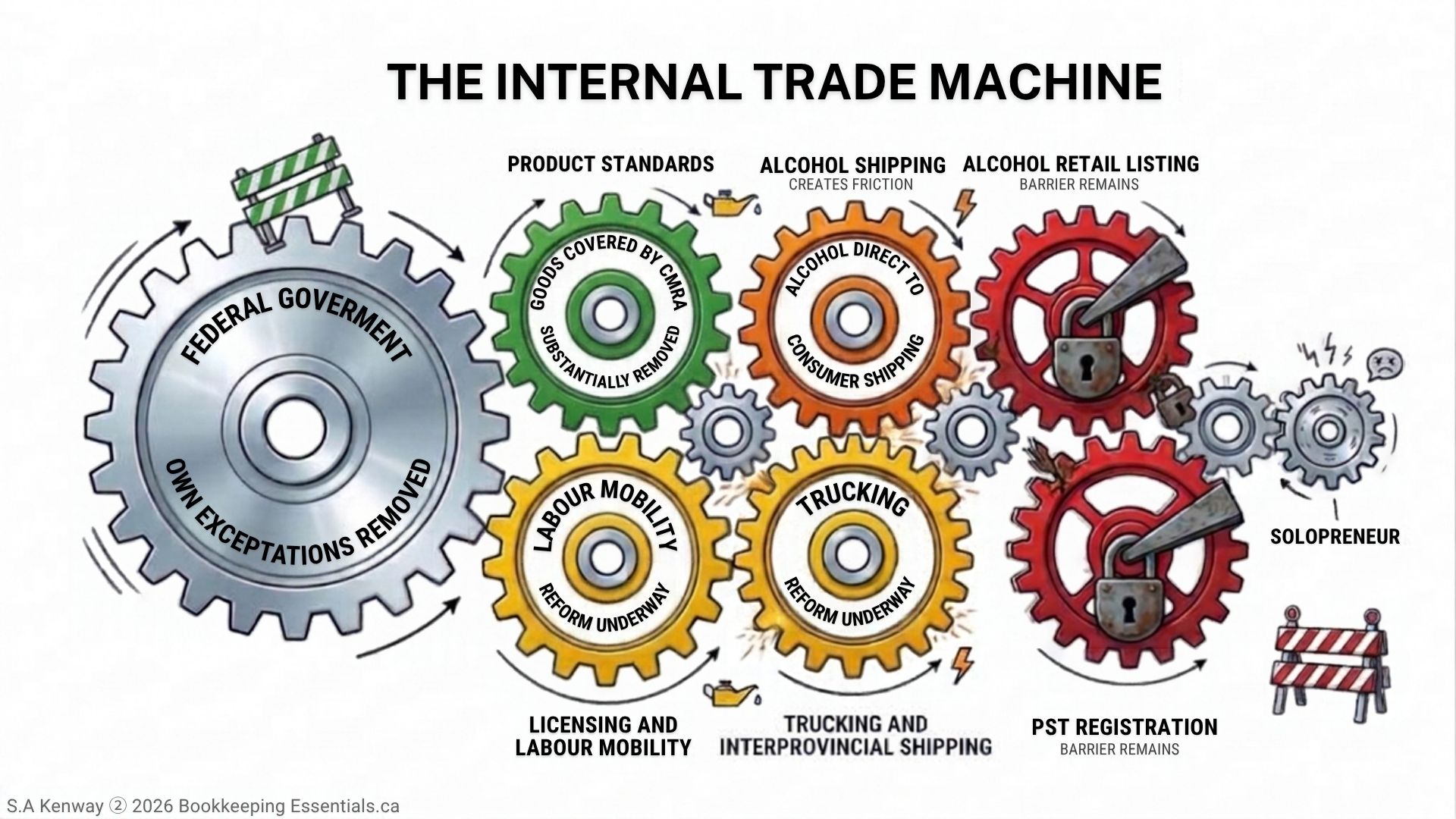 The status of interprovincial trade barriers in November 2026
3. What has changed?
Governments have signed agreements and introduced reforms to reduce interprovincial trade barriers. But signing an agreement doesn't necessarily mean the barriers have disappeared.
I've created a tracker to show where twelve barriers stand, what progress has been made since early 2025, and which rules a one-person business still needs to plan around.
Legend: Interprovincial Trade Barrier Tracker
🟢 Removed or substantially addressed. The barrier is gone or reduced enough that it is no longer worth planning around.
🟡 Reform underway. Governments have signed something, but it is not fully in place yet, or it is being rolled out in phases.
🟠 Still creates friction. Formal progress has been made, but differences remain in practice.
🔴 Barrier remains. Nothing has substantively eased. Plan around it as is.
| Barrier | Status | What It Means | Who It Affects | Jurisdictions |
|---|---|---|---|---|
| Product standards & labelling: goods covered by CMRA [10] | 🟢 | Goods that can legally be sold in one province can generally be sold in another without extra testing or approvals. Some listed product requirements remain. | Physical-product businesses | All 13 |
| Goods excluded from CMRA [10] | 🟡 | The CMRA does not cover food, cannabis tobacco, live animals, plants. Each province’s own rules still apply. Alcohol is tracked separately below. | Producers and sellers of these goods | All 13 |
| Licensing & labour mobility [1] [9] | 🟡 | Recognition works between provinces that both regulate an occupation. A 30-day service standard for applications was ratified in August 2026. Gaps remain when an occupation is regulated in one province but not another. | Trades and regulated professions | All 13, varies by occupation |
| Trucking & interprovincial shipping [15][16][17] | 🟡 | Partly harmonized for years, still filling remaining gaps | Owner-operator truckers and anyone shipping goods by road | All 13; several items still under negotiation |
| Construction codes & approvals | 🟡 | Building codes and product approvals still differ between provinces. Governments are working to harmonize codes and approve new building materials and prefabricated homes. Only willing jurisdictions have signed on so far. | Builders, renovators, and makers of building materials or prefab homes | Willing jurisdictions; varies |
| Services (mutual recognition) | 🟡 | The CMRA covers goods only. In March 2026, governments committed to extend mutual recognition to services by December 2026. | Consultants, contractors, and others who sell services across provinces | Federal, provinces, and territories |
| Government procurement [6][7] | 🟠 | Local preference is legal below set dollar thresholds | Businesses bidding on government contracts | All 13; MASH* sector runs separately |
| Alcohol shipping (direct-to-consumer) [11][12][13][14] | 🟠 | Shipping directly to consumers is rolling out province by province, not yet universal | Small beverage producers | See Section 6 for the full breakdown |
| Alcohol retail listing and sales through liquor boards [11][41][42] | 🔴 | Provinces do not have to stock another province’s products. Selling through a liquor board is separate from shipping directly to a customer. | Small brewers, distillers, and wineries | All 13 |
| Provincial sales tax registration [2][3][4][5] | 🔴 | Registration rules vary by province, and some set a minimum sales threshold | Anyone shipping product or billing clients there | BC, Saskatchewan, Manitoba, Quebec |
| Quebec’s French-language commerce rules [8] | 🔴 | French required on commercial materials, and on signs and packaging where they apply | Anyone selling to Quebec consumers | Quebec only |
| Supply management (Dairy, egg & poultry) [18] | 🔴 | Production is controlled by provincial quotas. Trade reform has not changed this. Some analysts call it an internal barrier. The industry disagrees. | Dairy, egg, and poultry producers | 10 provinces; NWT (eggs only); not in YT, NU |
*MASH - Municipalities, Academic institutions, School boards, and Hospitals
Four of the twelve barriers remain in place (red status). Section 4 covers those. Only one of the twelve is green. Ottawa has removed its own CFTA exceptions, but most of the rules a one-person business meets are set by provinces.
📚 Go deeper notes
- Labour mobility. A remaining gap exists. Mutual recognition generally works when both provinces regulate the same occupation. But if your home province does not regulate your occupation, a province that does may not recognize your qualifications. Quebec's regulation of human resources consultants is one example.
Sources: CFTA labour mobility information [1], Quebec professional regulation [9] - Provincial sales tax and purchasing. Two rows on the tracker show provincial authority at work - sales tax registration and government procurement.
Some provinces run their own sales tax systems. British Columbia, Saskatchewan, Manitoba, and Quebec each publish their own registration rules for out-of-province sellers. Each province also handles its own government purchasing. The shared rules for that sit in the procurement chapter of the Canadian Free Trade Agreement.
Section 4 explains how the sales tax rules differ, and Section 5 shows what the procurement rules mean for a two-person business bidding on government work.
Sources: Government of British Columbia [2], Government of Saskatchewan [3], Manitoba Finance [4], Revenu Québec [5], Canadian Free Trade Agreement, Government Procurement chapter [6]
What The Canadian Mutual Recognition Agreement Is ... And What It Covers
- Definition: Mutual recognition means one province accepts what another has approved. For goods covered by the agreement, this can eliminate the need to meet additional provincial requirements.
- How it works: The CMRA is an agreement among governments. Each province and territory is responsible for putting it into effect through its own laws or regulations.
- Timeline: Signed November 19, 2025. Governments set June 30, 2026 as the deadline for every province and territory to have it in place.
- Status: By August 2026, the federal government confirmed that the CMRA had been implemented. All 13 provinces and territories had signed. Work was underway to expand mutual recognition to services by the end of 2026.
- Included: Goods in Chapters 25 to 97 of the Harmonized System. This is the customs classification code. Examples include clothing, toys, furniture, household appliances, electronics, tires, and vehicles.
- Excluded: Food, alcoholic beverages, cannabis, tobacco, live animals, and plants. Each government can also list its own exceptions in Annex A.
- Also out: How a good is sold, and who may sell or buy it. The agreement covers the goods themselves ... not every rule governing their sale. Provincial sales tax registration is one example. It is my view that it acts as an interprovincial trade barrier for small businesses and self-employed workers from other provinces. Why? Because that can still mean extra paperwork and compliance costs.
4. What hasn’t changed?
Four barriers on the tracker are red. None of them has eased. Plan around each one as it stands today.
- Alcohol retail listing and sales through liquor boards. Provinces are not required to stock alcoholic beverages from other provinces. A small producer from another province can be treated like a foreign supplier. This is separate from the progress being made on direct-to-consumer shipping.
- Provincial sales tax registration. Selling into British Columbia, Saskatchewan, Manitoba, or Quebec can mean registering to collect tax there. The rules vary by province.
- Quebec’s French-language commerce rules. Selling in Quebec usually means French on commercial materials. Signs and packaging also have their own rules. Together, they add steps that a one-person business has to work through.
- Supply management. Dairy, egg, and poultry production runs on provincial quotas. Some analysts call this an internal trade barrier. The industry disagrees.
📚 Go deeper notes
- Alcohol retail listing. Even if a producer's alcoholic beverages are already listed for sale in their home province, that listing does not automatically carry over to another province.
Getting a product onto liquor store shelves is a separate process from shipping directly to consumers. Provincial liquor authorities have their own product registration, listing, pricing, and distribution requirements. Depending on the province, a small producer may need a registered agent, product testing, or approval through a formal listing process. These additional steps can make expanding into another province costly and time-consuming.
Sources: CFTA Trade in Alcoholic Beverages [12], CFTA direct-to-consumer agreement [40]. - Sales tax. Each province with its own sales tax has different registration requirements. Some have minimum sales thresholds, while others require registration based on the type of sale or business activity. A self-employed worker selling into several provinces may need to check more than one set of rules.
Sources: British Columbia [2], Saskatchewan [3], Manitoba [4], Quebec [5]. - French-language commerce rules. Quebec's commercial language requirements apply to businesses of all sizes, not just large companies. Their purpose is to protect and promote the French language in commerce.
Sources: Charter of the French Language, section 52 [8], Couillard, IRPP [25]. - Quebec signs and packaging. Since June 1, 2025, storefront signs displaying a non-French trademark must include French wording that is markedly predominant. Packaging has separate requirements. Generic or descriptive words within a trademark generally must appear in French.
Source: Regulation respecting the language of commerce and business [8]. - Canadian labels versus Quebec rules. Federal law already requires English and French on most prepackaged consumer goods across Canada. Quebec's rules go further, covering commercial materials such as websites and brochures when the business operates in or targets the Quebec market. Simply having a website accessible from Quebec does not automatically trigger the requirement.
Source: Quebec's Charter of the French Language [8] - Supply management. Canada sets national production limits for dairy, eggs, and poultry, then allocates quotas to provincial marketing boards. These boards control how much individual producers can produce and market. Because quotas and marketing rules operate provincially, producers cannot necessarily expand production or sell across provincial borders as freely as businesses in other industries.
This is why some analysts consider supply management an internal trade barrier. The industry argues that the system coordinates production nationally, stabilizes prices, and does not prevent products from moving between provinces. Supply management is also exempt from certain internal free-trade rules.
Sources: Library of Parliament [18], The Globe and Mail [19].
5. What does this mean for a small business?
Most of these barriers hit a one-person business harder than a large one. There is no staff to absorb the extra work, so the sale may simply not happen.
Why should a Solopreneur care?
Some tracker rows apply to trucking operators or to dairy, egg, and poultry producers. Others apply to a laptop, a Shopify store, a client list, a home kitchen, or a design practice.
- A large company may have staff to work through thirteen sets of rules. A national retailer may have a compliance department.
- A solopreneur handles it alongside everything else.
- A one-person business may decide the Canadian market is too complicated to pursue. In that case, the sale does not happen.
What does this look like in today's market?
Which of the four businesses sounds like yours?
- The Vancouver designer. Thanks to the internet and remote work, a one-person graphic design business wins a client in Ontario. Graphic design is not a licensed profession anywhere in Canada. Licensing is not a barrier here.
- The Alberta manufacturer. A home-based business makes a physical product and wants to sell it across the country. Two questions come up. Does the national agreement (CMRA) for goods cover the product, or is it food or alcohol, which the agreement excludes? Does the destination province require sales tax registration? A single shipment can raise both questions. The answer on sales tax depends on the province, and in some provinces on how much you sell there.
- The Quebec consultant. A consultant wants clients across the country. What applies depends on the profession. For example, human resources consulting is regulated only in Quebec and Ontario, so a consultant moving in from a province that does not regulate it gets no mutual recognition. Selling to Quebec consumers also usually means offering commercial materials in French.
- The two-person business bidding on government work. Above a set dollar threshold, the rules prohibit discrimination against out-of-province bidders. Below it, local preference is legal.
The Time Cost of “Yes, But...”
In most of these examples, the answer is “yes, but”. For a business with no compliance department, the “but” can make a sale not worth pursuing.
- The cost shows up as time.
- Examples include researching which government department is responsible, working out which registration applies, waiting on a licensing office, learning a new province’s labelling rules, and tracking a second set of deadlines.
- A larger company may assign this work to staff. For a one-person business, the owner does it.
- That extra work can decide whether the owner enters a market at all.
📚 Go deeper notes
- The Vancouver designer. Ontario has a voluntary credential for people who want to call themselves a “Registered Graphic Designer”. A designer without the credentials can still take the work and send the invoice.
Source: Job Bank, Graphic Designer in Canada [22]. - The Alberta manufacturer, goods. The national agreement (CMRA) for goods excludes food, alcohol, and a few other categories. The 'Wobble Card' in Section 3 has the full list. Fun fact: it's called a Wobble Card because the duck wobbles if you touch or hover over it!
Source: Canadian Mutual Recognition Agreement [10]. - The Alberta manufacturer, sales tax. British Columbia, Saskatchewan, Manitoba, and Quebec each have registration rules for out-of-province sellers. Some set a minimum sales threshold. See Section 4 for more about provincial sales tax registration.
Sources: British Columbia [2], Saskatchewan [3], Manitoba [4], Quebec [5]. - The Quebec consultant, professional regulation. Only Quebec and Ontario regulate human resources consulting. A consultant coming from a province where the occupation is not regulated may not qualify for mutual recognition. See the labour mobility note in Section 3.
Source: Éducaloi [9]. - The Quebec consultant, French-language commerce rules. Quebec's commercial language requirements do not have a general exemption for small businesses. See Section 4 for more about French-language commerce rules.
Source: Charter of the French Language, section 52 [8]. - Government bidding. The dollar thresholds come from the procurement chapter of the Canadian Free Trade Agreement and a law firm summary of the 2025 figures.
Sources: CFTA Government Procurement, Chapter Five [6], Fasken [7].
6. What agreements are already in place?
Some work is already done. Ottawa has changed its own rules, alcohol shipping is rolling out, and several groups of governments have agreements of their own.
- Federal. Ottawa has removed its own exceptions to the CFTA. Governments have signed the CMRA on goods, with exceptions. Federal minister Dominic LeBlanc is working to extend mutual recognition beyond goods to services, update labour mobility rules, and develop shared systems to make it easier for people to use credentials earned in another province. Work on trucking continues.
- Alcohol shipping. Nine provinces signed a direct-to-consumer agreement in July 2026. Eight began right away. British Columbia allows wine only for now.
(a) Who has not signed. Quebec and Yukon are working toward signing. Nunavut and the Northwest Territories (NWT) chose not to sign, to protect local community rules that reflect community priorities and cultural values.
(b) What each province keeps. Registration, levies, delivery rules, purchase limits, and age checks stay with each province. - The 2024 trucking pilot. In September 2024, Canada and ten of the thirteen provinces and territories started a trucking pilot. Participants agreed to recognize each other’s trucking rules. In June 2025, first ministers agreed to expand it. I will talk more about this in Section 8.
- Five regional agreements. Several governments have agreements that go further than the national baseline in specific areas:
1. The New West Partnership Trade Agreement (NWPTA) links BC, Alberta, Saskatchewan, and Manitoba.
2. A Territorial Trade Zone (TTZ) links the three territories.
3. A 2006 agreement between Ontario and Quebec covers construction labour.
4. A separate agreement connects Ontario to all three territories.
5. The Atlantic Trade and Procurement Partnership (ATPP) links the four Atlantic provinces.
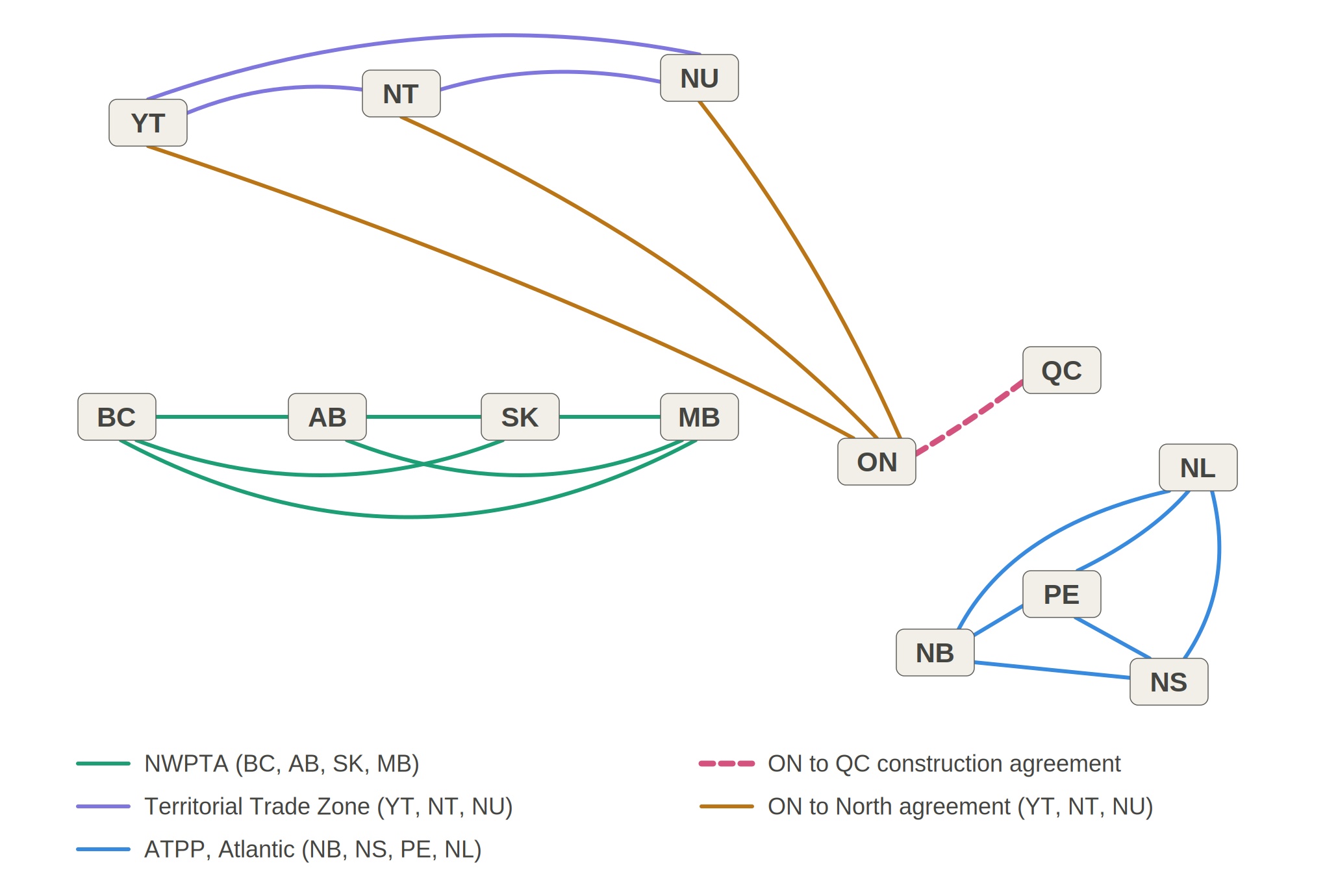 Who has a deal with whom? Five regional trade agreements between Canadian provinces and territories.
Map 1: Simplified and not to scale.
Let's look at each of the five regional agreements:
- The Atlantic cluster. The four Atlantic provinces have a history of working together to reduce trade barriers. Procurement cooperation dates back to 1996. In 2014, they aligned apprenticeship rules across sixteen trades, and the provinces recognize each other's workplace safety training.
The Atlantic cluster made a political commitment to regional cooperation in 2019. The ATPP was subsequently formalized through a memorandum of understanding signed on January 13, 2020. In March 2025, New Brunswick's premier wrote to the other Atlantic premiers proposing a full Atlantic free trade area. New Brunswick and Prince Edward Island have since signed their own bilateral memorandum working toward that goal.
More recently, the Atlantic Economic Panel has called for the four provinces to work increasingly as one economic region. Its September 2026 report recommends reducing barriers between the provinces and coordinating economic development, investment and infrastructure. This would go beyond the existing partnership. I discuss this more thoroughly in Section 8. - The Western cluster. British Columbia, Alberta, Saskatchewan and Manitoba are connected through The New West Partnership Trade Agreement (NWPTA). It is a voluntary agreement among the four provinces and has no separate government of its own. Each province remains responsible for its own laws and regulations while agreeing to follow the trade rules established under the agreement.
The four provinces also participate individually in the Committee on Internal Trade, where all thirteen provinces and territories and the federal government work on reducing internal trade barriers. - The Northern cluster. The three territories signed an MOU in July 2025 to work toward creating a Territorial Trade Zone (TTZ). They want to reduce trade and labour mobility barriers, work toward a shared credential registry, coordinate infrastructure priorities and improve investment opportunities. The framework also recognizes the distinct economic circumstances of northern and Indigenous communities.
- Ontario and the three territories. In July 2025, Ontario signed a separate MOU with Yukon, the Northwest Territories and Nunavut. The four governments agreed to work together to reduce trade barriers, improve recognition of professional credentials, align technical safety requirements and make it easier for workers and businesses to operate across their jurisdictions.
- Narrower agreements. Not every interprovincial trade agreement covers a broad range of economic activity. Some focus on a particular sector or type of barrier. For example, a 2006 Ontario-Quebec agreement addresses construction labour mobility, while the Atlantic Trade and Procurement Partnership (ATPP) includes cooperation on government procurement.
📚 Go deeper notes
- Federal.
In 2025, Ottawa removed all of its own exceptions to the CFTA. In November 2025, governments signed the Canadian Mutual Recognition Agreement (CMRA) on goods. Work continues on extending mutual recognition to trucking rules, driver training and permitting. These developments feed into the progress tracker in Section 3.
In June 2026, federal, provincial, and territorial transportation ministers signed a Memorandum of Understanding on Interprovincial Trucking. Further work is underway to align driver training requirements and improve permitting for oversized and overweight vehicles.
Sources: Advancing Internal Trade [20], Canadian Mutual Recognition Agreement [10], Council of Ministers MOU [15], Truck News [16], Treasury Board question period note [17]. - Alcohol shipping - the agreement and how it works.
On July 21, 2026, nine provinces signed the Operating Agreement on Direct-to-Consumer Sales of Alcoholic Beverages. They are Alberta, British Columbia, Saskatchewan, Manitoba, Ontario, New Brunswick, Nova Scotia, Prince Edward Island, and Newfoundland and Labrador.
Eight provinces began implementing their own approaches on the day of signing. British Columbia continues to allow wine-only sales and has committed to having a system for all types of alcohol in place by February 2027.
Ontario and Nova Scotia had signed an earlier agreement in March 2026, while Alberta and British Columbia already had a wine agreement.
The agreement allows participating provinces to retain their own registration requirements, levies, delivery restrictions, purchase limits and age-verification rules. Orders are for personal consumption. The agreement does not require provinces to put other provinces' products on liquor store shelves.
Sources: BNN Bloomberg [11], CFTA alcohol page [12], Canadian Press via National Newswatch [13], Inside.beer [14], CFTA premiers sign final agreement [40]. - Alcohol shipping - who isn't participating?
Quebec and Yukon participated in drafting the July 2026 agreement but had not signed at the time of publication. Both are working toward direct-to-consumer sales. Yukon is working with its dry communities to ensure their preferences are reflected. Quebec needs to change several provincial laws before it can participate.
Nunavut and the Northwest Territories were not part of the original memorandum or the final agreement. Both governments chose not to sign. Many communities in these territories have locally determined alcohol restrictions or prohibitions, reflecting community priorities and cultural values.
Sources: CFTA premiers sign final agreement [40], Inside.beer [14], Joint Statement from Premier Main and Premier Simpson [43]. - The 2024 trucking pilot.
On September 26, 2024, ministers announced a trucking pilot at the Committee on Internal Trade meeting in Charlottetown. Canada and ten of the thirteen provinces and territories took part, with Newfoundland and Labrador co-chairing. They are Ontario, Nova Scotia, Manitoba, Prince Edward Island, Saskatchewan, Alberta, Newfoundland and Labrador, the Northwest Territories, Yukon, and Nunavut.
Participants agreed to recognize each other’s trucking rules, even where differences exist. Oversized vehicle signage is one example. Ministers said the pilot would test what mutual recognition can do and guide work in other areas, including labour mobility.
Source: Government of Canada trucking pilot announcement [29]. - The Atlantic cluster.
Sources: Government of Nova Scotia [31], Government of Newfoundland and Labrador [32], Government of New Brunswick [33] (March 2025 proposal and bilateral MOU), CFTA Atlantic Procurement Agreement [34], Council of Atlantic Premiers [35], Canadian Press via CTV News [37], Atlantic Canada Opportunities Agency [38] - The Western cluster.
Sources: Government of Saskatchewan [30] (NWPTA), Advancing Internal Trade [20] (participation in the Committee on Internal Trade) - The Northern cluster.
Source: Yukon Government [49] - Ontario and the three territories.
Source: Ontario Government [50] - Narrower agreements.
Sources: Government of Ontario [36] (Ontario–Quebec construction labour agreement), CFTA Atlantic Procurement Agreement [34] (ATPP procurement cooperation)
C. Next Steps
Jump To >> Why does a more connected Canadian market matter? | Where is Canada heading with internal trade? | What to watch right now?
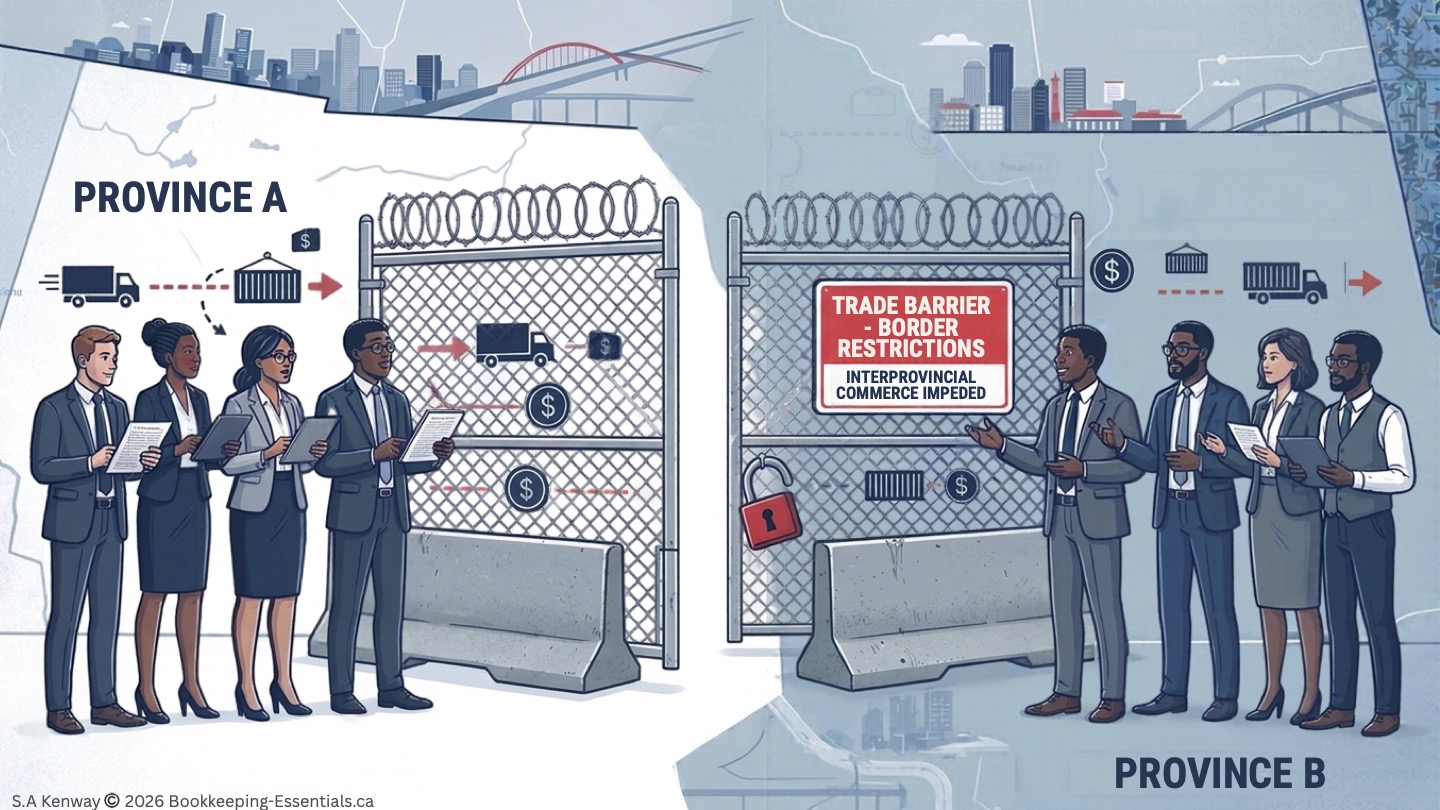 The padlock is open, but the barriers are still in place.
Progress is real, and the work isn't finished.
7. Why does a more connected Canadian market matter?
The trade conflict with the United States has exposed a vulnerability in Canada's economy. Canada has relied on one major trading partner. Its trade policies can change quickly and unpredictably.
Canada cannot control the trade decisions of another country. But it can work to reduce its economic vulnerability by creating more choices for Canadian businesses. That means looking both outward and inward.
Looking outward: Building stronger international relationships
At the October 2026 Canada-EU Summit in Montreal, Canada and the European Union announced plans to deepen their economic and strategic relationship. Two developments are particularly relevant to businesses operating in an increasingly digital economy.
- First, the two sides concluded negotiations on a Digital Trade Agreement. It is intended to establish clearer, more predictable rules for digital trade. It should also facilitate cross-border data flows. The goal is to make it easier for Canadian businesses to sell goods and services online in Europe.
- Second, Canada and the EU will work toward connecting their instant payment systems. The goal is to allow people and businesses to transfer money between the two economies more quickly and at lower cost.
These developments complement each other. Easier access to customers is only part of the equation. Businesses also need practical ways to receive and send payments across borders.
For a Canadian solopreneur, this could eventually mean a more straightforward way to find European customers, sell digital services or products, and get paid.
More broadly, stronger trade relationships, modern digital rules and connected financial infrastructure could give Canadian businesses more options beyond the U.S. market. That helps diversify Canada's economic relationships and strengthens its ability to make independent choices.
Looking inward: Making Canada work more like one market
Canada also has an opportunity to make its own domestic market work better.
The European Union's single market provides an example of how countries can reduce barriers between their markets through common rules and mutual recognition. Canada has a different constitutional structure. Provinces and territories retain authority over many of the rules that affect businesses operating within their borders.
Rather than requiring every province to adopt identical rules, Canada is working toward greater mutual recognition. The idea is that where one jurisdiction has already assessed and approved a good or service, another jurisdiction should not automatically require the business to start the process again.
The Canadian Mutual Recognition Agreement (CMRA) is one step in that direction. First Ministers have also committed to work toward model mutual recognition legislation to help create one Canadian market.
The bigger picture
The trade conflict with the United States has made Canada's economic vulnerabilities harder to ignore. Building stronger relationships with other trading partners is one response. Making Canada's own domestic market work better is another.
These efforts address different parts of the same problem. International diversification gives Canada more trading relationships and opportunities. Internal trade reform makes it easier for Canadian businesses to operate across provincial and territorial borders.
Neither eliminates economic risk. But together, they could give Canadian businesses more opportunities to grow and give Canada more flexibility in choosing its economic relationships.
Sovereignty is national. It means Canada can make its own economic decisions. Economic independence is personal. It means your business has the freedom to act on its own choices. Having the authority to decide doesn’t always mean having the practical ability to carry it out.
Options help close that gap. There are three kinds:
- More markets: If Canadian businesses can sell to Europe, Asia and other markets, we're less dependent on the United States.
- More suppliers: If Canadian businesses have alternative sources for materials and products, they're less vulnerable to disruptions or pressure from one trading partner.
- A stronger domestic market: If businesses can sell more easily across provincial borders, they have more opportunities to grow within Canada.
All three give Canada more economic options. And having options makes it easier to withstand external pressure without having to change course simply because there are few alternatives.
What this could mean for your business
- Short term. Not much changes in how you sell. The barriers marked red on the tracker still apply, so plan around them. Governments have set targets for the end of 2026. A target is not a change.
- Mid term. If governments follow through, selling to another province could get easier. So could selling digital products and services to Europe. Each province still has to make current and future agreements law or enact them through regulations. Expect changes to arrive in pieces.
- Long term. In my view, Canada is heading toward more choices for small businesses. More customers, more suppliers, and more ways to get paid. How far it gets depends on whether every government follows through.
8. Where is Canada heading with internal trade?
Governments are working toward a more connected Canadian market, but they haven't settled on exactly how to get there.
There are two sides to this story. The first is where Canada is heading. The second is what is driving the work underway. These two sides sometimes overlap. A government initiative may help shape the national approach, while a national commitment may encourage provinces to move ahead on their own. Looking at both helps explain not only what governments hope to achieve, but how they might get there and what remains uncertain.
Side 1: Where is Canada heading?
There are national commitments, different provincial approaches, and regional initiatives underway.
A national approach: One model law
On July 23, 2026, the Prime Minister and all provincial and territorial premiers agreed to work toward an agreement in principle by the end of 2026 on one model law for mutual recognition across Canada.
The goal is to create one Canadian market for goods, services, and labour. The new law is expected to draw on the most beneficial elements of existing provincial and territorial legislation.
Federal minister Dominic LeBlanc has also outlined steps to update labour mobility rules under the Canadian Free Trade Agreement (CFTA), and develop shared systems so credentials earned in one province can be recognized elsewhere.
The current agreement covers goods. Ottawa wants to extend it to services by the end of 2026. If achieved, it will make it easier for businesses to offer services across provincial borders without facing different requirements in each province.
The other proposed changes do not yet have specific completion dates.
Different provincial approaches
Not everyone is proposing the same route.
- Saskatchewan Premier Scott Moe has invited other governments to join the New West Partnership Trade Agreement (NWPTA). It currently links British Columbia, Alberta, Saskatchewan, and Manitoba.
Moe argues that the NWPTA has lower procurement thresholds and fewer exceptions than the CFTA. His approach is to expand an agreement that already exists. - Ottawa's approach is different. It wants all governments involved in developing a new model law, drawing on what has worked in existing agreements.
These approaches have a common objective. That is to reduce barriers between provinces and territories. Whether governments adopt one route, combine elements of both, or develop something different remains to be seen.
Regional initiatives: The Atlantic provinces
The Atlantic provinces are also exploring closer economic ties.
- New Brunswick's premier proposed a full Atlantic free trade area in March 2025. New Brunswick and Prince Edward Island have since signed a bilateral memorandum to work toward deeper economic integration.
- An independent, private-sector-led Atlantic Economic Panel released its report on September 25, 2026. It recommends that the four Atlantic provinces work towards functioning as one economic region while remaining four separate governments.
Will the regional agreements combine?
Canada already has five regional trade agreements. They haven't merged with one another.
The federal government is reviewing what works in each of them, along with other existing legislation, as it develops the proposed national model law.
Some regional agreements have grown through additional participation. Manitoba joined the NWPTA in 2016, and all Canadian jurisdictions were invited to join in 2025. New Brunswick and Prince Edward Island are working toward a deeper Atlantic agreement.
The question is whether these regional arrangements will eventually become part of one broader national framework, or continue operating alongside it.
Will Quebec participate?
As of October 2026, Quebec’s new government is taking a more independent approach to its relationship with Ottawa. Its actions appear to signal that it does not wish to participate in a Team Canada approach. That raises questions about its participation in future national trade reforms ... particularly the planned expansion of mutual recognition into services and labour mobility.
Other provinces and territories can move ahead without Quebec, as they have previously done. If that happens, clients and businesses across the rest of Canada may increasingly favour hiring independent contractors and consultants in jurisdictions where credentials, licensing, and rules are seamlessly recognized across provincial borders.
In my view, that could leave self-employed professionals and solo businesses in Quebec at a competitive disadvantage. Freelancers elsewhere in Canada could also face extra administrative hurdles when working with Quebec clients.
Whether Quebec will participate in the proposed national model law and services expansion ... and whether the other governments could proceed without it ... remains to be seen.
Side 2: What's driving the work underway?
Governments have discussed reducing internal trade barriers for years. What’s different now is the pressure to make progress. Three pressures stand out.
- The trade conflict with the United States. It has exposed the risks of relying too heavily on one trading partner. Governments want more options for Canadian businesses.
- The cost of the barriers themselves. Different rules in each province add time and expense for businesses. That can mean higher prices and slower growth. Removing the barriers is seen as a way to strengthen the economy.
- Budget pressures. Governments are facing budget pressures and looking for ways to strengthen their economies. Removing interprovincial trade barriers would be a long-term gift to Canada that would keep on giving for years to come.
Former New Brunswick premier Frank McKenna named the trade war and provincial budget pressures when he spoke about the push for Atlantic cooperation.
Two examples show where the work is moving:
- Accelerating the timetable. In August 2026, Newfoundland and Labrador joined other internal trade ministers in agreeing to aim for an agreement in principle by the end of fall 2026. That is sooner than the end of the year.
- Trucking. On June 2, 2025, First Ministers meeting in Saskatoon directed their Ministers of Transport to work together to rapidly expand the trucking pilot. The pilot was announced in 2024. It aims to remove many internal trade barriers in the domestic trucking supply chain. Section 6 describes the pilot.
Conclusion: What remains uncertain?
Many of the changes on this page are commitments, targets, and proposals. None of them is complete. These are the items whose final shape is still open.
- The model law
- Services and credentials
- Which route governments take
- Whether the regional agreements combine
- The Atlantic proposals
- Will Quebec participate?
- Alcohol direct to consumer shipping
- Newfoundland and Labrador’s schedule
Two areas have no announced change: supply management and Quebec’s French-language rules.
For Canadian solopreneurs, the important distinction is between what governments have agreed to pursue and what has actually changed. Until new arrangements are implemented, businesses still need to follow the rules that apply in each jurisdiction.
📚 Go deeper notes
These notes add the detail behind each item above. Skip them if the summary is enough, or open them to see the dates, sources, and fine print.
- The model law. On July 23, 2026, Prime Minister Mark Carney met with every premier. They agreed to work toward an agreement in principle by the end of the year. The joint statement says the new law will draw on the best parts of existing provincial and territorial legislation. The NWPTA is one example of existing mutual recognition. It covers four provinces and has operated for over a decade.
Sources: First Ministers’ Joint Statement [26], Government of Saskatchewan [30]. - Services and credentials. Minister LeBlanc’s plan has four steps. First, extend the goods-only agreement to services by the end of 2026. Second, update the labour mobility rules under the CFTA. Third, align approvals for things like prefabricated homes. Fourth, build shared systems so a credential earned in one province is recognized everywhere.
Only the services step has a stated date. Mirage News reports that LeBlanc has described the single model law as the most consequential part of the plan.
Source: Mirage News [27]. - Which route to take. Saskatchewan’s Scott Moe wants other governments to join the NWPTA. He says it has lower procurement thresholds and fewer exceptions than the CFTA. The federal approach asks every government to help write a new law, informed by what existing agreements have already worked out.
Sources: Government of Saskatchewan [30], First Ministers’ Joint Statement [26]. - Whether the agreements combine. Ottawa is reviewing each regional agreement for what works. It is using that material to write one law meant to apply everywhere. Meanwhile, the NWPTA has grown. Manitoba joined in 2016, and all jurisdictions were invited to join in 2025. New Brunswick and Prince Edward Island are working toward a deeper Atlantic agreement.
Sources: First Ministers' Joint Statement [26], Government of Saskatchewan [30], Government of New Brunswick [33]. - The Atlantic proposals. In November 2025, the federal minister responsible for the Atlantic Canada Opportunities Agency appointed the Atlantic Economic Panel. According to the agency, the panel worked independently of government.
On September 25, 2026, the panel released its report. Among its recommendations are removing trade and labour mobility barriers, creating a shared regional investment platform, and establishing a $1 billion Atlantic Prosperity Fund. The Canadian Press reports that removing the barriers is a process that has already started.
Sources: Government of New Brunswick [33], The Canadian Press via CTV News [37], Atlantic Canada Opportunities Agency [38], The Canadian Press via National Newswatch [39] - McKenna. Frank McKenna, a former New Brunswick premier, was at the report’s launch. He cited the Canada-US trade war and pressure on provincial budgets as factors in the momentum.
Source: Canadian Press via National Newswatch [39]. - Alcohol direct to consumer shipping. Nine provinces signed an operating agreement on July 21, 2026. Eight began implementing their own approaches the same day.
✔ British Columbia allows wine only for now and targets February 2027 for all types of alcohol.
✔ Quebec and Yukon took part in drafting the agreement and aim to sign in the near future. Neither had signed at the time of publication. Both are currently working on the necessary infrastructure and tax/regulatory frameworks with the intention of signing on at a later date. The Yukon is also working with its dry communities to account for local preferences.
✔ Nunavut and the Northwest Territories chose not to sign. Many of their communities have locally determined alcohol restrictions, which the governments say reflect community priorities and cultural values.
Sources: Canadian Press via National Newswatch [13], Inside.beer [14], CFTA, Premiers Sign Final Agreement [40], Joint Statement from Premier Main and Premier Simpson [43]. - Newfoundland and Labrador’s schedule. Internal trade ministers, including the province’s, agreed in August 2026 to accelerate efforts toward an agreement in principle by the end of fall 2026.
Source: Government of Newfoundland and Labrador [28]. - Trucking. On June 2, 2025, First Ministers meeting in Saskatoon directed their Ministers of Transport to rapidly expand the trucking pilot announced in 2024.
Source: Prime Minister of Canada, First Ministers’ Statement [51]. - Supply management. Supply management is protected by law. No changes have been announced.
Sources: Library of Parliament [18], The Globe and Mail [19]. - Quebec’s commerce French-language rules. They reflect a policy choice. No changes have been announced.
Source: Couillard, IRPP [25].
9. What can a solopreneur watch right now?
The items below have stated targets or open decisions on this page. Section 8 explains what is still open, and Section 6 gives the details.
| What to watch | What this page says | Timing | Where to check |
|---|---|---|---|
| Agreement in principle on a single model law | Aims at one Canadian market for goods, services, and labour.[26] | End of 2026 | First Ministers’ Joint Statement [26] and Advancing Internal Trade [20] |
| Services added to the national mutual recognition agreement | The current agreement covers goods only, and the federal plan would extend it to services.[27] | End of 2026 | Advancing Internal Trade [20] |
| Labour mobility rules and shared credential systems | The federal plan includes updated labour mobility rules and shared systems so a credential earned in one province is recognized everywhere.[27] | No date given | CFTA Labour Mobility chapter [1] |
| Alcohol shipping rollout | British Columbia targets February 2027 for all types of alcohol. Quebec and Yukon aim to sign the agreement in the near future.[13][14][40] | February 2027 for BC. No date given for Quebec and Yukon. | CFTA alcohol page [12] |
| Newfoundland and Labrador’s schedule | Ministers agreed to aim for fall 2026 instead of year end.[28] | End of fall 2026 | Government of Newfoundland and Labrador news release [28] |
Takeaways
- A barrier can stop a sale without making anything illegal. Time, paperwork, and registrations can cost a one-person business more than the sale is worth.
- Start where the rule is set. Provinces and territories set most of the rules that create friction, so look at the province you want to sell into first. Expect change to arrive in pieces.
- Check what an announcement actually covers before you change your plans. Most of the progress so far covers goods and Ottawa’s own rules. Sales tax registration and Quebec’s commerce language rules, which can reach any one-person business, have not changed.
- Government targets are not the same as change. Targets may get missed. Plan around the rules that apply today. Treat each announcement as something to watch, not something to count on.
- Structural change takes years, so plan for it. Don’t wait for a target date to change how you run your business. Look at your business model, ask where you could sell if the rules got easier, and build a plan that works whether or not they do. What’s Next? Building a 10-Year Plan in an Era of Trade Uncertainty shows how.
🦆 Solo CEO Move
Pick one province and one rule. Look it up, and keep a dated record of what you find.
- Pick the one province you most want to sell into.
- Check the tracker in Section 3 for the barriers that apply to your business.
- Choose the one rule that matters most, such as shipping, sales tax registration, language rules, or licensing.
- Look it up in an official government source.
- Write down what you found, where you found it, and the date. File it with your business records.
- If the rule is unclear, confirm it with the provincial agency or a professional.
Related Pages
Tracking Canada's Trade Deals | What's Signed, What's Not
"Tracking the trade deals and economic opportunities Carney has brought home from his travels abroad."
What’s Next? Building a 10-Year Plan in an Era of Trade Uncertainty
No one can predict how CUSMA's next chapter unfolds ... or the current trade war. Business owners can build a strategic plan based on today's economic and trade realities.
Section 338 Tariffs: What They Mean for Canadian Home-Based Businesses
An explainer: What Happened covers the facts. What It Means covers the practical impact on home-based businesses. What to Watch Next covers what could change.





Methodology, References and Sources
Methodology
- Each tracker row is checked against at least one primary source where one is available. That means government legislation, a regulator’s own bulletin, or an official agreement.
- News reports, law firm commentary, and legal information sites are used for recent developments and context.
- A row is included when it describes a rule that the 2025 to 2026 reforms have addressed or left in place.
- The Who it affects column says whether a row applies to a one-person business.
- Status colours are an editorial judgment based on the sources listed for each row.
Sources
1. The Canadian Free Trade Agreement. “Labour Mobility (Chapter Seven)”. cfta-alec.ca.
2. Government of British Columbia. “Provincial Sales Tax: registration requirements for out-of-province sellers”. gov.bc.ca.
3. Government of Saskatchewan. “Information Bulletin PST-5: Information for Non-Resident Businesses”. saskatchewan.ca.
4. Government of Manitoba, Manitoba Finance. “Retail Sales Tax Information Bulletin”. gov.mb.ca.
5. Revenu Québec. “Specified Registration System for QST”. revenuquebec.ca.
6. Canadian Free Trade Agreement. “Government Procurement (Chapter Five)”. cfta-alec.ca.
7. Fasken. “Trade Agreement Procurement Thresholds for 2025”. fasken.com.
8. Légis Québec. “Charter of the French Language” and “Regulation respecting the language of commerce and business”. legisquebec.gouv.qc.ca.
9. Éducaloi. “Regulated professions in Quebec: Human resources consulting”. educaloi.qc.ca.
10. Canadian Free Trade Agreement. “Canadian Mutual Recognition Agreement (CMRA)”. cfta-alec.ca.
11. BNN Bloomberg. “Deadline looms for interprovincial alcohol shipping deal as provinces lag on implementation”. May 26, 2026.
12. Canadian Free Trade Agreement. “Trade in Alcoholic Beverages”. cfta-alec.ca.
13. The Canadian Press via National Newswatch. “Nine premiers agree to direct-to-consumer alcohol sales from out-of-province”. July 21, 2026.
14. Inside.beer. “Canada: Nine Provinces Sign Cross-Border Direct-to-Consumer Alcohol Deal”.
15. Council of Ministers Responsible for Transportation and Highway Safety. “MOU on Interprovincial Weights and Dimensions, Summary 2025”. comt.ca.
16. Truck News. “CTA applauds interprovincial trucking agreement aimed at cutting red tape”.
17. Treasury Board of Canada Secretariat. “Question Period Note: Regulatory Cooperation and Mutual Recognition”. open.canada.ca.
18. Library of Parliament. “Canada’s Supply Management System”. lop.parl.ca.
19. The Globe and Mail. “Farmers divided over bill to enshrine Canada’s supply management system in law”. theglobeandmail.com.
20. Government of Canada. “Advancing Internal Trade”. Intergovernmental Affairs, canada.ca.
21. Government of Canada, Job Bank. “Bookkeeper in Alberta”. jobbank.gc.ca/marketreport/requirements/12562/AB.
22. Government of Canada, Job Bank. “Graphic Designer in Canada”. jobbank.gc.ca/marketreport/requirements/5703/ca.
23. Macdonald-Laurier Institute. “Canada’s internal trade barriers require legal reform, not political shortcuts”. April 27, 2026.
24. Torys LLP. “Canada takes on internal trade barriers”. February 2025.
25. Couillard, Philippe. “The Canadian Free Trade Agreement: A Quebec Perspective”. Centre of Excellence on the Canadian Federation, IRPP.
26. Prime Minister of Canada. “First Ministers’ Joint Statement”. July 23, 2026. pm.gc.ca.
27. Mirage News. “LeBlanc Seeks Unified Canadian Economy Before Trade Talks”.
28. Government of Newfoundland and Labrador. “Newfoundland and Labrador Supports Accelerated Action to Strengthen Internal Trade Across Canada”. August 2026.
29. Government of Canada. “Ministers LeBlanc and Anand announce trucking pilot to improve movement of goods”. September 2024.
30. Government of Saskatchewan. “Premier Moe Calls on Canadian Premiers to Join New West Partnership Trade Agreement”. July 17, 2025.
31. Government of Nova Scotia. “Trade agreements for procurement”. novascotia.ca.
32. Government of Newfoundland and Labrador, Public Procurement Agency. “Trade Agreements”. gov.nl.ca.
33. Government of New Brunswick. Canadian Free Trade Agreement. “Interprovincial trade”. gnb.ca.
34. The Canadian Free Trade Agreement. “Atlantic Procurement Agreement (replaces APA 1996)”. cfta-alec.ca.
35. Council of Atlantic Premiers. “Key Initiatives: Atlantic Trade and Procurement Partnership, Atlantic Apprenticeship Harmonization”. cap-cpma.ca.
36. Government of Ontario. “Agreement for construction sector labour mobility between Ontario and Québec (2006)”. ontario.ca/document/agreement-construction-sector-labour-mobility-between-ontario-and-quebec.
37. The Canadian Press. “Eastern Canada business leaders call for ‘single economy’ between Atlantic provinces”. CTV News, September 25, 2026.
38. Atlantic Canada Opportunities Agency. “Atlantic Economic Panel unveils blueprint for Atlantic Canada’s future”. Government of Canada news release, September 25, 2026. canada.ca.
39. The Canadian Press. “One Atlantic region economy needed to save ‘burning platform,’ ex-N.B. premier says”. National Newswatch, September 26, 2026.
40. Canadian Free Trade Agreement. “Premiers Sign Final Agreement Towards Canada-Wide Direct-to-Consumer Alcohol Sales”. July 21, 2026. cfta-alec.ca.
41. Liquor Control Board of Ontario. “LCBO Annual Report 2024-25”. lcbo.com.
42. Société des alcools du Québec. “The SAQ announces net income of $1.401 billion for fiscal 2024-2025”. June 5, 2025. saq.com.
43. Government of Nunavut and Government of the Northwest Territories. “Joint Statement from Premier John Main and Premier R.J. Simpson on the Direct-to-Consumer Operating Alcohol Agreement”. July 21, 2026. gov.nu.ca and gov.nt.ca.
44. Cornell Law School, Legal Information Institute. “Dormant Commerce Clause”. Wex. law.cornell.edu.
45. Supreme Court of Canada. “Case in Brief: R. v. Comeau, 2018 SCC 15”. scc-csc.ca.
46. European Commission. “Mutual recognition of goods”. single-market-economy.ec.europa.eu.
47. Government of Canada, Justice Laws Website. “Free Trade and Labour Mobility in Canada Act (S.C. 2025, c. 2, s. 2)”. laws-lois.justice.gc.ca.
48. Government of Canada. “Canada acts to eliminate barriers to interprovincial trade in alcohol”. April 9, 2019. canada.ca.
49. Government of Yukon. "Territorial governments sign Memorandum of Understanding towards creating a Territorial Trade Zone". yukon.ca, July 28, 2025
50. Government of Ontario. "Ontario Signs New Free Trade Agreements with British Columbia and Canada’s Three Territories". news.ontario.ca, July 21, 2025
51. Prime Minister of Canada. “First Ministers’ Statement on Building a Strong Canadian Economy and Advancing Major Projects”. pm.gc.ca, June 2, 2025.
Back to top