- A Roadmap To CRA Compliance and Financial Stability
- The Concierge Desk
- The Backgrounder Library
- Transshipments Explained
Cheating the System: How Transshipment Works
A Backgrounder Article | Drawer E: The Economy - What's Behind The Headlines

By L.Kenway BComm CPB Retired
This is the year you get all your ducks in a row! Start by starting ... and keep it simple. Consistency beats perfection.
Published August 17, 2026
WHAT'S IN THIS ARTICLE
Introduction | At A Glance | What Is Transshipping? | What Motivates Businesses To Transship? | Does Canada Have Mechanisms To Deal With Transshipment? | Are Businesses Circumventing Canada's Trade Remedies? | What About The Raw Goods Origins? | Melt-and-Pour Subsidy Problem | How Does CUSMA Inform Transshipment Rules? | The Business Lesson | What's Next
BACK TO >> The Backgrounder Library
RELATED >> How Tariffs Actually Move Supply Chains | Section 338 Tariffs | Canada's Next Move
In How Tariffs Actually Move Supply Chains, we looked at how U.S. tariffs can cause businesses to change where and how they supply a market. We used vehicles sold in Canada as an example. When routing a vehicle through the United States became more expensive, manufacturers changed their supply chains. They began supplying the Canadian market directly from lower-cost countries like Mexico or South Korea instead.
That's trade diversion. The route changed, and the origin claim changed along with it. Today, we’ll look at a different, and more controversial, use of third-country trade routes: transshipment.
Transshipment At A Glance
- Trade diversion vs. transshipment: Trade diversion is an honest response to changed costs, the origin claim changes because production genuinely moved. Transshipment tries to make the paperwork say something that isn't true.
- Why it happens: Businesses transship to dodge tariffs, anti-dumping duties, or countervailing duties, sometimes 25% to 50% or more of landed cost. In extreme cases, it can be up to several hundred percent.
- CUSMA's rule: Goods passing through a third country must stay "in the box" (Article 4.18); importers must prove it with paperwork on request (Article 5.4).
- Canada's remedy tool: SIMA anti-circumvention investigations can extend existing duties to goods rerouted through a new country to dodge them.
- The newer twist: Since July 2025, a separate 25% surtax targets steel and aluminum melted or cast in China, regardless of where it's shipped from or assembled.
- Why it matters now: The 2026 CUSMA review is actively debating origin rules for autos, tied to concerns about Chinese-linked assembly in Mexico.
- The lesson: Route and origin are separate legal questions. Proving origin is the business's job, not the shipping route's.
Before we get into the detail, here’s a diagram showing you the difference between trade diversion and transshipping using Canada-US autos and auto parts that were subject to 232 sectoral tariffs in 2025.
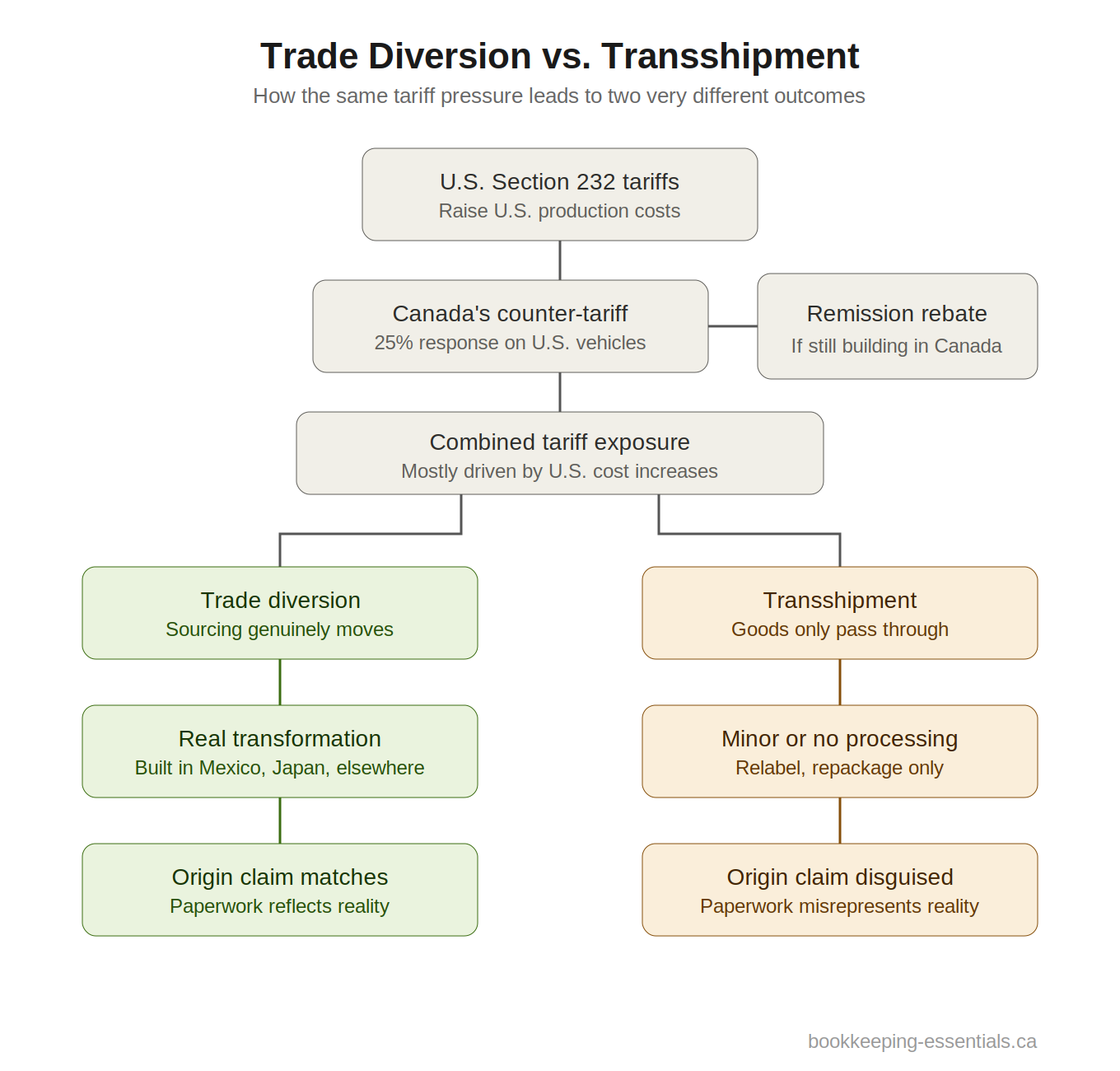 How the same tariff pressure leads to two very different outcomes
What Is Transshipping?
Transshipping is when a product is routed through a third country specifically to disguise where it actually came from, so it can qualify for a lower tariff rate it wouldn't otherwise get.
Picture a product made in Country A, where tariffs are high. Instead of shipping it directly, the exporter routes it through Country B first, where tariffs are low or non-existent. On paper, the shipment now appears to originate in Country B. In reality, nothing meaningful happened to the product in Country B except a stopover, maybe a relabel, maybe light repackaging.
A 2022 Investigation of Transshipping
A well-documented case comes from the U.S. solar industry. In 2022, the U.S. Department of Commerce opened an investigation into Chinese solar cell and panel manufacturers. At issue was whether they were routing products through Cambodia, Malaysia, Thailand, and Vietnam. The goods received only minor processing in those countries. The suspected goal was to avoid existing anti-dumping and countervailing duties on Chinese solar products.
In August 2023, Commerce issued its final determination. Goods from five of the eight companies investigated were, in fact, circumventing the duties through exactly this pattern Duties were extended to cover them. Three companies were cleared, including facilities that Commerce found were doing genuine manufacturing, not just relabeling. ¹
The rates involved show just how much is at stake in getting the origin question right. Duties on the circumventing companies ranged as high as several hundred percent, while cleared companies continued shipping duty-free. Same region, same finished product, completely different tariff outcome. What mattered was whether real manufacturing happened where the paperwork said it did.
The distinction between this and trade diversion sounds subtle, but it isn't. Trade diversion is a business responding to changed costs with a real shift in where goods are made. Transshipment is a business trying to make a product's paperwork say something that isn't true.
Let’s Stop and Recap
- Not enough: Chinese product → shipped to Southeast Asia → minor processing → shipped to U.S.
- Potentially enough: Chinese inputs → shipped to Southeast Asia → genuine manufacturing → shipped to U.S.
What Motivates Businesses To Transship?
The incentive is simple ... MONEY. When a country imposes a steep tariff, anti-dumping duty, or countervailing duty on goods from a specific country, that duty can add 25%, 50%, or more to the landed cost. If a business can make those same goods appear to come from a country without that duty, it can undercut competitors who are paying it honestly.
Let's look at two examples to see how motivation turns into action.
Example 1: Two Ways Businesses Look for a Gap
A Canadian e-commerce entrepreneur buys unbranded T-shirts from China in bulk, brings them into Canada, adds a logo, slogan or graphic, and then ships individual orders to U.S. customers.
If the Canadian business claimed that the T-shirts had become Canadian products simply because it added a logo or slogan, that would be a problem. The processing hasn't necessarily changed the product's legal origin. If the business used a false Canadian origin claim to avoid U.S. tariffs on Chinese goods, it would be transshipment.
The route might look like this:
China → Canada → light processing → U.S.
The Canadian business is real. The Canadian processing is real. The problem is the claim about where the product came from. If the business used a China origin claim, it would not be transshipment and there would be no problem because the paperwork would match reality - logo or no logo.
Now compare that with what I call the “Temu” model.
The seller in China ships the product directly to an individual U.S. customer. Before the U.S. suspended the de minimis exemption for these shipments in August 2025, a shipment valued at $800 or less could enter the U.S. without the duties that would normally apply.
The route looks like this:
China → individual U.S. customer
This was not necessarily illegal. It was an efficient use of a rule that had been created for low-value shipments. But when millions of small shipments began flowing into the U.S. this way, the economic impact of the exemption became much bigger than policymakers had originally intended.
The government response was therefore different.
With transshipment, the government enforces the existing rule by investigating whether the claimed origin is legitimate.
With de minimis, the government changes the rule when the loophole is being exploited on a scale it no longer considers acceptable.
Let's Stop and Recap
- Transshipment breaks the law: the product's origin is misrepresented.
- Loophole exploitation bends the law: the business stays within the technical rules but uses them in a way policymakers didn't intend.
- Both are responses to the same incentive: avoid a high tariff.
- The government response is different: enforce the existing rule for one, change the rule for the other.
Example 2: When Tariffs Change the Economics
Tariff decisions don't stay contained, and that unpredictability is part of what pushes businesses toward workarounds. Here’s an example of a current chain reaction that is motivating businesses to change.
- 2024: The U.S. imposed 100% Section 301 tariffs on Chinese electric vehicles, citing intellectual property theft and industrial overcapacity.
- 2024: Canada matched the tariff to stay aligned with its largest trading partner.
- March 2025: China retaliated with steep tariffs on Canadian canola, pork, and seafood, but none on U.S. product.
- March 2025: The U.S. added Section 232 tariffs on autos and auto parts, citing national security. Most Canadian auto trade stayed exempt through USMCA compliance. The U.S. escalated various tariffs throughout the year in many sectors.
- April 2025: Canada retaliated with tariffs on non-CUSMA U.S. vehicles. There were counter-tariff exemptions for cars imported for sale in Canada if they maintained operations in Canada and complete planned investments.
- January 2026: Canada scaled back its EV tariff to ease pressure on canola exports. China lowered its tariffs in return.
- Aftermath: Some U.S. officials criticized Canada's move.
- The Result: A chain reaction across many different trading relationships.
There's an irony in all of this. The 2024 tariffs were meant to protect the U.S. auto industry from Chinese competition. The 2025 tariffs, aimed at national security, have raised the cost of building a car in North America. Those costs are largely passed on to consumers. In the end, they weaken the very competitiveness the earlier tariffs were meant to protect.
This example shows something important. When tariff rates and trade relationships can change this quickly, the cost advantage of one supply route can disappear overnight. A business that suddenly faces a 25%, 50%, or 100% duty has a powerful financial reason to ask whether there is another legitimate way to structure its supply chain. For some businesses, it's an incentive to cross the line into circumvention.
Let's Stop and Recap
- The sequence didn't cause transshipment
- The sequence created a chain reaction that could lead to transshipment.
Does Canada Have Mechanisms To Deal With Transshipment Aimed At Gaining Preferred U.S. Market Access?
Yes, and this matters for Canadian businesses even when the target market is the U.S., not Canada. Canada has agreed, through CUSMA, to make sure goods claiming CUSMA treatment through Canada really meet the agreement's rules. Otherwise, Canada's trade routes could become a side door into the U.S. market.
The main tool is CUSMA's own transit and transshipment rule. Under Chapter 4, Article 4.18, if a good passes through a third country on its way between CUSMA members, it must stay "in the box" the whole way. It can be unloaded, stored, split into smaller shipments, or reloaded. But you can't do anything to the product that changes it or makes it look like it came from the third country.
If a customs officer asks, the importer needs to be able to prove it. Chapter 5, Article 5.4 gives the Canada Border Services Agency the right to request proof. That can include shipping records, bills of lading, and customs documents. Together, they need to show where the good actually went, and that it stayed under customs control the whole time. No paper trail, no preferential rate. ³
A Small Business Example: The De Minimis Loophole
Take the T-shirt business from earlier, selling custom shirts to U.S. customers under de minimis.
For years, the U.S. $800 de minimis exemption made this attractive. Individual shipments below the threshold could enter the U.S. without the usual duties and tariffs. The arrangement created an incentive to use Canada as a shipping or light-processing hub for Chinese goods headed to the U.S.
The U.S. closed that loophole for these shipments in August 2025.
But there's an important distinction here. Putting a Canadian business between China and the U.S. doesn't automatically make the goods Canadian. If the goods remain Chinese-origin goods, they remain subject to the rules that apply to Chinese goods.
That distinction matters even more once de minimis closes. With the exemption gone, every shipment now needs a formal customs entry and duty payment, no matter how small. Filing that on thousands of individual $30 orders is expensive per package, which pushes volume sellers toward consolidating shipments rather than mailing one at a time. At that point, this business's only way to keep avoiding the full Chinese-goods tariff is to claim the shirts qualify for CUSMA preferential treatment instead.
That's exactly when CBSA can invoke Article 5.4. It would need to produce the bills of lading, the customs entry showing the shirts' Chinese origin, and records proving the logo work happened under its own control in Canada. An invoice claiming "Made in Canada" wouldn't be enough. No trail like that, and the claim gets denied, regardless of how legitimate the logo work actually was.
Let's Stop and Recap
- The incentive: A tariff or duty makes the normal route more expensive.
- The opportunity: A trade rule such as de minimis created a cheaper route.
- The temptation: Route the goods through another country and do just enough processing to make the new route worthwhile.
- The problem: Moving or lightly processing a product doesn't necessarily change its legal origin.
- The lesson: A Canadian address doesn't automatically make a Chinese product Canadian.
Are Businesses Circumventing Canada's Trade Remedies?
Sometimes, yes, but not always, and the investigation process itself is worth understanding.
Separately from CUSMA, Canada has its own domestic tool for this under the Special Import Measures Act (SIMA). Canada can place an anti-dumping or countervailing duty on a specific product from a specific country. It can raise a red flag if a Canadian producer suspects then complains to the Canada Border Services Agency (CBSA) that importers are rerouting that same product through a third country to dodge the duty. Often, this involves only minor processing along the way. CBSA can then open what's called an anti-circumvention investigation. ²
An Example of SIMA in Action
Canada's first-ever case of this kind involved container chassis. In 2022, Canada placed steep anti-dumping and countervailing duties on chassis from China. Imports from Vietnam then rose, and in late 2024, a Canadian manufacturer filed a complaint alleging the "Made in Vietnam" chassis were really just Chinese components lightly assembled there to dodge the duty.
The CBSA opened a formal investigation, including an on-site inspection at the Vietnamese factory. What it found didn't support the complaint: the manufacturer was performing substantial fabrication in Vietnam, including steel workpiece fabrication, welding, painting, and full assembly, and Chinese-sourced components weren't a major share of the chassis’ cost. In May 2025, the CBSA concluded the Vietnamese imports were not circumventing the duty, and the anti-dumping and countervailing duties were not extended.
The case is like a double-edged sword, and that's the point. The CBSA didn't take the shipping route at face value, in either direction. It didn't assume guilt just because the goods came from a new country after a duty was imposed, but it also wasn't going to accept "assembled in Vietnam" as sufficient proof of origin without evidence. The manufacturer had to show real production, real cost breakdowns, and a real paper trail, and once it did, the route held up.
What About Goods That Change Processing Country But Not Raw Material Origin?
There's a third pattern worth knowing about, and it's a newer one. Since July 2025, certain steel and aluminum imports into Canada face an extra 25% surtax if the raw metal was originally melted in China, regardless of which country the finished product was shipped from or assembled in.
This is a different question than the one CUSMA and SIMA ask. Those tools trace the shipping route: did the good pass through a third country to dodge a duty? The melt-and-pour surtax traces the raw material itself. Was the steel first poured, or the aluminum first cast, in China, no matter how many countries and how much processing happened afterward? Route through Vietnam, finish it in Mexico, assemble it anywhere. If the metal's first liquid form happened in China, the surtax still applies unless the importer can prove otherwise with certification. ⁴
Why Melt-and-Pour Exists: The Subsidy Problem
Behind the melt-and-pour surtax is a simpler story. China produces far more steel and aluminum than global demand justifies, kept afloat by heavy government support rather than market pricing.
Canada's own regulatory record cites Chinese government support of up to $70 billion for aluminum production alone between 2013 and 2017, plus production subsidies, below-market financing, and labour and environmental standards other countries don't allow. ⁴
That combination lets Chinese steel and aluminum sell for less than it costs to make elsewhere, undercutting producers who play by normal market rules.
A tariff on 'steel from China' is easy to dodge. Here's how. Ship the raw steel to a third country, do some light finishing, and it legally 'originates' somewhere else, even though it's still the same subsidized metal. Canada saw this happening in real time. Steel imports from Indonesia jumped 101% and from Malaysia over tenfold in early 2025 alone, as exporters rerouted around existing tariffs. Melt-and-pour closes that gap by tracing the metal back to where it was first poured or cast, not where it last changed hands. ⁴
Canada isn't alone in this approach. The European Commission is weighing a similar "melt and poured rule" of its own.
It's a different tool aimed at a different point in the supply chain, but it comes from the same instinct. Authorities are increasingly tracing goods back to where they were actually made, not just where they last changed hands or where the paperwork says they came from.
Let’s Stop and Recap
- CUSMA asks: Did the good merely pass through another country?
- SIMA asks: Was there enough actual production to establish the claimed origin?
- Melt-and-pour asks: Where did the underlying metal originate?
How Does CUSMA Inform Canada's Transshipment Rules?
CUSMA is the backbone here, not just for Canada-U.S.-Mexico trade directly, but for how seriously all three countries take the integrity of preferential access. The agreement's rules of origin exist to make sure only genuinely North American-made goods get North American trade benefits. Transshipment, at its core, is an attempt to borrow those benefits without earning them.
Example of Transshipment Affecting 2026 CUSMA Negotiations
That's exactly why transshipment concerns are surfacing again in the current 2026 CUSMA joint review. One live sticking point: the U.S. is pushing for vehicles to contain 50% U.S.-made content to qualify for preferential access, well above the current 75% North American threshold with no country-specific split. Part of what's driving that demand is concern that Chinese-owned or Chinese-supplied auto assembly operations in Mexico could be using Mexican assembly as a side door into the U.S. market. Mexico opposes the proposal, and as of this writing it remains unresolved. ⁵
Whatever the outcome, it's a reminder that "made in North America" is being defined and redefined in real time, and the businesses paying closest attention to how it's being redefined will be the ones least caught off guard.
One Sticking Point, Two Different Fixes
The 2026 CUSMA auto review actually involves two separate U.S. concerns, not one.
The first is about how North American content is divided. The U.S. wants 50% of a vehicle's value to come specifically from the U.S., not just from North America broadly, well above the current 75% North American threshold with no country split.
The second is about Chinese content specifically. U.S. negotiators are also weighing a separate cap, reportedly in the 20% to 25% range, on Chinese-linked value in a vehicle. The list includes batteries, electronics, processed minerals, or parts from Chinese-owned suppliers, regardless of which North American country assembled the car.
The Wall Street Journal says Mexico has countered with a different idea. Keep the 75% North American threshold as-is, but tax only the portion of a vehicle's value built outside North America, rather than applying a flat tariff to the whole vehicle. That would soften the penalty for falling short. But it doesn't address the Chinese-content question at all. A vehicle could clear Mexico's proposed threshold and still contain a meaningful share of Chinese-linked parts. ⁶
Canada, notably, has not yet joined these specific auto talks. Formally launching CUSMA renewal negotiations is one of Canada's own asks, alongside relief from separate U.S. sectoral tariffs, and as of this writing neither has been resolved.
The Business Lesson
In trade diversion, a business changes its route, and its origin claim changes to match it. In transshipment, the route changes but the product's true origin doesn't even though the paperwork says it did.
Customs authorities don't take a shipping route, or even a processing country, at face value. If you're claiming a preferential rate, the burden is on you to prove where a product really came from, not just where it last passed through. Route and origin are legally separate questions. It's the business's job to answer the origin one, not only document the route.
What's Next? A Solo CEO Move
Watch for changes to the rules in addition to changes to the tariff rate.
Headlines cover tariff percentages because they're easy to summarize. But the CUSMA joint review is actively rewriting the rules that decide who qualifies for those rates in the first place, content thresholds, origin verification standards, and anti-circumvention provisions. A business that only tracks the rate can be blindsided by a rule change that quietly moves them out of preferential treatment altogether.
If your supply chain touches the U.S., Canada, or Mexico in any way, even indirectly through a supplier, keep half an eye on the CUSMA review headlines through the rest of 2026. The number that changes your bottom line might not be a tariff rate. It might be a percentage buried in a rules-of-origin clause.
References
1. U.S. Department of Commerce, "Department of Commerce Issues Final Determination of Circumvention Inquiries of Solar Cells and Modules from China," press release, August 18, 2023. Federal Register, 88 FR 57419, August 23, 2023.
2. Canada Border Services Agency, "Statement of Reasons — Anti-circumvention investigation: Container Chassis (CC 2024 AC)," May 23, 2025.
3. Global Affairs Canada, Canada-United States-Mexico Agreement (CUSMA), consolidated text, Chapters 4 and 5.
4. Canada Gazette, Part 2, Vol. 159, No. 17, SOR/2025-154, "Steel Goods and Aluminum Goods Surtax Order," Regulatory Impact Analysis Statement, August 13, 2025.
5. The Globe and Mail, "North American-made autos must contain at least 50% U.S. content, Trump negotiators tell Mexico," May 30, 2026.
6. Gavin Bade and Amanda Coletta, "Mexico Pushes for Lower Auto Tariffs in Trade Talks," The Wall Street Journal, August 12, 2026.
Author's Note: This article was developed from my research, notes, and ideas with AI-assisted drafting and editing. I reviewed, corrected, and approved the final content. My thanks to my nephew, A.P. Kenway, for assisting in preparing the article for publication, and to my niece, S.A. Kenway, for researching and selecting the image(s).
Back to top