- A Roadmap To CRA Compliance and Financial Stability
- Small Business Tax Obligations
- Indexation & Tax Brackets
Canadian Tax Brackets and Indexation
Federal Rates, Bracket Creep and Frozen Amounts

By L.Kenway BComm CPB Retired
This is the year you get all your ducks in a row! Start by starting ... and keep it simple. Consistency beats perfection.
Published October 20, 2026
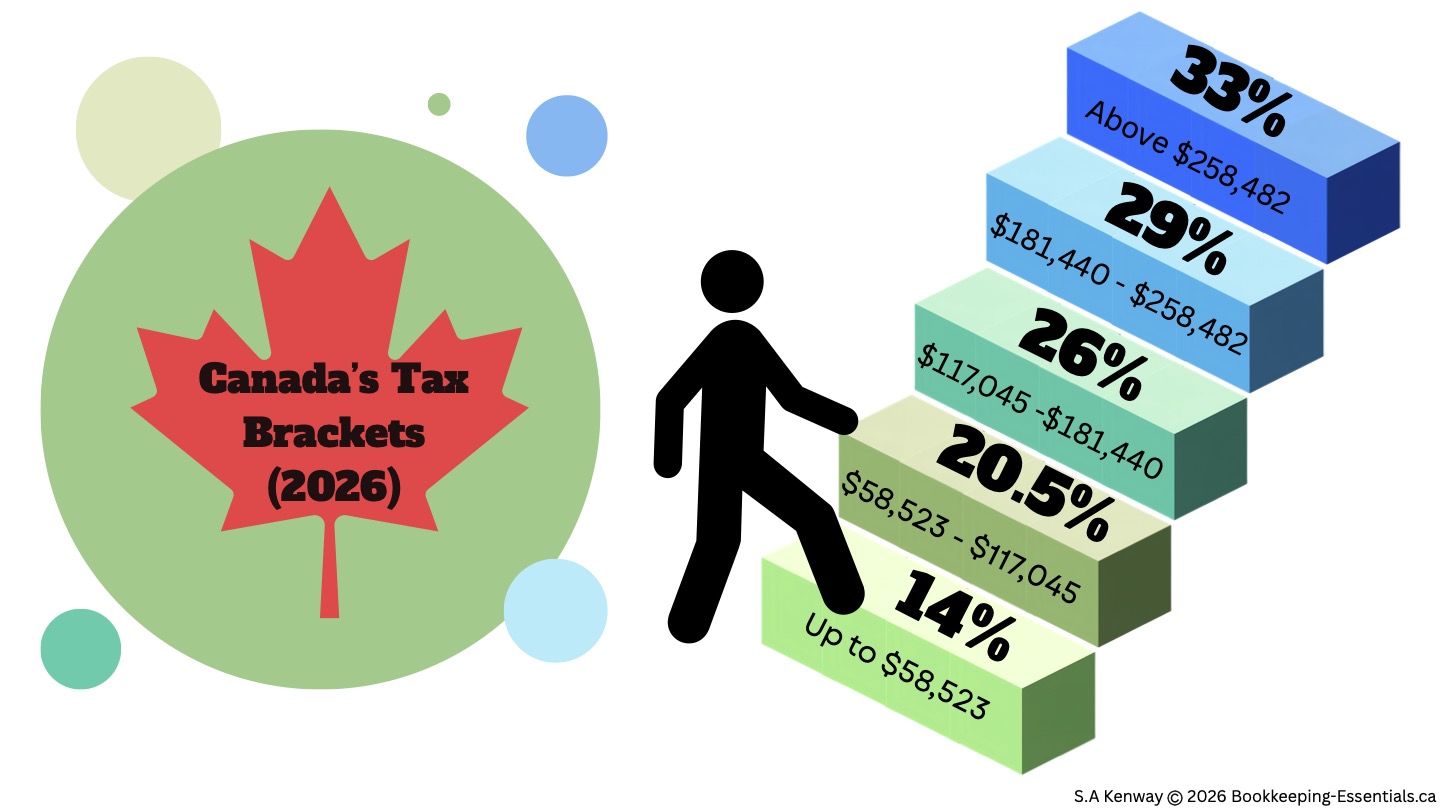 Tax brackets work like stairs.
Only the income on each step is taxed at that step’s rate.
WHAT'S IN THIS ARTICLE
Introduction | Where Do You Want to Start? | Terms Used | Who is This Article For? | What You'll Find | FAQ | Want to Understand the Why? | Indexation - What It Is and What Is Frozen | What's New | Federal Tax Brackets | Provincial Bracket Creep | Solo CEO Move
BACK TO >> Small Business Tax Obligations and Command Centre
RELATED >> T1 & T2 Income Tax Deadlines | T2125 Tax Schedule
Introduction
Which federal tax bracket are you in? This article shows you how your 2026 income is taxed. It also explains why your tax can rise even when no rate changes.
The reason is inflation. Most (not all) Canadian tax and benefit amounts rise each year to keep pace with it. This is called indexation.
When a government stops indexing (freezes tax brackets), taxpayers face 'bracket creep'. Incomes rise, but the brackets stay put. More of your income is then taxed at higher rates. It works like a ‘silent’ tax hike.
Why would a government decide to de-index? Large deficits are the usual reason. Freezing the brackets raises tax revenue without announcing a rate increase.
In this article, I look at where bracket creep and frozen amounts still appear. As always, I will update this article when rules, rates, or thresholds change.
Where Do You Want to Start?
- Just want the 2026 brackets? Go to Federal Tax Brackets.
- Looking for a quick answer? Go to the FAQ.
- Want to understand why? Go to how indexation works.
- Want to know what changed this year? Go to What’s New.
Would you like to follow along with your own tax numbers?
Get the last T1 Income Tax and Benefit Return you filed so you can compare your numbers. At the end, you’ll write down a few numbers to see where you stand.
Terms Used
- Business income (Line 13500) - Your sales minus your business expenses. You are taxed on this profit, not on your sales. It comes from your T2125.
- Net income (Line 23600) - Your total income minus certain deductions, such as RRSP contributions.
- Taxable income (Line 26000) - The amount your federal tax is calculated on. It is your net income after any further deductions.
- Basic personal amount (Line 30000) - A federal tax credit that reduces the tax you owe. It is often described as the amount you can earn tax free.
- Marginal tax rate - The rate you pay on your next dollar of taxable income. It is the rate of the tax bracket you are in.
- Average tax rate - Your total tax payable divided by your taxable income. It is usually lower than your marginal rate, because lower brackets and credits such as the BPA bring your average down.
Who Is This Article For?
This article is for Canadian sole proprietors, freelancers, the self-employed, and home-based business owners. If you report your business income on your personal tax return, the federal tax brackets apply to you. You do not need to be a tax expert to understand how they work. Your last T1 return has the numbers you need.
You will see mention of some amounts that have nothing to do with your business. That is on purpose. Self-employed owners have families too. You may have children, a parent who gets OAS, or a relative with a disability. Frozen amounts and bracket creep reach all of them, so I include the ones that touch your household.
This article can help you:
- Find out which federal tax bracket your taxable income falls into.
- Understand how indexation changes the thresholds each year.
- Learn why your tax bill can increase even when tax rates stay the same.
- Find out which provinces have stopped adjusting their brackets for inflation.
What You'll Find
- How indexation works: Indexation adjusts most tax amounts each year to keep pace with inflation. The 2026 federal indexation rate is 2.0%.
- What bracket creep means: When tax brackets are not adjusted for inflation, your income may rise while the tax thresholds stay the same. As a result, more of your income may be taxed at higher rates.
- 2026 federal tax brackets: Federal brackets are indexed to inflation. You'll find the 2026 thresholds and rates in the table below.
- The basic personal amount: This is the income you can earn tax free. It is reduced for higher income earners, but both the base amount and the income threshold for reduction are indexed.
- Provincial tax brackets: Several provinces have paused or stopped indexing, often because of budget deficits. It is a 'silent tax' that allows them to increase tax revenue with no fanfare.
- Amounts that haven't kept pace with inflation: Some federal amounts have never been indexed or have not changed in years. As prices rise, these amounts lose purchasing power.
- What to watch for in the federal budget: The November budget could contain some changes to the frozen index thresholds and limits that have not been indexed to inflation.
FAQ
What is bracket creep?
What is bracket creep?
Bracket creep is a ‘silent’ tax hike. It happens when your income rises but the brackets stay put. See Provincial Bracket Creep for the provinces that have stopped indexing.
Are provincial brackets indexed like federal brackets?
Are provincial brackets indexed like federal brackets?
Not all of them. Several provinces have paused or stopped indexing, often because of budget deficits. See Provincial Bracket Creep for the list.
When does CRA announce new indexed amounts?
When does CRA announce new indexed amounts?
In the fall, usually in November. The 2026 amounts were released on November 24, 2025. I will update this article when the 2027 amounts come out. See How Indexation Adjustments Work for how the factor is calculated.
How do I find my federal tax bracket?
How do I find my federal tax bracket?
Find line 26000, taxable income, on your last T1 return. Then match it to the table in Federal Tax Brackets - 2026. The Solo CEO Move walks you through it.
Want to Understand the Why?
Keep reading to learn how indexation works, why it matters, and what happens when thresholds and benefit amounts do not keep pace with inflation.
A. Indexation
How Indexation Adjustments Work
As mentioned, most tax brackets and benefits amounts in Canada are indexed to inflation. This means the income thresholds and benefit limits are adjusted annually to keep pace with rising prices. Why? It helps prevent inflation from quietly increasing your tax bill.
Section 117.1 of the Income Tax Act (ITA) lays out the indexation calculation for the Canadian personal income tax system. The calculation compares the CPI (Consumer Price Index) all-items average for the 12 months ending September 30 to the same average for the preceding 12 months. The percentage increase determines the indexation rate applied for the following tax year.
For example, indexation affects your personal tax bracket thresholds, CPP contributions and EI premiums, TFSA and RRSP limits, and Old Age Security (OAS) payments.
Effective Dates
Tax brackets and non-refundable tax credit adjustments take effect on January 1 each year. Most benefits are income-tested with the inflation adjustments taking effect July 1 as they are tied to the filing of your prior year return.
More >> General tax and benefit filing deadlines
How Personal Tax Brackets Are Indexed - 2025 & 2026
On November 24th, 2025, CRA (Canada Revenue Agency) released its 2026 indexation adjustment for personal income tax and benefit amounts in a fact sheet.
The federal indexation rate for 2026 is 2.0%, down from 2.7% in 2025. The CRA table shows how the indexed amounts have changed from 2023 to 2026.
Federal Amounts That Have Never Kept Pace With Inflation
Not all federal tax amounts are indexed to inflation. Some have never been indexed, while others have remained unchanged for many years. As prices rise, the value of these fixed amounts decline in real terms. The federal government is also running a large deficit so freezing some amounts helps their bottom line.
Amounts that have remained unchanged for years:
- 1991 - GST/HST small supplier threshold $30,000 (2026 value* $60,000)
- 1996 - CPP basic exemption $3,500 (2026 value* $6,500)
- 1998 - Foreign asset reporting thresholds $100,000 (2026 value* $180,000)
- 2006 - Pension income amount $2,000 (2026 value* $3,000)
- 2008 - RDSP (Registered Disability Savings Plan) maximum lifetime personal contribution limit $200,000 (2026 value* $290,000)
- 2009 - Corporate small business limit $500,000 (2026 value* $730,000)
- 2015 - Child care expense limits $8,000 for under age 7 and $5,000 between ages 7 and 16. (2026 values* $10,400 and $6,500 respectively)
Amounts that have never been indexed:
- Charitable donation threshold ($200)
- Tuition maximum transfer amount ($5,000)
These amounts illustrate how inflation can gradually reduce the value of tax thresholds, credits, and contribution limits that remain fixed.
Could the Fall 2026 Federal Budget bring changes? I'm watching for the November federal budget to see if it proposes changes to the frozen thresholds and limits.
The CPP basic exemption, for example, has remained at $3,500 since 1996. It has not increased with inflation. That means more of a low-income worker's earnings are now exposed to CPP contributions each year. Doane Grant Thornton LLP reported that pre-budget submissions indicate the following may be reviewed and changed:
- The Small Business Deduction (SBD) limit,
- Passive income & taxable capital thresholds, and
- Excess Interest and Financing Expenses Limitation (EIFEL).
It is my understanding that these changes are anticipated because the Fall 2026 Budget will focus on boosting domestic investment and productivity. From that perspective, reviewing frozen thresholds could be part of a broader discussion about helping domestic businesses retain capital and grow in Canada.
These are areas to watch. I'll update this section if the Fall 2026 budget announces relevant changes.
Sources: Knowledge Bureau, Year-End Tax Planning 2026: What Tax-Saving Opportunities Are Clients Missing? (October 14, 2026), Doane Grant Thornton LLP, Federal Budget 2026: Pre-budget submission highlights (October 1, 2026)
* Conservative illustrative estimates only, calculated by Claude from Statistics Canada annual average CPI. The comparison shows purchasing power equivalents, not proposed thresholds.
B. Tax Brackets
Everyone in Canada pays federal income tax using the same tax brackets. Your province adds its own tax on top. That means where you live changes how much tax you pay on your next dollar of income.
The two maps below illustrate this using $65,000 of taxable income. This is an example of a modest income for a self-employed worker, not a target or an average.
Step 1: How Much Tax Does Your Province Add?
At $65,000 in taxable income, combined federal and provincial income tax on your next dollar ranges from about 28 cents to 37 cents, depending on where you live.
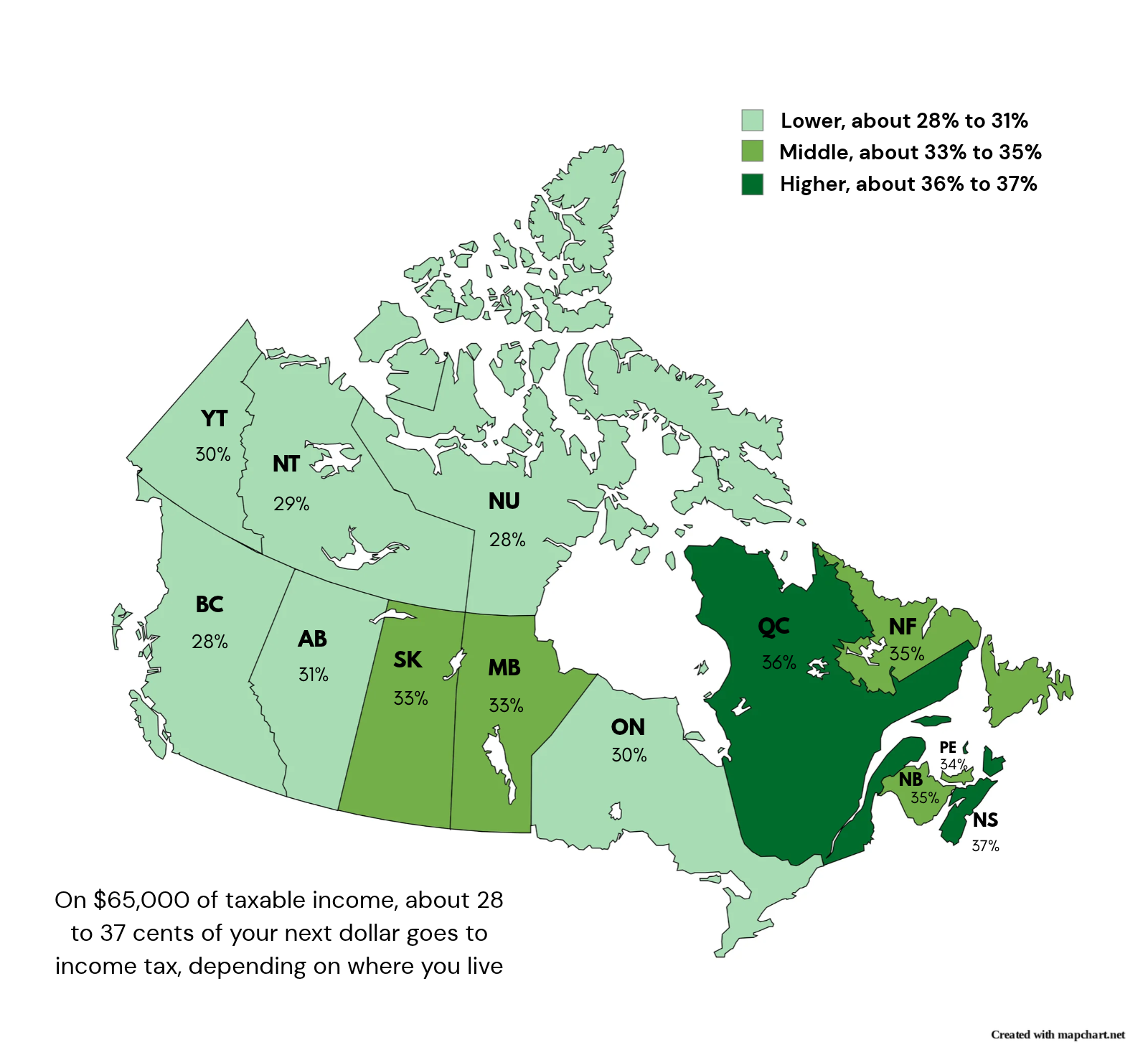 Map 1: 2026 combined marginal tax rate at $65,000 of taxable income
Imagine you earn one more dollar on top of $65,000. This is not the top rate you often see quoted in articles and maps. It is the rate at a modest income. On this map, federal tax and provincial tax are added together. The darker the shading, the more of that dollar goes to tax.
For example, the combined marginal tax rate is about 31% in Alberta and 37% in Nova Scotia. On an extra $1,000 of income, that difference amounts to about $60 more tax paid in Nova Scotia.
Step 2: Which Provinces Are Allowing Bracket Creep?
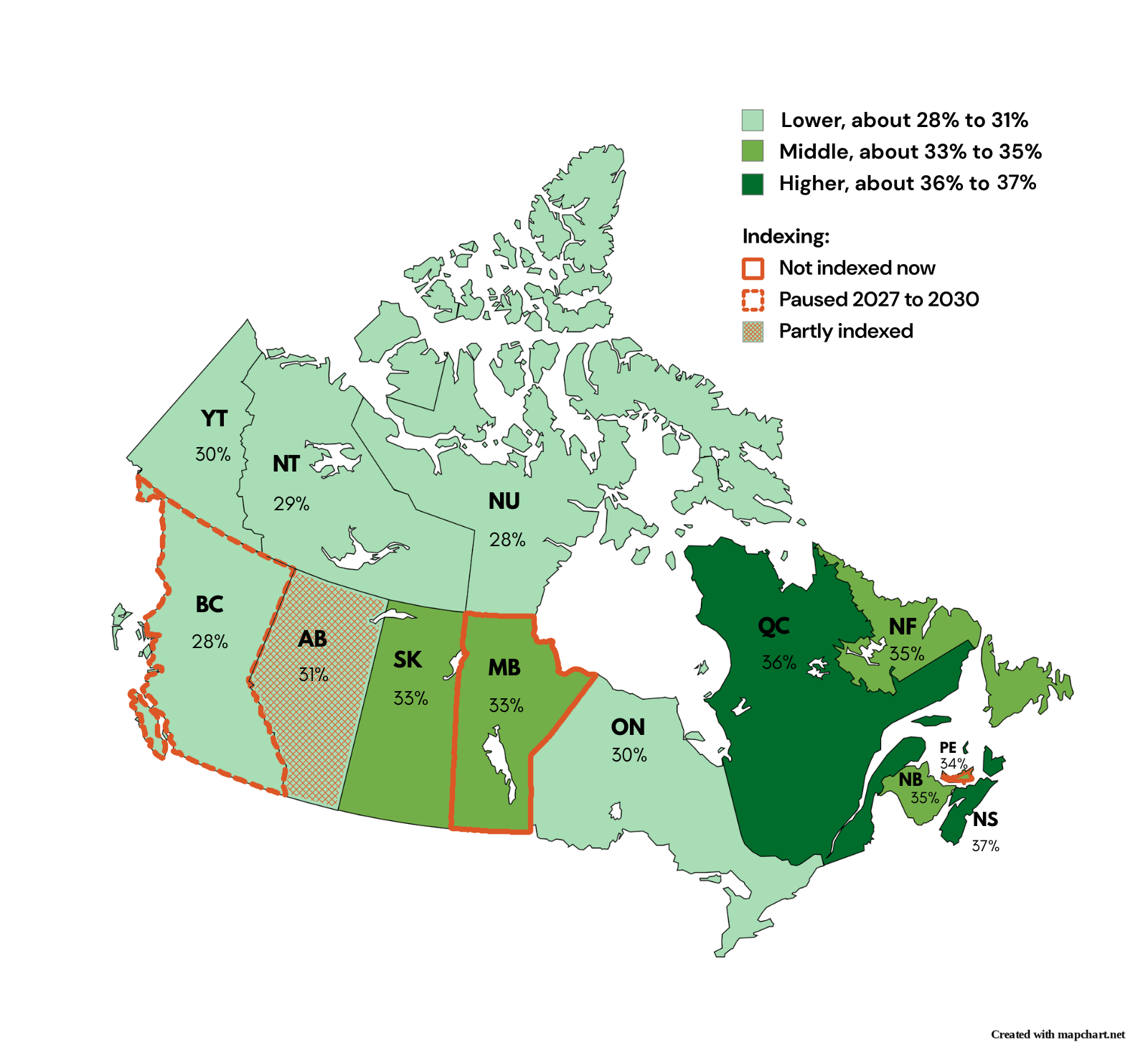 Map 2: Adds an overlay of provincial indexation policies
The second map shows the same combined marginal tax rates, with an overlay. The overlay outlines provinces that are not fully adjusting their tax brackets for inflation. In other words, they are not keeping their brackets in step with prices:
- Solid outline: Manitoba and Prince Edward Island are not currently indexing their brackets to inflation.
- Dashed outline: British Columbia is pausing indexing for 2027 through 2030.
- Cross-hatching: Alberta has partial indexation. Its annual adjustment is limited to the lesser of 2% or Alberta’s inflation rate.
When tax brackets are not fully adjusted for inflation, bracket creep follows. Your income rises with prices but the tax brackets don't keep pace. As a result, more of your income is taxed at higher rates.
The sections below show how the federal brackets work first. Then you will see which provinces have stopped or limited indexing, and what a freeze could cost you.
Graphics: Map Images by S.A. Kenway
What's New in 2026
Here are the main changes pertaining to this article for federal personal income tax amounts:
- The lowest federal rate dropped to 14%. For 2025 it was 14.5%, because the cut from 15% to 14% started on July 1, 2025.
- The indexation factor is 2.0%, down from 2.7% the year before.
- Basic personal amount (the amount you can earn tax free) is $16,452 ($16,129 in 2025).
- Income under $58,523 is taxed at 14% federally ($57,375 in 2025).
A note on timing
The Canada Revenue Agency (CRA) typically announces the next year's indexation amounts in November. The official T1 return forms for a tax year are usually released the following January or February.
Until the latest forms are live, the line and page numbers referenced on this page reflect the most recent CRA publication. References and illustrations will be updated when the new forms become available.
Federal Tax Brackets - 2025 & 2026
These are federal personal income tax amounts. If you are a sole proprietor, your net business income is reported on your personal T1 return and is calculated on your T2125 tax schedule. It is subject to personal tax rates, not corporate tax rates.
Related >> How Are Sole Proprietors Taxed?
2026 Tax Brackets
The federal tax brackets are indexed to inflation each year. The 2026 indexation factor is 2.0%.
Rate Taxable Income Range
14% $0 to $58,523
20.5% above $58,523 to $117,045
26% above $117,045 to $181,440
29% above $181,440 to $258,482 (income-tested BPA phases down)
33% above $258,482 (base BPA applies)
Brackets updated November 27, 2025
The image below shows the federal tax brackets and federal tax calculation on page 5 of your 2025 T1 jacket. Your taxable income on Line 26000 runs through the brackets until it tops out.
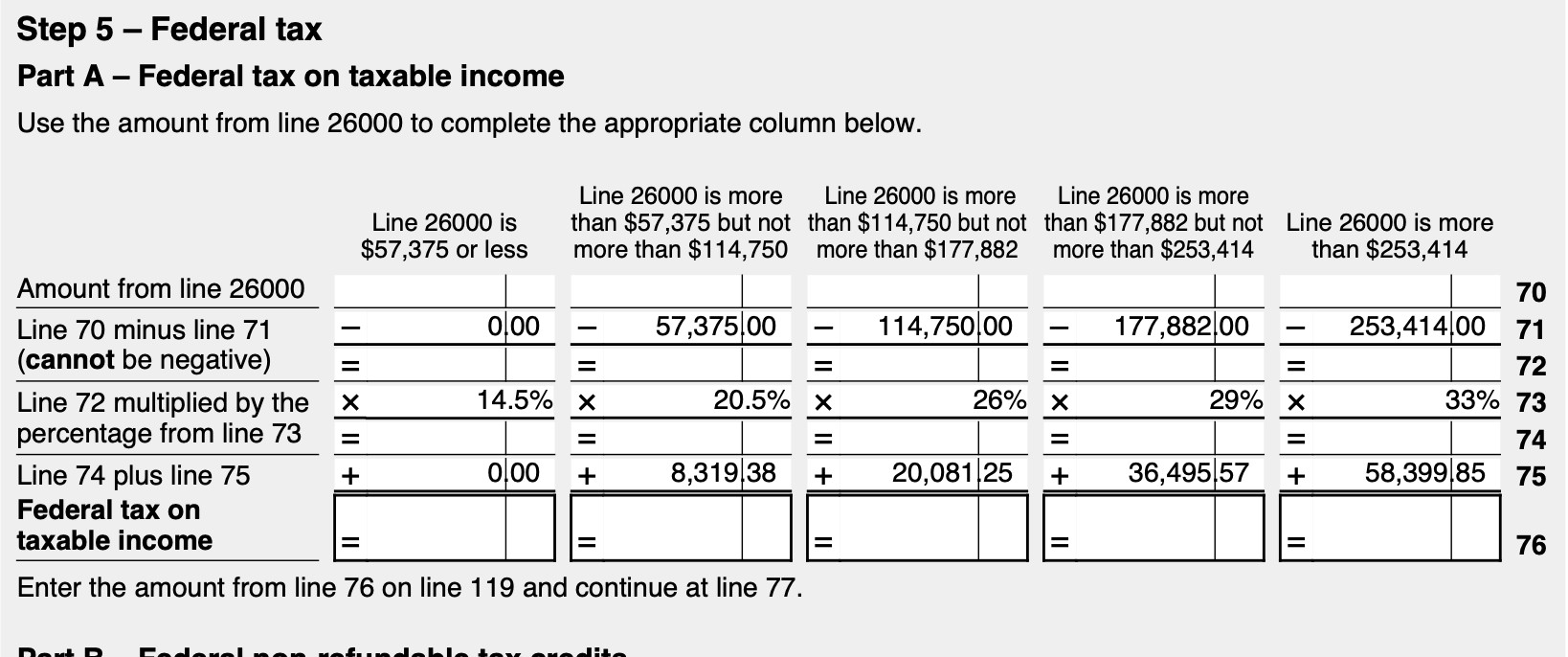 Step 5 Part A Federal tax on taxable income calculation is on page 5 of the 8 page T1 jacket.
The basic personal amount (BPA) also changes for higher-income earners. If your income falls in the 33% bracket, you receive the lower, or base, BPA. I'll explain how this works below.
Example: Federal tax on $90,000 of taxable income in 2026
You'll find your taxable income on line 26000 of your T1 return. Let's use $90,000 to see how the federal tax brackets work. For simplicity, I’m ignoring your provincial tax burden in this example.
Step 1: Apply 14% to the first $58,523
$58,523 × 14% = $8,193
Step 2: Apply 20.5% to the remaining income
$90,000 − $58,523 = $31,477
$31,477 × 20.5% = $6,453
Step 3: Add the two amounts
$8,193 + $6,453 = $14,646
Your federal tax on $90,000 of taxable income is approximately $14,646 before credits. Credits, such as the basic personal amount, then reduce it.
Step 4: Subtract the BPA credit
$16,452 × 14% = $2,303
$14,646 − $2,303 = $12,343 federal tax payable
Other credits could lower your federal tax payable further.
Notice what did not happen. Your whole $90,000 was not taxed at 20.5%. Only the $31,477 above $58,523 was. Your first $58,523 is still taxed at 14%. This is why Canada's tax system is called progressive. The more you earn, the higher the rate on each additional step of income.
We've been looking at marginal tax rates. Let's look at your average tax rate now. Notice how it differs from your marginal tax rate.
- Average federal tax rate (13.7%) - Your overall federal tax burden is based on your current income ($12,343 tax after BPA / $90,000 taxable income).
- Marginal federal tax rate (20.5%) - Your actual tax bracket, which represents the rate you will pay on your next dollar of taxable income.
Tax Bracket Notes
Basic personal amount (BPA)
The basic personal amount is a federal non-refundable tax credit. It's often described as the amount you can earn tax free, although technically it reduces the federal tax you owe.
For 2026, there are two BPA amounts:
- Full BPA: $16,452. Available to individuals with net income at or below the 29% bracket threshold. In 2026, this was $181,440.
- Base BPA: $14,829. Applies to individuals whose net income reaches the 33% bracket. In 2026, this was $258,482.
For those between these income levels, the BPA gradually decreases. Both amounts are indexed to inflation each year.
 2025 Basic Personal Amount on page 5 of your 8 page T1 jacket is based on Line 23600 Net Income.
How the BPA came about?
The federal government introduced the income-tested BPA in late 2019. The additional amount above the base BPA gradually phases out as income rises. Here's the best way I can explain it:
- What happened? The Government began income testing the basic personal amount.
- What is the BPA? The basic personal amount is the amount of income you can earn tax free.
- What does income testing do? It gradually phases out the extra amount that was added on top of the base BPA.
- What is base BPA? For individuals in the 33% bracket, the BPA is the base amount. It was $12,298 in 2020 and is indexed each year. For 2026, it is $14,829.
How the BPA phase-out works
If your net income is $181,440 or less, you get the full BPA. You can skip to the Old Age Security (OAS) section as the phase-out does not apply to you.
The full BPA of $16,452 applies up to net income of $181,440 (the 29% tax bracket).
Between $181,440 and $258,482, it gradually decreases to its minimum of $14,829. That minimum applies once your income reaches $258,482 where the 33% tax bracket starts.
The total reduction is $1,623 over the $77,042 range ($258,482 - $181,440).
Example: Net income of $220,000 in 2026
This example shows how the income-tested BPA is calculated. For this calculation, if you are following along, use your net income on line 23600 of your T1 return, rather than your taxable income on line 26000.
If your income is $181,440 or less, there is no phase-out. You get the full BPA.
Step 1: Calculate how far your income is into the phase out range.
Income above the 29% threshold: $220,000 − $181,440 = $38,560
Step 2: Calculate the full phase-out range.
33% threshold $258,482 − 29% threshold $181,440 = $77,042
Step 3: Calculate the percentage (share) of the range used.
$38,560 ÷ $77,042 = about 50%
Step 4: Calculate the reduction in your BPA.
50% × the total reduction $1,623 = about $812
Step 5: Calculate your BPA.
For this person, it is $16,452 − $812 = about $15,640
Old Age Security (OAS) Recovery Tax
This section matters if you or a parent receive OAS. If this does not apply to you, skip ahead to Provincial Bracket Creep.
If you receive Old Age Security (OAS), your payments may be reduced when your net income exceeds a specified threshold. This is commonly called the OAS clawback, although the official term is the OAS recovery tax.
Your OAS clawback is calculated when you file your T1 return. If your income exceeds the annual threshold, you will have to repay some or all of your OAS. The repayment is generally deducted from your OAS payments starting the following July.
The clawback threshold for July 2026 to June 2027 is $93,454, based on your 2025 net income. Your OAS will be reduced if your net income is higher. It is fully recovered (clawed back) at the levels below.
Here are the thresholds for the July 2026 to June 2027 payment period:
- Recovery begins at $93,454
- Full recovery threshold, ages 65-74 $152,062
- Full recovery threshold, for ages 75 and over $157,923
For the period July 2025 to June 2026, the clawback started at $90,997 based on your 2024 income. For the period July 2027 to June 2028, the clawback will start at $95,323 for your 2026 income.
The recovery tax generally requires you to repay 15% of your net income above the applicable threshold, up to the amount of OAS you received.
How OAS and BPA phase outs differ:
Both rules can affect high income Canadians, but they work differently.
- OAS clawback - You repay 15% of your income above the threshold, up to the full amount of your OAS. It is based on your prior year income.
- BPA phase-out - Your 'tax free' credit shrinks gradually as income rises through the range. There is no repayment. You simply get a smaller BPA on your return.
Provincial Bracket Creep
Not every province and territory indexes. Several provinces have paused or stopped indexing their tax brackets and non-refundable credits to help with budget deficits.
'Bracket creep' is a 'silent' tax hike. As your income increases, more of your income is pushed into higher tax brackets because the brackets did not move with it.
This list is not exhaustive.
- British Columbia is the latest province to pull back on inflation protection. It is pausing indexing for 2027 to 2030. Indexation is expected to return in 2031.
This creates a double whammy, as the province increased the lowest personal income tax rate for 2026 as well. To be fair, the government did increase the B.C. Tax Reduction Credit to offset it for the lowest earners.
However, Persons with Disabilities (PWD) will be hit hard ... because the government has not raised the $16,200 Annual Earnings Exemption (AEE) since 2024. This means their income no longer keeps up with inflation. Since 2024, prices have risen roughly 5%. That $16,200 now buys about $800 less. That is about 6 weeks of groceries for one adult. - Manitoba stopped indexation in 2025 and kept the freeze for 2026. No date has been given for indexation to return.
- Alberta paused indexation in 2020 and 2021. Beginning in 2025, Alberta adjusts tax brackets based on the new 'Alberta Escalator' framework. It is the lesser of 2% or the Alberta CPI.
- Saskatchewan paused indexation in 2018 and 2019.
- Ontario has partial de-indexing. The two top tax brackets were introduced in 2014 with the legislation stating they would not be indexed to inflation.
- Prince Edward Island did not index its tax brackets between 2008 and 2026. Instead, it chose annual reviews. These resulted in (a) annual adjustments to the BPA beginning in 2019, and (b) a 1.8% increase to the bracket thresholds in 2026. A review is not indexing, and 1.8% does not close the gap. Prices are up about 44% since 2008.
- Nova Scotia did not index its brackets from 2000-2024. In 2025, the government began re-indexing them.
Bracket Creep in Action: A B.C. Example
Here is what a freeze looks like with real numbers.
Imagine you live and operate your self-employed business in British Columbia. In 2026, your taxable income is $65,000. Prices rise about 2% a year, so you raise your rates 2% a year to keep up. You are no better off. You are just keeping pace.
B.C.’s first bracket ends at $50,363 in 2026. Income up to that amount is taxed at 5.6%. Income above it is taxed at 7.7%.
Now the pause begins. From 2027 to 2030, B.C. will stop adjusting that threshold. It stays at $50,363.
If indexing had continued, the threshold would rise 2% a year. By 2030, it would be about $54,500. That would keep about $4,150 more of your income in the 5.6% bracket. With the freeze, that income is taxed at 7.7% instead.
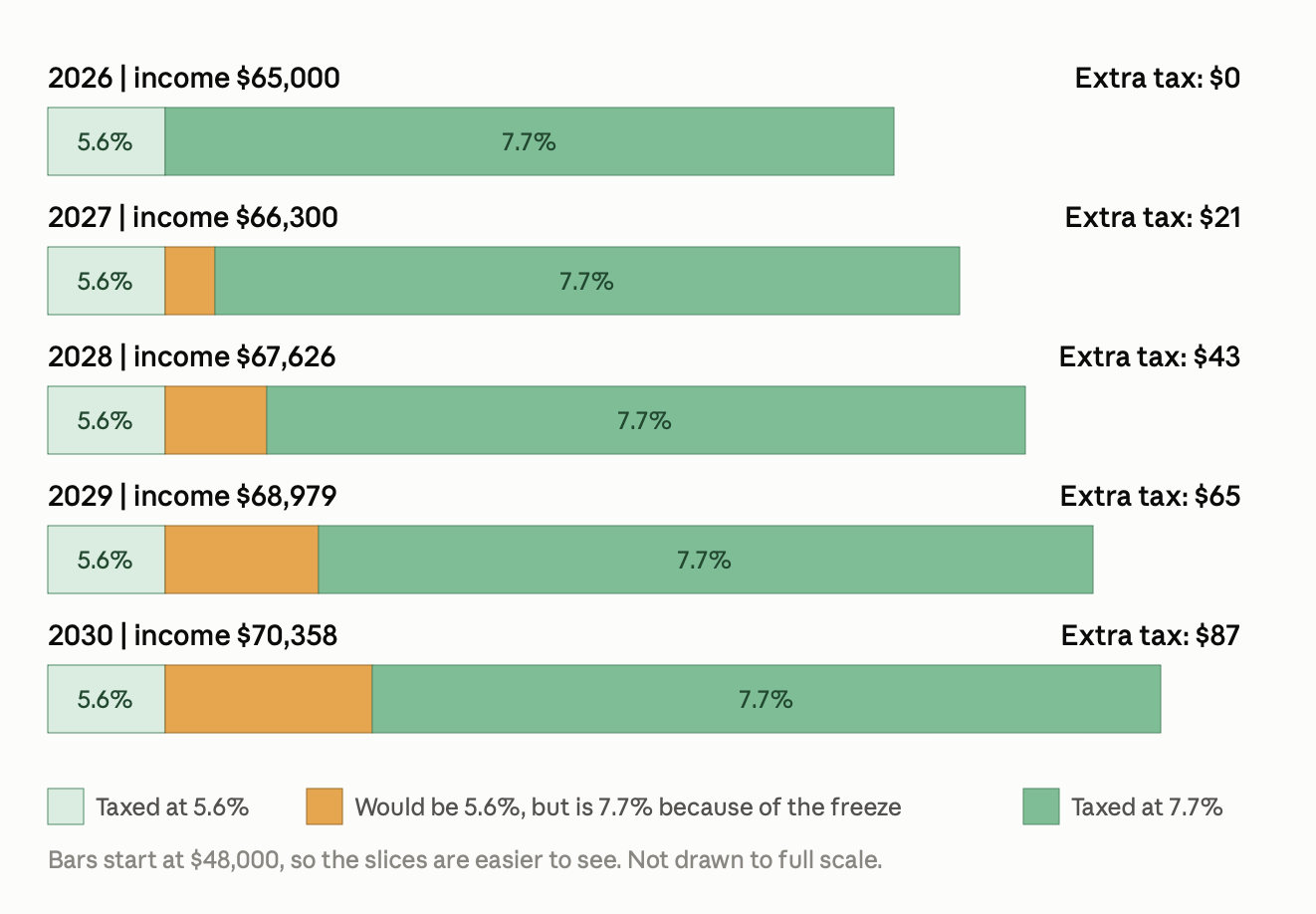 Illustration of B.C. bracket creep
The orange area shows income that would still be taxed at 5.6% if B.C.’s bracket had kept up with prices. Because the bracket is frozen, it will be taxed at 7.7%. Each year, the orange slice grows. So does your extra tax:
- 2026: $0
- 2027: about $21
- 2028: about $43
- 2029: about $65
- 2030: about $87
That adds up to about $216 over four years. Now picture every B.C. taxpayer in a similar position.
B.C.’s budget puts a number on the freeze. It expects about $60 million in 2027, $309 million in 2028, and $590 million in 2029. That adds up to almost a billion dollars in three years. That covers every bracket and credit, not only the first bracket in my example.
The amount grows each year, because the gap between the frozen brackets and indexed brackets keeps widening. The freeze runs through 2030, and B.C.’s plan stops at 2029. The total will be higher still. That is B.C.'s 2026 budget plan. A future budget could change it.
Sources: B.C. Budget and Fiscal Plan 2026/27 to 2028/29, Table 2.1. B.C.'s fiscal year runs April 1 to March 31. Bracket creep chart by Claude.
Notice the amounts for individuals are small in any one year. That is why this is called a 'silent tax' hike. No rate changed. Nothing on your return says you are paying more. The threshold stood still while your prices and income moved on. Across the province, the small amounts add up. B.C.’s budget will be counting on this revenue to help protect services and improve its finances.
Three points about this example:
- It counts the bracket only. Other amounts may also be affected, so your real cost could be higher.
- It uses B.C. tax only. Federal brackets are still indexed, so they do not add to the creep.
- If you earned $75,000 instead, you would pay about the same extra tax. The cost comes from the frozen threshold, not from the size of your income.
Want to see where you stand? The Solo CEO Move below shows you which lines on your return to check.
🦆 Solo CEO Move
A 🦆 Solo CEO Move is something I have introduced to this site. When you see it, it means there will be one task for you to undertake as the owner of your business. Its purpose is to get you to lift your eyes off the road and check the map ... because we all know that the time to have a map is before you enter the woods.
Open your last T1 Income Tax and Benefit Return filed. Find these lines and write each number down:
- Line 13500, business income. In 2025, it was located on page 3. This is your net business income from the T2125 form. It is where your business income enters your personal return.
- Line 23600, net income. In 2025, it was located on page 4. This number decides how much basic personal amount you get. It also decides whether OAS clawback applies.
- Line 26000, taxable income. In 2025, it was located on page 5. The federal brackets are applied to this number.
- The bracket table. Your taxable income is carried onto Step 5 Part A, where the brackets are applied. Find the bracket it landed in, and note how much room you had before the next bracket started. In 2025, it was located on page 5.
- Line 30000, basic personal amount. In 2025, it was located on page 5 in Part B Federal non-refundable tax credits. Compare it to the 2026 amount on this page. The difference is indexation at work.
Save your notes in your tax folder. Then check this article again after the November budget. Now you know which numbers on your return relate to the numbers on this page.
Income Tax Compliance Articles
13 Non-Deductible Business Expenses For The Self-Employed
Save yourself a lot of grief and don't claim these 13 non-deductible business expenses. Understand not every business expense is tax deductible.
Every Tax Deduction Canadian Solopreneurs Can Claim | T2125 Line-by-Li
A line-by-line guide to every allowable expense on CRA Form T2125 for self-employed Canadians. Know what to claim, what to skip, and how to stay audit-ready.
Canadian Home Based Business and Taxes | Questions and Answers
Home based business and taxes Q&A ... some frequently asked questions and answers for the work from home (WFH) business owner who does their own bookkeeping...